

The product record does not describe the worker
A seafood buyer can know where a product was landed and still know little about the people who caught it. A commercial record follows a consignment. A worker's experience follows recruitment, the vessel, payment and the possibility of leaving or seeking help. Connecting those paths is the central challenge in assessing labour conditions in fishing. The question is not simply whether a supplier can provide documents, but whether those documents support a credible account of conditions and a practical response when they fail.
OPAGAC's 1 October 2026 account describes a European Parliament meeting hosted by fisheries committee chair Carmen Crespo and Virginia Battu-Henriksson from commissioner Costas Kadis's cabinet. ILO, ETF, EJF and Oxfam participated. OPAGAC director-general Julio Morón advocated market conditions supporting labour standards.
The meeting supplies a reason to examine the gap between formal commitments and actual protection. It does not establish that every vessel or supplier has the same conditions. A useful analysis should preserve that distinction while explaining how purchasers, vessel operators and public authorities can obtain evidence that reaches beyond a statement of compliance.
Testimony and a study answer different questions
Euronews' 8 October account attributes 16 months aboard a Chinese vessel and withheld documents to Indonesian fisher Fredi Seprizal's testimony. These are his reported experiences, not findings about every vessel.
Testimony can reveal mechanisms that a conventional purchasing file does not capture. It can show why a person found it difficult to challenge conditions or obtain assistance. It should remain attributed to the person describing the experience, with no invented quotation or unsupported extension to other workers. Recognising its importance does not require treating it as a statistical survey.
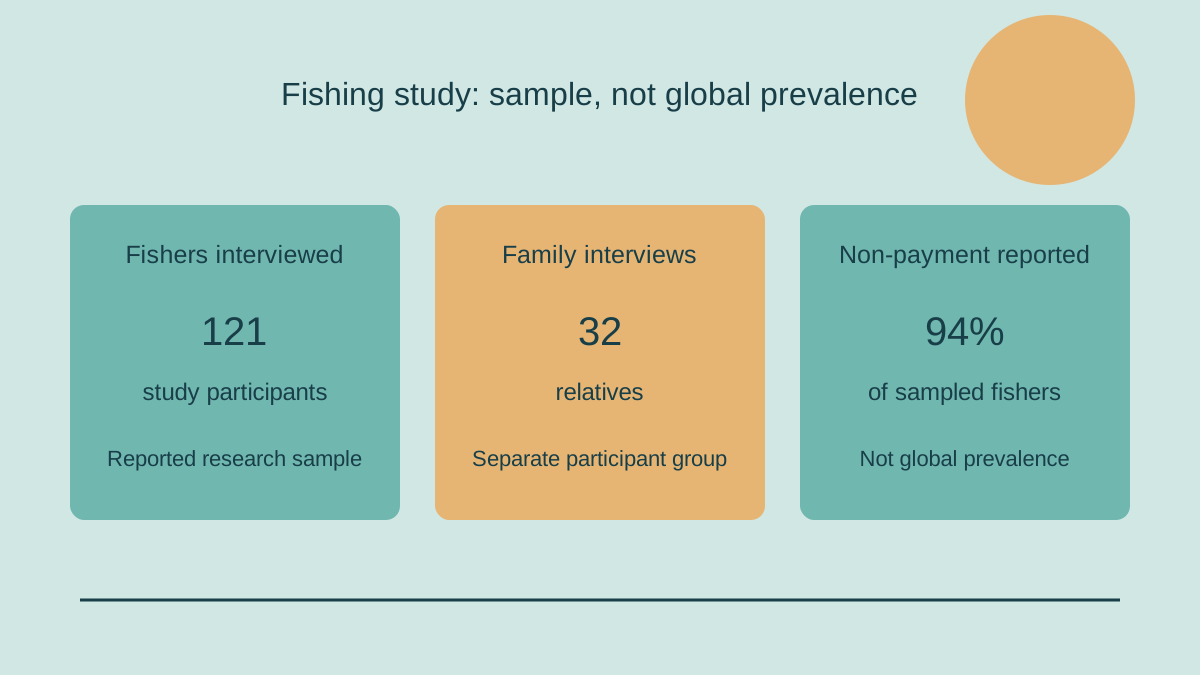
The article reports Sallie Yea's study: 121 fishers and 32 relatives from the Philippines, Indonesia, Cambodia and Fiji. Among interviewed fishers, 94% experienced unpaid wages, all reported worsened contracts, and a quarter witnessed a colleague's death. These are sample findings, not global prevalence.
The reported study gives a different form of evidence. Its numbers describe the participants studied. Without a representative sampling design and an appropriate population definition, they cannot be turned into a claim about all fishers worldwide. The distinction does not diminish the seriousness of the experiences. It prevents a striking percentage from being used to answer a question the study, as reported, does not establish.
Use the denominator before the percentage
A percentage is meaningful only when the population, event and period are clear. Non-payment at some point in a worker's experience differs from non-payment on every voyage. A person witnessing a death differs from a mortality rate among all workers. A vessel-level observation differs from a worker-level observation. Mixing these measures would produce a misleading account even if each original figure were transcribed correctly.
The illustration accompanying this article therefore labels the interview sample and its reported wage finding. It does not present a global estimate or convert the sample into an exact count of affected people from a rounded percentage. The purpose is to make the basis of the evidence visible, not to create a more precise statistic than the source supplies.
For procurement teams, the right response is to examine the risk mechanisms and gather evidence relevant to their own chain. A reported study can inform the questions they ask. It cannot certify a particular supplier as compliant or non-compliant without additional information. That step requires a connection between the documented concern and the actual vessel, recruiter and employment arrangement.
Recruitment belongs in the supply-chain review
A labour review that begins only when a person boards a vessel can miss important conditions created earlier. The terms offered during recruitment, the identity of intermediaries and the worker's understanding of payment and departure all affect the employment relationship. A purchasing review should therefore identify the recruitment route as well as the vessel operator. This is an analytical recommendation, not a claim that every recruitment agency engages in abuse.
Documents should make the parties and obligations understandable. A buyer can ask which organisation recruited the worker, which entity owes payment and how a dispute can be raised. If the answers change between the recruitment file and the on-board agreement, that inconsistency deserves investigation. A chain with several intermediaries should not allow responsibility to disappear between them.
The review also needs the worker's perspective. An apparently complete contract file may say little about whether the person could understand, question or retain the terms. Evidence of practical access to information matters because formal documentation and meaningful consent are different issues. A credible process should make it possible to test both.
The convention offers specific document tests
The ILO's 2007 Work in Fishing Convention, C188, provides for comprehensible work agreements, a chance to review terms and seek advice, and access to a copy aboard the vessel. Articles 16–20 describe these requirements, with the Article 19 exception for a single-handed owner-operator.
These provisions show why a signature alone is an incomplete test. The document should correspond to the worker's arrangement and remain available when a question arises. A review can compare the contract held ashore with the version used aboard and identify any change that affects payment or conditions. The practical question is whether the record supports the relationship it purports to describe.
Application depends on the relevant legal framework and circumstances; this article does not determine the obligations of a particular vessel. It uses the convention to explain the types of evidence a serious labour assessment should consider. Procurement decisions and public enforcement have different roles, but both benefit from records that are consistent, accessible and linked to the people concerned.
Payment evidence must reach the recipient
A payroll entry records an employer's account of payment. It does not always establish that the worker received the expected amount under the agreed terms. A meaningful check should reconcile the contract, the amount due, the payment record and evidence available to the recipient. Where deductions occur, their basis should be understandable rather than concealed inside a final net figure.
The aim is not to demand that every personal financial detail circulate through the commercial chain. Sensitive information should be handled appropriately. The aim is to obtain credible assurance that payment obligations have been fulfilled and that unresolved differences can be investigated. A reviewer can design a proportionate evidence process without treating a supplier declaration as the only available proof.
Timeliness also matters. A payment made long after the agreed date may leave a worker exposed during the intervening period. An annual compliance statement could hide that experience. A useful monitoring process therefore identifies the payment period and tracks resolution of missing or disputed amounts. It should show whether the person ultimately received a remedy, not merely whether an internal case was closed.
Rest is an operating condition
C188 Article 13 addresses safe staffing and regular rest sufficient for safety and health. These are operating requirements rather than a statement that a vessel's paperwork alone demonstrates adequate conditions.
Scheduling evidence should be compared with the actual pattern of work. A written roster can look reasonable while a different routine is followed aboard. A credible review needs a way to detect that difference. Worker accounts, operational records and the explanations of responsible personnel can be considered together, with inconsistencies investigated rather than resolved by automatically preferring the most formal-looking document.
The important analytical connection is between working conditions and how the operation is organised. Staffing, workload and opportunities for rest cannot be assessed solely as separate administrative items. A control should test whether the planned arrangement can function during ordinary work. This article does not diagnose an individual's health or prescribe a medical intervention; it examines the evidence needed to understand a working arrangement.
A complaint channel needs practical access
A written grievance procedure has limited value if a worker cannot use it privately or does not know who will receive the complaint. Access depends on communication, language, trust and the perceived consequences of speaking. A review should therefore test the channel from the worker's position. The existence of a telephone number or web page is not enough to establish that assistance is realistically available.
An effective process should identify who investigates, how the worker receives a response and what happens if the complaint concerns the person controlling access to communication. These are proposed design questions, not findings about a named operator. They focus attention on the situations in which a formally available channel could become ineffective.
Protection from retaliation also needs a practical mechanism. A person may remain dependent on the employer while an investigation takes place. The response should consider that dependency and preserve confidentiality appropriately. A commercial buyer should ask how a concern reaches an accountable decision-maker and how the affected person is protected while the facts are examined.
Traceability should connect two histories
Product traceability follows where goods move. Labour evidence follows who worked, under what arrangement and during which period. The two histories need a meaningful connection if a buyer is to evaluate a particular consignment. A vessel name alone may be insufficient when crews, ownership or operating arrangements change. The link should identify the relevant voyage and employment period without treating all historical records as interchangeable.
Processing and aggregation can make that task harder. A product may pass through several commercial stages after landing. A review should understand where records are joined and where information is lost. The purpose is not to assume wrongdoing whenever the chain is complex. It is to identify the evidence needed to preserve the connection through ordinary business operations.
A stronger system can reveal uncertainty rather than pretend every link is complete. If a consignment cannot be connected to adequate labour evidence, the buyer should know the nature of the gap and what action is required. A traceability claim is more useful when its boundaries are visible and unresolved questions can be pursued.
The EU regulation has a specific application date
Regulation (EU) 2024/3015 prohibits products made with forced labour on the Union market. Article 39 sets general application from 14 December 2027, while listed preparatory provisions apply earlier. The future general date should not be reported as an already completed enforcement outcome.
A legal deadline and an effective protection system are different things. The regulation creates a framework, but practical results depend on evidence, investigation and implementation. Businesses can use the preparation period to understand their chains and improve records. They should not interpret the later general application date as a reason to postpone attention to conditions or as proof that a particular product will automatically pass future scrutiny.
This article explains the disclosed timeline rather than giving transaction-specific legal advice. A company assessing its own obligations needs the applicable text and qualified analysis of its circumstances. The broader analytical point is that preparation should connect the product file with credible labour evidence before a dispute makes that connection urgent.
Remedy is different from supplier removal
Ending a commercial relationship can change a buyer's exposure, but it does not necessarily resolve unpaid wages or provide assistance to workers. A response should distinguish commercial action from remedy for the person affected. The right sequence depends on the facts and the applicable obligations. An assessment should avoid declaring success merely because the buyer no longer purchases from the supplier.
Where deficiencies can be addressed, the plan should define responsibilities, milestones and evidence of actual improvement. Where immediate action is necessary, the response still needs to consider the affected workers. A corrective-action file should not end with a promise to revise policy. It should track whether the relevant condition changed and whether the person received the owed payment or other appropriate resolution.
That distinction makes accountability more concrete. A buyer can measure its own process while separately examining the worker's outcome. The two may move at different speeds. Keeping both visible helps prevent an administrative closure from being mistaken for a completed remedy.
A practical evidence checklist
A proportionate review can begin with the following questions. They are proposed evidence tests, not an assertion that the listed problems exist in every chain:
- Can the product be linked to the relevant vessel, voyage and employment period?
- Do recruitment terms, on-board agreements and payment records describe the same arrangement?
- Can workers access their terms, obtain advice and raise concerns through a usable channel?
- Do work records and worker accounts support the planned staffing and rest arrangements?
- Does a corrective response track the affected person's outcome as well as the buyer's commercial decision?
The resulting file should identify evidence, dates and unresolved gaps. It should separate a supplier's statement from an independently checked fact and preserve the attribution of testimony. A clear record helps later reviewers understand why a decision was made and what would cause it to be reconsidered. This is more useful than an undifferentiated label of compliance.
The meaningful test is protection in practice
The parliamentary discussion connects market responsibility with conditions at sea. The reported testimony and study indicate serious concerns while retaining their specific evidential limits. C188 supplies concrete reference points for work agreements and operating conditions, and the EU regulation supplies a dated product-market framework. None of these should be reduced to a claim that possessing documents is enough.
The strongest assessment follows the worker's experience and the product's history together. It asks whether payment, access to terms, safe operation and a usable complaint route are supported by evidence. It then asks whether a response improves the affected person's situation. That is the practical difference between a chain that can repeat a standard and one that can demonstrate meaningful protection.
Further evidence: the dated Euronews account, ILO Convention C188 and the EU forced-labour regulation.

















Leave a comment