

Interfax reported on September 1, 2025, that Russia and China would hold talks concerning exports of mung beans and wheat bran to the Chinese market. The report described a prospective negotiation step, not completed shipments of those products. For a supplier, that distinction leaves a separate question: what would make a particular commercial offer ready if the intended route becomes available?
A negotiation milestone is different from a fulfilled sale
Market-access discussions can be significant without establishing a sale. A supplier's commercial assessment should retain the difference between the state of the proposed route and the state of a particular order. One concerns the possibility of a transaction under the applicable arrangements; the other concerns an identified buyer, an accepted product and a completed delivery commitment. This article does not state current permission requirements or interpret a legal instrument. It examines the commercial questions left open by the historical report, with any future availability of the route kept conditional.
A planning record could therefore show several distinct states: a route being explored, a buyer discussing a requirement, a lot under assessment and an order with an accepted outcome. These states should not be collapsed into one label such as export ready. Progress in one state could justify further work while leaving the others unresolved. Keeping the distinctions visible would allow a supplier to prepare a bounded proposition rather than promise immediate delivery on the strength of a negotiation announcement whose commercial implications have not yet been demonstrated.
The product name should lead to an identified lot
A commodity name identifies the subject of a market discussion but does not define everything a buyer would accept. A prospective offer would need an identified lot and a specification relevant to the buyer's intended use. This is not a statement about the technical requirements of either product in the reported route. Those requirements would need their own verification. The analytical point is that a broad market opportunity and an accepted lot are different objects. An offer should connect them through evidence rather than assume that the commodity label completes the connection.
The lot record would need to retain its origin within the supplier's own assessed supply and the observations used to describe it. If a buyer evaluates one sample but the intended shipment comes from another population, that relationship should be stated. A promising sample result would then support the conclusion appropriate to the sample, with the delivered population left for its own assessment. Preserving lot identity would help prevent an early commercial conversation from acquiring a wider product promise that the available observations do not establish.
The buyer's requirement is a commercial endpoint
An interested buyer and a buyer accepting a defined requirement would represent different levels of commercial evidence. A supplier could record the requirement being discussed, the proposed quantity and the point at which acceptance would be assessed. Without that record, expressions of interest might be treated as demand for any available material. A future commercial comparison should instead identify what is actually being sought. This would give preparation work a defined target and allow the supplier to distinguish a potential customer relationship from an order it can reasonably evaluate.
The requirement should also remain separate from an assumed universal market specification. Different prospective buyers might ask different commercial questions, and the assessment should retain the question attached to each offer. An accepted proposition for one buyer would not automatically establish acceptance for another. A supplier could still develop a common product description, but its connection to each customer commitment would need to be documented. That distinction would make the proposition more useful by showing which part is supported across offers and which part depends on the selected buyer.
Available supply should be compared with committed supply
A supplier could have material in an inventory record while remaining unable to assign it to a new offer. The commercial assessment should distinguish physical presence from quantity available for the proposed commitment. Existing allocations, unresolved acceptance decisions or an incomplete lot record could affect that distinction in a hypothetical assessment. This article reports none of those conditions for a named supplier. It identifies why an aggregate supply figure would not, by itself, demonstrate the ability to fulfil a particular offer if the proposed export route becomes available.
The offer should consequently have a quantity boundary connected to its assigned lots. A future record could show the quantity offered, the quantity accepted for that requirement and the quantity still awaiting a decision. It would retain changes in allocation rather than attach every order to the same nominal stock. The purpose would be to make the commitment traceable. A claim about supply capability would then rest on reconciled quantities within the intended offer, instead of an impressive total whose relationship to other commitments remains unknown.
Readiness has more than one clock
A prospective route, a buyer decision and a material preparation stage could each have a different timing boundary. A supplier should not assume that progress on one clock aligns the others automatically. A planning assessment could identify the date on which each required condition is observed, as well as the conditions still dependent on future events. That would allow a commercial proposition to retain its dependencies. The historical report establishes a planned discussion step; it does not establish the dates on which a particular buyer or delivery arrangement would become ready.
A supplier could use a conditional schedule without presenting it as a confirmed delivery promise. The schedule should state which event would allow the next commitment to be made and what remains unassessed. If an event changes, the record should show the resulting change rather than silently retain an outdated promise. This approach would connect preparation with a real decision boundary. It would also make clear that an announced market discussion can create a reason to assess an offer without supplying a completed timeline for that offer.
A sample and a shipment need a documented relationship
A sample could help a prospective buyer evaluate a product proposition before a larger commitment. Its usefulness would depend on the relationship between the sample and the material eventually offered. A record should therefore identify the sampled lot and the scope of the observation. A supplier should not describe a favourable sample as proof for every later lot unless it has evidence for that transfer. This is an analytical condition for the commercial comparison, not an assertion about sampling practice or a prescribed testing method for the reported commodities.
Changes between the sample and the intended shipment should remain visible. If the supplier substitutes material, the buyer assessment would need an identified decision about the substitution. Some earlier observations might remain relevant, while others might require further work. The record should explain that relationship rather than assume either complete continuity or complete invalidation. A commercial programme could then develop from small observations towards a larger offer while preserving the evidence supporting each step, instead of treating the earliest accepted sample as an unlimited product acceptance.
A fictional offer shows why states should remain separate
Consider an explicitly fictional supplier with three proposed lots, called A, B and C. A prospective buyer accepts the commercial description associated with a sample from A. Lot B is still being assessed, while C is already assigned to another customer. The proposed route itself remains conditional. None of these invented facts describes actual trade in the reported products. The example separates the questions: buyer interest exists for an assessed description, some material remains unresolved, and some material is outside the new offer's available quantity.
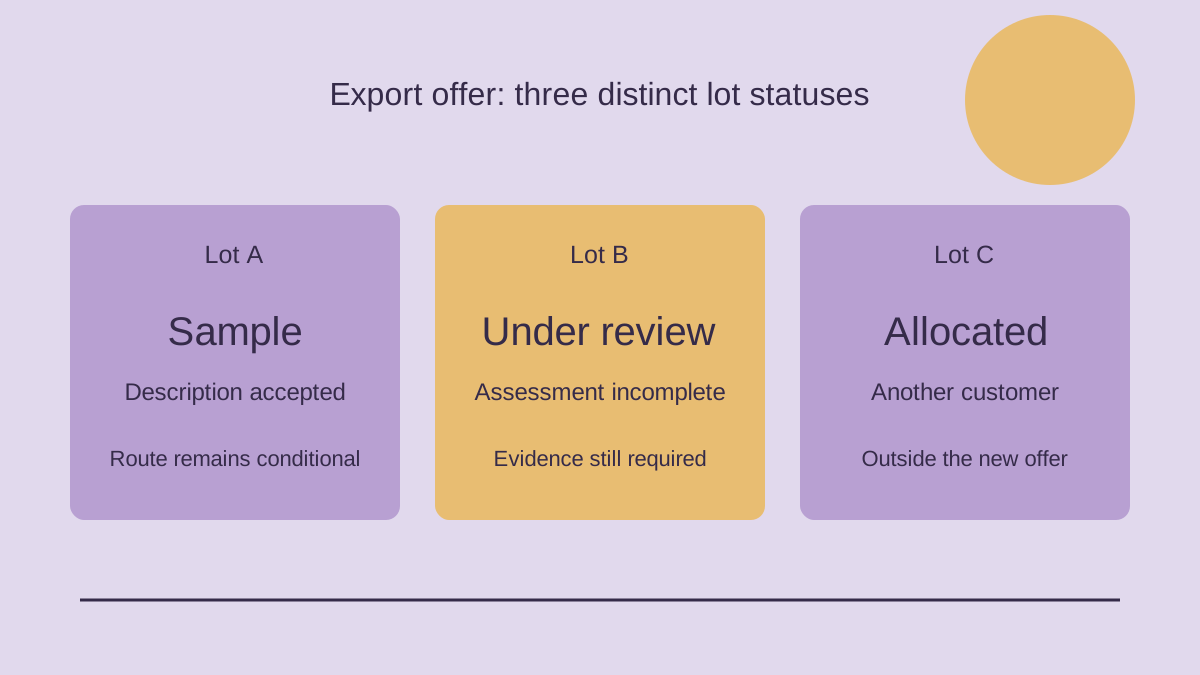
Describing all three lots as export ready would erase those distinctions. Describing the entire proposition as having no commercial value would erase the progress on A. A useful record could preserve both progress and limits, with the next commitment attached to the next unanswered question. It might request evidence for B or clarify the relationship between A's sample and A's intended shipment. That work could be worthwhile without promising a shipment before the route and delivery conditions are established. Commercial preparation and completed trade would remain different conclusions throughout the example.
The delivery offer needs a complete boundary
A future delivery proposition would need to identify where the supplier's assessed service begins and where its accepted outcome is observed. A departure record and a buyer acceptance record answer different questions. Both could be useful, provided the report names their boundaries. A supplier evaluating the proposition should retain the activities and commitments between them, rather than assume that a completed departure demonstrates the whole delivery promise. This article supplies no actual route, transport arrangement or delivery duration for the prospective exports discussed in the historical report.
The same boundary should apply to a reference offer used in an economic comparison. Comparing one offer at departure and another at customer acceptance would produce uneven evidence. A future assessment could show both intermediate and final observations for each, including unresolved outcomes. That would help identify where a difference arises and which part of the proposition requires further evidence. A named delivery boundary would also prevent a market discussion from being interpreted as proof that a complete logistics service is already available for every supplier and buyer.
Exceptions should keep an owner and a status
A commercial assessment would need a way to retain a discrepancy without immediately assigning it an unsupported explanation. A lot mismatch, an unresolved buyer question or a changed delivery commitment could each create an exception in a hypothetical record. The record should name the affected offer, its status and the party responsible for the next decision. It should distinguish a confirmed rejection from an unresolved question. This would help the supplier evaluate readiness without either hiding an inconvenient observation or treating uncertainty as proof that the entire proposition cannot work.
Resolution should connect back to the original exception. If a changed offer is accepted, that result should apply to the changed offer, with the earlier state retained in the history. A report should not rewrite the initial proposition as though it had always been complete. Such a record would make commercial learning visible. It could show where additional evidence enabled a bounded commitment and where the commitment remains conditional. The practical value lies in the traceable decision sequence, rather than in a general label suggesting that every outstanding issue has disappeared.
A readiness ledger can connect the offer
A concise ledger could assemble the information needed to assess a specific proposition while keeping the route's separate status visible. The following entries are a proposed analytical structure, not a list of legal requirements, an existing supplier procedure or a record of completed exports:
- The intended buyer, product description and commercial acceptance endpoint.
- Lot identities and the relationship between assessed samples and proposed shipments.
- Offered, assigned, accepted and unresolved quantities within the proposition.
- Dependencies and observed dates for each required preparation decision.
- The assessed delivery boundary and the responsibilities at its handoffs.
- Exceptions, their decision owners and the evidence needed before the next commitment.
A completed form would not establish a completed commercial proposition. The entries would need supporting observations. Missing evidence should be marked as missing, and an unassessed condition should remain unassessed. That would allow the ledger to guide preparation without presenting preparation as proof of a fulfilled sale.
A commercial comparison needs an accepted-sale denominator
A prospective price is one input to an offer, not a complete measure of its commercial result. An assessment would need to name the expenditure boundary and the accepted outcome used as its denominator. Spending per quantity prepared could answer a different question from spending per quantity accepted by the buyer. A future comparison should preserve the resources committed to unresolved material and incomplete delivery, where those resources belong inside the chosen boundary. This article provides no price forecast, profitability estimate or claim that the proposed route would generate a particular return.
A conditional calculation could still help identify which missing observation matters most to the offer. It should show its assumptions rather than convert them into measured results. If the calculation depends on all offered material being accepted, the report should retain that dependence until acceptance is observed. The distinction would allow a supplier to direct further work towards the commercial uncertainty that changes the decision. It would also prevent the existence of market discussions from becoming a financial promise through an unexplained assumption about demand or successful fulfilment.
The next commitment should follow the next piece of evidence
The reported discussions provide a reason to examine a prospective offer, with its commitments kept consistent with what is actually known. If the buyer requirement is unclear, that question could become the next task. If the relationship between the assessed sample and the proposed material remains unresolved, the lot evidence could become the focus. If delivery has not been assessed, the supplier would need a distinct service comparison. Naming the question would connect preparation to a decision rather than simply repeat a headline about the possibility of market access.
The strongest future commercial case would link an identified buyer requirement with available, traceable lots, documented preparation decisions and an accepted delivery outcome. The route's applicable arrangements would need their own verification at the point of the decision; the historical report cannot establish them indefinitely. Until the offer's connections are demonstrated, negotiations, product preparation and completed sales should remain separate states. That separation preserves the significance of a market-opening discussion while making the supplier's practical proposition assessable on its own evidence, with its next commitment bounded by the question still awaiting an answer.
Sources: Interfax English.






Leave a comment