

The importance of a railway project is not always proportional to the length of track involved. A short connection can join two extensive passenger networks, while a much longer improvement may change travel times within a network that is already connected. Both can be valuable, but they solve different problems. Measuring them only in kilometres makes the first kind of benefit particularly easy to overlook.
On 15 April 2026, Euronews reported plans for a passenger connection between Finland and Sweden through Tornio and Haparanda. The proposed arrangement involved changing trains at Haparanda rather than sending one train seamlessly through both networks. Opening remained a plan, with local officials expressing hope for a summer start.
A separate announcement from the Finnish transport authority described an agreement taking effect on 10 April. It addressed practical arrangements between the two national safety authorities, including vehicle authorisations and the coverage of safety certificates at the border. These developments illustrate two distinct tasks: making a connection operationally possible and making it useful to passengers. The analysis below examines that distinction without treating the proposed service as an already completed journey.
A missing connection changes which places can be reached
Imagine two hypothetical passenger networks. One connects six towns and the other connects ten. If no usable passenger link joins them, each network can serve journeys within its own group, but it cannot offer an all-rail journey between the groups. Adding one connection potentially creates 60 combinations pairing a town on the first side with a town on the second.
The arithmetic is simply six multiplied by ten. It is not a forecast of passenger numbers, a count of direct trains or a claim about the actual towns served by the proposed border route. Its purpose is to show why the effect of a connecting segment can extend far beyond its own endpoints.
Nor are all those possible journeys equally useful. Some may be too slow, infrequent or expensive to attract travellers. Nevertheless, the connection changes the set of options that planners can consider. Its first contribution is to make combinations possible; subsequent service design determines how many of them become practical.
Track, permission and service are different layers
A line on a map can represent physical infrastructure without representing a passenger service that someone can use. The railway may exist, but an operator still needs an appropriate operating arrangement, available vehicles, staff and a timetable. Treating those layers as one thing obscures where a project is actually waiting for progress.
The April agreement is a useful example of an administrative layer. Traficom described arrangements allowing appropriately authorised vehicles from each national network to reach the neighbouring border station. That statement concerns a defined cross-border area. It should not be read as permission for any train to operate anywhere in the other country.
For project evaluation, the practical question is which missing layer prevents the intended service. If the physical route is ready but the operating arrangements are unresolved, another kilometre of track does not address that particular obstacle. Conversely, an agreement cannot replace unfinished infrastructure. A credible programme tracks each requirement separately and then checks whether they come together.
A transfer can connect networks without making them identical
The proposed Haparanda arrangement is based on a passenger interchange. Its importance lies in providing a way to move between services, not in making every technical feature of the two networks the same. This is a useful distinction whenever a transport system meets another system with different operating characteristics.
From the passenger's perspective, the transfer becomes part of the route. Finding the next platform, moving luggage and understanding the next departure are not incidental details outside the railway product. They are steps that determine whether the connection works for the person making the trip.
A station can therefore create value through a well-organised handover between services. That does not require claiming that the handover is effortless for everyone. Planners should examine the route through the station under the circumstances of different passengers, including those who move more slowly or need assistance. A connection that looks simple on a diagram may require more time in actual use.
The timetable gives the connection a direction
Maps usually draw a link without showing how its usefulness changes during the day. Timetables do not have that luxury. An arrival that connects neatly with a departure in one direction may fail to connect with the corresponding service in the other direction. The physical link is shared, but the available journeys can be asymmetric.
Consider an entirely hypothetical interchange where an arriving train reaches the station at 10:00. A connecting departure at 10:30 produces a different journey from one at 10:02, even though the same stations are linked. If a return train arrives after the last onward departure, a convenient outbound trip may coexist with an impractical return.
Evaluating the connection therefore requires looking at complete sequences, not just counting trains. Morning and evening movements, weekday and weekend patterns, and the final departure of the day can have different implications. None of the illustrative times here is a timetable for Tornio or Haparanda; they show the questions a timetable must answer.
Waiting time can outweigh a faster section
A journey is the sum of several parts: reaching the first station, travelling, transferring, waiting and reaching the final destination. Reducing one part is useful, but it does not guarantee that the total journey becomes better. A shorter running time can be overwhelmed by a poorly timed connection.
Suppose a hypothetical service improvement saves 20 minutes on a train journey but introduces a 70-minute wait that did not previously exist. The passenger's total time rises by 50 minutes. The train itself is faster, yet the complete itinerary is slower. This is simple addition rather than a model of the actual border service.
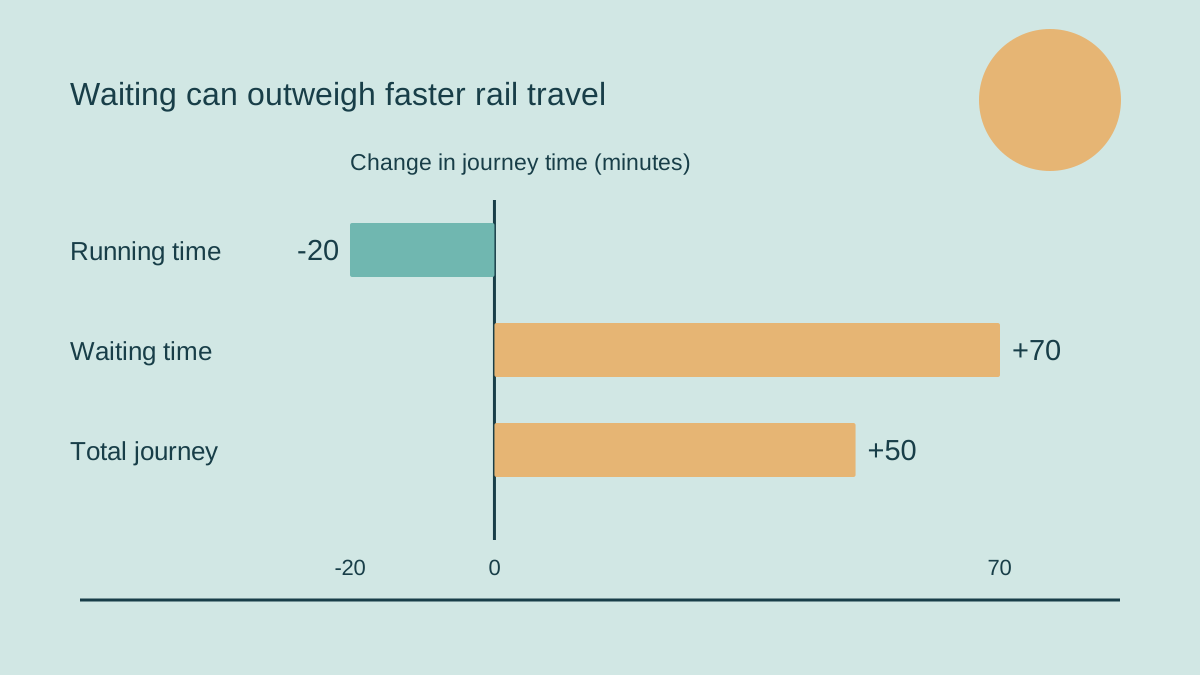
The example explains why a project dashboard should distinguish sectional speed from end-to-end usefulness. Both are legitimate measurements. Problems arise when one is presented as though it proves the other. For a connecting route, the timetable at the interchange may be as consequential as improvements along the approaches.
Frequency changes the consequence of a missed connection
Missing a departure has different consequences when another service follows shortly afterwards and when the next option is the following morning. The same delay can therefore have a very different effect on a complete journey depending on the onward timetable. A connection cannot be evaluated fully by its scheduled transfer interval alone.
This does not imply that every route requires a very high service frequency. Demand, resources and the purpose of the service all matter. It does imply that planners should examine the available recovery options and communicate them accurately. A passenger needs to understand what happens when the planned sequence fails, not only when every component runs as scheduled.
For an early-stage project, that examination can identify a targeted improvement. A modest adjustment to one departure might protect a useful connection. Alternatively, a timetable may reveal that the desired journey requires a larger service change. Either conclusion is more informative than assuming that physical connectivity guarantees convenient recovery.
Separate possible journeys from expected demand
The hypothetical 60 town-pair combinations demonstrate a change in network reach, but they say nothing about how many people want to make those trips. A route can create many theoretical possibilities while attracting most of its passengers from a small number of nearby origins and destinations.
A demand assessment would need evidence about actual travel purposes, competing options and the service being offered. A student making occasional trips, a worker travelling regularly and a visitor with flexible dates may value the same timetable differently. Counting them as interchangeable passengers can hide the reasons they would choose or reject the route.
Early evaluation should therefore keep the map of reachable places separate from the evidence about likely use. The map identifies opportunities. Surveys, observed travel patterns and later operating results help assess which opportunities matter. Neither one automatically supplies the other, and a striking long-distance itinerary is not a substitute for understanding everyday regional journeys.
Look at the existing journey that the link may replace
A new railway connection does not create mobility from nothing. People may already travel by road, combine a bus with trains or choose a different route altogether. The relevant comparison is therefore with a real alternative, not with an imaginary situation in which nobody can cross the border.
For one passenger, removing a road transfer could simplify the trip. For another, a direct coach might remain more convenient than a rail itinerary with several changes. A third person might value the new railway option even if it is not the fastest. These are possible responses, not observed findings about the planned service.
This comparison also helps keep claims proportionate. Establishing an additional all-rail option is a meaningful result in itself. It need not be described as universally superior to every other mode. The strongest assessment identifies which journeys improve, which trade-offs remain and which travellers are likely to benefit from the particular arrangement offered.
The station handover needs information as well as a path
A passenger can physically reach the next platform and still be uncertain about whether the next service is part of the intended itinerary. Clear station names, departure information and operator identification reduce that uncertainty. Consistency between the timetable shown before travel and the information displayed at the interchange is particularly important.
Consider a hypothetical traveller who buys two separate journey segments and later encounters a changed departure. The infrastructure may be fully usable, yet the traveller needs to know which operator can explain the change and what the revised options are. A diagram of connected tracks cannot answer those questions.
Project teams can test this information handover with concrete scenarios before making broad claims about ease of use. The test is whether a person can understand the next step from the available information. It should not depend on having memorised the organisational boundaries between infrastructure managers, train operators and station owners.
Use milestones that describe what has actually changed
Infrastructure completion, an agreement entering into force, a timetable announcement, ticket availability and the first passenger service are separate milestones. Each can remove an obstacle, but none should silently stand for all the others. A project report becomes clearer when it names the milestone and its immediate consequence.
For the April account, the distinction matters because a future opening was still being discussed. Reporting the agreement as effective and the passenger service as planned preserves the state of knowledge at that date. It also leaves room for the programme to change without rewriting a forecast as though it had always been a completed event.
A useful progress record could distinguish:
- Physical work completed and remaining.
- Operating arrangements established for the intended service.
- Timetables and passenger information confirmed.
- Actual service operation and subsequent performance.
This is not a prescribed legal checklist. It is a way to keep different kinds of evidence from being collapsed into a single, ambiguous statement that the connection is “ready”.
Assess the border project as part of a programme
A connecting segment depends on services beyond its immediate boundaries. If an approach route changes its timetable, the usefulness of the border connection can change even when nothing happens at the border itself. That dependence argues for evaluating the project within a wider operating programme.
The programme need not solve every long-distance journey at once. It can identify an initial set of useful connections, preserve them where possible and monitor where passengers encounter the greatest difficulty. This creates a basis for choosing later adjustments rather than treating the opening ceremony as the end of coordination.
Responsibility matters here. Someone needs to maintain the picture of the complete journey when individual organisations optimise their own parts. Otherwise, a locally sensible timetable change can weaken a connection that another organisation assumed would remain available. The network benefit depends on continued coordination, not only on the original investment.
Measure the benefit at the scale where it appears
The most visible asset may be a short border segment or an interchange station, while the benefit appears in journeys that begin and end elsewhere. Evaluation should be able to follow that benefit without attributing every later journey improvement solely to the border project.
A practical assessment would distinguish newly possible itineraries, changes in total journey time and actual passenger use. It would also record the service conditions under which those results occurred. That makes it possible to compare like with like when frequency or connections change.
The planned Tornio–Haparanda passenger link is therefore useful as an example of network reasoning. Its significance cannot be read from distance alone. The important question is how infrastructure, operating arrangements and timed connections combine to create journeys that people can actually make. As of the April report, that remains the opportunity the proposed service is intended to turn into operation.





Leave a comment