

A drinks bottle is a system people operate without reading a manual. They grip it, break the seal, remove the cap, take a sip and close it again. Changing one of those movements can therefore expose a much larger industrial task than the size of the component suggests. A closure has to work for the person holding the bottle, the equipment filling it and the organisation collecting it afterwards.
Euronews reported on 24 May 2024 on the transition to attached plastic bottle caps ahead of the European Union deadline. The central idea is simple: keeping a small component with its container reduces the opportunity for it to become a separate piece of litter. The practical question for businesses is how to deliver that connection without making the package difficult to use. The discussion below examines that question as a manufacturing and product-design problem, rather than claiming that any particular design has already solved it.
Start with the requirement, not the shape of a familiar cap
The relevant starting point is Article 6 of Directive (EU) 2019/904. For the products within its scope, plastic caps and lids must remain attached during the intended use of the container. Article 17 sets 3 July 2024 as the application date for this requirement. The obligation describes a result; it is not an instruction to copy one manufacturer's hinge, connecting strip or opening movement.
The scope also deserves more care than the phrase “all bottle caps” allows. Part C of the annex covers beverage containers with a capacity of up to three litres, including bottles and composite beverage packaging. It excludes glass or metal beverage containers with plastic caps, and containers intended and used for specified liquid foods for special medical purposes. Article 6 separately says that metal caps with plastic seals are not treated as plastic caps for this provision.
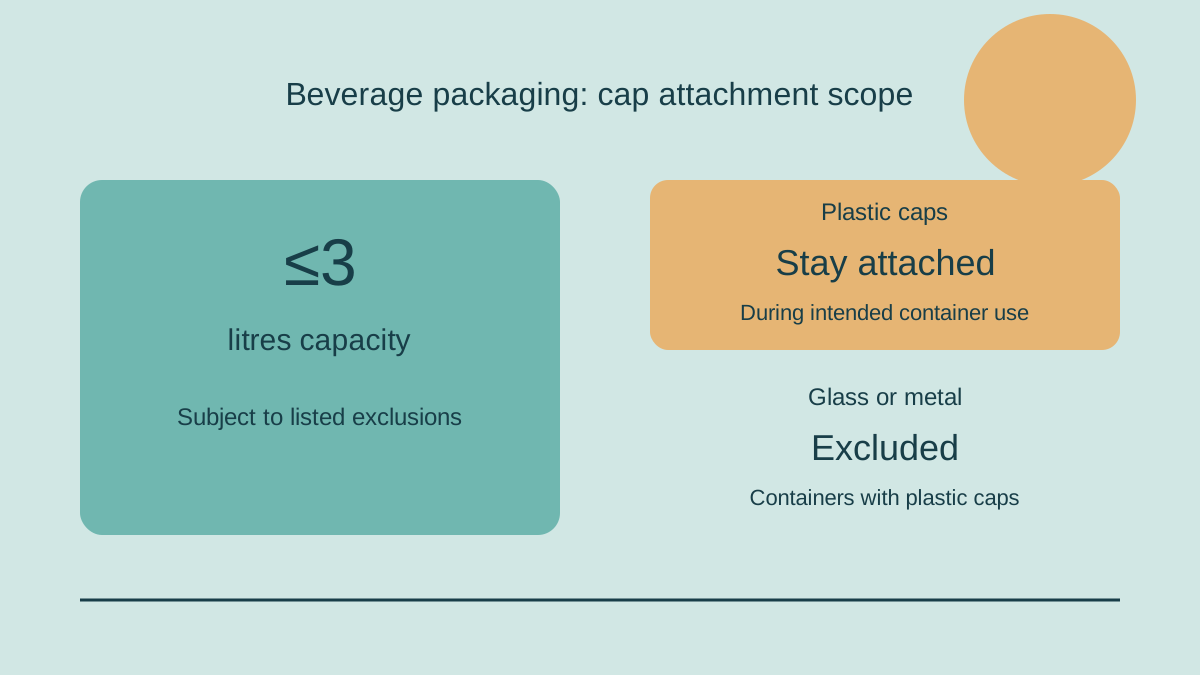
These distinctions matter when a producer maps its range. A carton and a plastic bottle may require examination even though they have different bodies and filling processes. A metal container should not be assigned the same answer merely because its closure includes polymer material. The sensible unit of assessment is the actual product configuration and its intended use, with national implementation checked for the market concerned. That assessment precedes a purchasing decision.
The interface between the hand and the package
The attachment becomes part of an interaction that has several stages. First opening is only one. A person may tilt the bottle sharply, pour slowly into a narrow glass, drink directly from the neck, replace the cap with wet hands, or carry a partly used bottle in a bag. A closure that performs well in a single demonstration might still be awkward during one of these other movements.
An operational review can therefore separate retention from usability. Retention asks whether the cap stays connected. Usability asks whether a person can understand and operate the package with reasonable effort. Treating them as different questions avoids a misleading pass mark: a very strong connection alone says little about whether the open cap obstructs the flow of liquid or makes closing confusing.
Consider a hypothetical comparison between two prototypes. Both keep the cap attached in the prescribed test. One holds the cap away from the drinking opening; the other lets it swing freely. Their retention result may be identical, while their performance during pouring differs. This example is a design question, not a report of measured performance for a commercial product. It shows why a specification needs to describe the complete sequence of use.
Testing that sequence with people who have different hand sizes, grip strength and familiarity with the package can reveal issues that a drawing cannot. The relevant observation is what the person actually does, including any attempt to tear the cap away. Such an attempt might indicate an unclear opening action, an inconvenient resting position or a habit carried over from the earlier design. Those explanations call for different responses.
A closure change reaches the filling line
A bottle and its cap meet in a process with tolerances. The closure must reach the equipment in the expected orientation, be applied correctly and leave with an intact seal. An attached design adds geometry that engineers need to examine against that process. It would be premature to conclude that every filling line requires replacement, just as it would be premature to assume that every existing setting remains suitable.
The useful engineering question is narrower: which interfaces change for this container, this closure and this machine? A trial can examine feeding, application, inspection and handling separately. If an interruption appears, recording its location helps distinguish a supply problem from an equipment setting or a damaged component. A total count of rejected bottles, without those distinctions, gives less guidance about what to correct.
Trial conditions also matter. A short run using carefully selected samples establishes something different from a sustained run across normal variation. Temperature, component batches and normal operating speeds can be recorded alongside the results. This is a proposed approach to evidence, not a claim that the directive prescribes this exact factory checklist. The purpose is to ensure that a packaging decision survives ordinary production rather than only a controlled demonstration.
- Identify the closure and bottle versions used in each trial.
- Record where interruptions or seal failures occur.
- Keep first-opening, reclosing and retention observations separate.
- Compare results under documented operating conditions.
- Assign responsibility for approving the final configuration.
Procurement needs an agreed boundary between components
Purchasing a cap is not the same as purchasing a functioning package. If the bottle supplier, closure supplier and filling contractor each approve only their own item, a problem can remain at the interfaces between them. An effective specification describes the combination and states which organisation supplies the evidence for each performance claim. That makes a disagreement easier to resolve before a large order is placed.
Change control is particularly relevant. A supplier may propose a revised material, tool setting or connecting feature while retaining a similar product name. From the buyer's perspective, the important question is whether the previously approved evidence still applies. Recording the version and the reason for any change provides a basis for deciding whether further testing is needed. It also makes complaints more useful because they can be connected to a defined configuration.
Commercial comparisons should consequently include more than the quoted unit price. Tooling, trials, rejected components, stock conversion and support from the supplier may affect the cost of the transition. No universal estimate follows from the available sources. A business should calculate those items for its own range and distinguish a one-time conversion expense from a recurring operating expense. Combining them into one unexplained number would obscure the decision.
Inventory creates a separate transition problem
A design can be approved while the supply chain still contains earlier components, empty containers and finished drinks. These are different inventories with different commercial histories. Article 3 defines placing on the market as the first making available on the market of a Member State. That wording is a reason to establish the history of stock and consult the applicable implementation, rather than treating the production date as a universal answer.
For planning purposes, a business can map where each type of stock sits and which organisation controls it. The exercise might include a packaging supplier, a contract filler, a central warehouse and a distributor. Their replenishment cycles need not align. Without that map, a planned conversion date at the factory may say little about which version is being ordered, shipped or displayed elsewhere.
This is also a communication problem inside the company. Sales staff need an accurate description of the product available to customers, while procurement needs to know which components remain authorised for new orders. A common version register can connect those conversations. It is more useful than an announcement that “the change is complete” if the announcement does not specify the relevant product range and stage of distribution.
One standard package or several market versions?
A producer serving several markets has a further choice: whether to use a common closure wherever possible or maintain different versions. Standardisation may simplify ordering, artwork and stock identification. Separate versions may preserve an established package in a market with different requirements or customer preferences. Neither option is automatically the cheaper one once operational complexity is included.
A useful comparison would count the number of components to manage, the risk of dispatching the wrong version, the frequency of production changeovers and the amount of stock held for each range. It would also consider whether a single design works well across bottle sizes. An attachment that is convenient on a small container need not produce the same pouring experience on a larger one.
The decision therefore belongs to a cross-functional group rather than only to a compliance or marketing team. Engineering can explain compatibility, purchasing can explain supplier constraints, logistics can explain inventory consequences and customer service can explain recurring difficulties. The point is not to add meetings. It is to prevent a saving in one department from silently becoming a larger cost in another.
Keeping the cap is different from proving recycling
The immediate mechanism of attachment is retention: two items are more likely to remain together while the package is used and discarded. That mechanism should be distinguished from the later stages of waste management. Collection, sorting and actual recycling still have to occur. A photograph of a cap attached to a bottle cannot establish the amount of material ultimately recovered.
The directive itself treats product design and recycled content as separate subjects. Article 6 includes requirements for recycled plastic in specified beverage bottles, expressed as averages across bottles placed on a Member State's market. Those provisions do not mean that any individual tethered cap demonstrates the recycled content of its bottle. Equally, recycled material in a bottle does not by itself establish that the closure remains attached during use.
For a brand making an environmental claim, this separation offers a practical discipline. Describe the property that has actually been changed, identify the intended benefit and avoid presenting an intended benefit as a measured result. If the company later reports an outcome, the measurement should explain its boundary: which products, which period and which part of the collection or recycling process it covers.
Customer instructions should explain an action
Consumers do not need a miniature legal briefing on the label. They need to understand how the package opens, where the cap rests and how to close it securely. A useful instruction is specific enough to change the next movement of the hand. General language about sustainability may explain the motivation but cannot substitute for an understandable opening action.
Before printing instructions across a range, a company can observe whether people understand them without assistance. If the same misunderstanding recurs, changing the wording may help; if the physical movement remains difficult, the design may need attention. That distinction prevents customer education from becoming an excuse for leaving an avoidable usability problem unresolved.
Complaints can be classified in the same way. Leakage after reclosing, discomfort when drinking, uncertainty about whether to detach the cap and difficulty pouring are different reports. Counting them together as dislike of a new package loses actionable information. A structured record can show whether a response should focus on manufacturing consistency, clearer instructions or a change in the geometry of the closure.
What would make the transition convincing?
A convincing transition has several kinds of evidence that reinforce one another. There is a documented assessment of scope, a defined package configuration, production results under known conditions and observations of ordinary use. There is also a clear account of the stock transition. These records answer different questions, so one should not be used as a substitute for all the others.
Management can review them in a sequence. First, determine which products are affected. Next, approve a design and its interfaces. Then confirm the manufacturing process and the distribution plan. Finally, monitor the package in use and investigate specific problems. This sequence is an analytical framework for organising the work; it is not an additional legal timetable or evidence that every producer has followed the same process.
The small size of the cap is what makes the change instructive. Packaging touches purchasing, factory operations, consumer habits and waste systems at once. Keeping one component attached can address a particular weakness in that system, but the quality of implementation depends on all those connections. The businesses best placed to explain their change will be those able to show how the package works, what they tested and which environmental outcomes remain to be measured.
Sources: Euronews; Directive (EU) 2019/904 — official legislation archive.






Leave a comment