

A percentage can settle a political argument while leaving an engineering and accounting problem open. If a group of producers is to finance most of a treatment process, someone must still define which equipment, operating expenses and measurements belong to that process. The distinction is central to Europe’s provisional agreement on urban wastewater: assigning responsibility is one step; turning it into a dependable service is another.
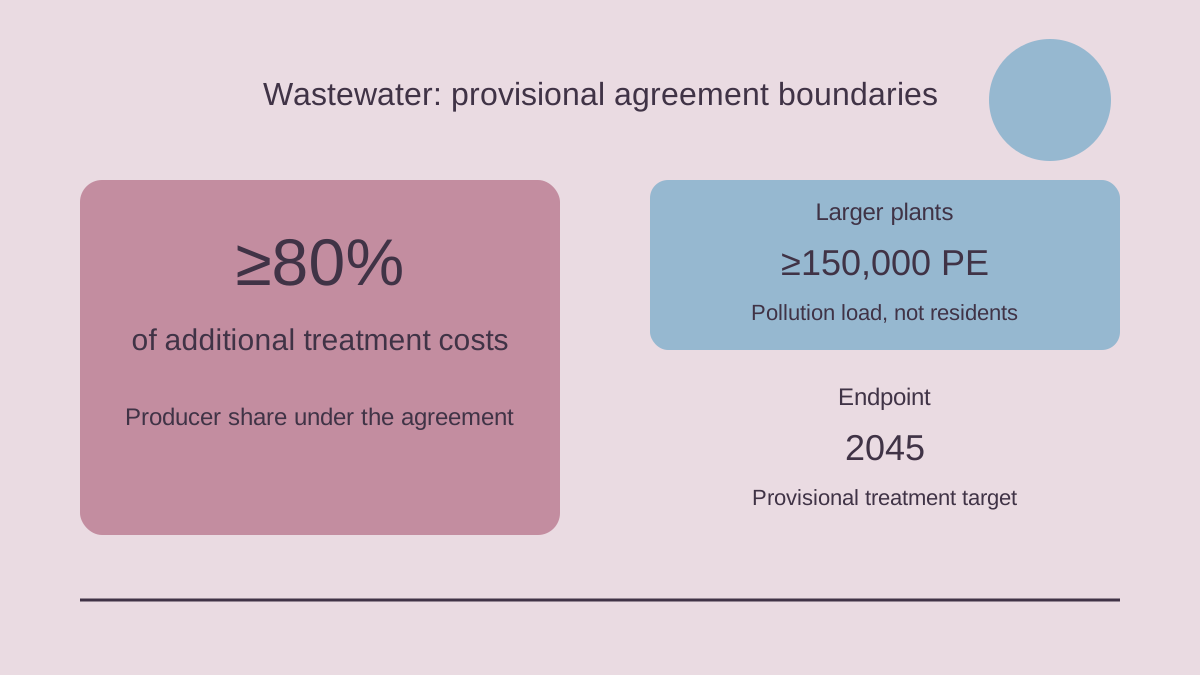
Euronews reported on 30 January 2024 that the previous day’s agreement would require pharmaceutical and cosmetics producers to cover at least 80% of the additional treatment costs associated with removing micropollutants. Formal approval by the Parliament and Council was still required. The proposal is therefore a direction for a future system, not evidence that a new charge is already being collected from every affected business.
The treatment boundary determines the financial boundary
The Council’s announcement distinguishes quaternary treatment for a broad range of micropollutants from other treatment stages. It sets a 2045 endpoint for larger plants at 150,000 population equivalent and above, with intermediate milestones, and a risk-based extension to smaller agglomerations. Population equivalent measures pollution load; it is not simply a headcount of residents. These distinctions matter when identifying which facilities and expenditure categories belong in the proposed system.
For an operator, the first practical question is what constitutes an additional treatment cost. A whole wastewater service contains activities that would still be necessary without the new stage. Adding a new unit may also require shared infrastructure. A fair allocation needs to explain the relationship between the new function and the surrounding plant, rather than apply a percentage indiscriminately to the total budget.
Imagine, solely as an accounting illustration, a site with an existing annual service cost of 100 units and an additional treatment cost of 20. Applying 80% to the second figure gives 16, not 96. The example is not an estimate for any real plant. It shows why the denominator must appear beside the percentage whenever the policy is discussed. Otherwise a correct percentage can support a misleading claim about the scale of the obligation.
Shared equipment creates the difficult cases
A dedicated new treatment unit is comparatively straightforward to identify. Shared pumps, buildings, electrical connections and staff time can be harder to attribute. An operator would need a documented rule for deciding which share, if any, belongs to the additional service. That rule should remain understandable to both those paying and those responsible for maintaining the rest of the wastewater system.
A useful test is to ask what expenditure would occur without the new treatment requirement and what changes because of it. This is an analytical question, not a claim that the provisional agreement prescribes a particular accounting method. A replacement that was already needed may differ from an upgrade required solely by the new stage. Where one investment serves both purposes, the reasoning behind any split should be visible.
Transparent allocation also protects the treatment operator. If a justified shared cost is excluded merely because it is not physically inside a new unit, the service may be underfunded. If unrelated costs are included, contributors may dispute the bill. Clear boundaries reduce both risks by connecting expenditure to a defined task. They are part of making the financing durable, not simply a device for making the initial estimate smaller.
Construction money and operating money follow different clocks
A treatment project can require substantial spending before it removes its first unit of pollution. Equipment procurement, installation and commissioning occur ahead of routine operation. Electricity, consumables, maintenance and verification continue afterwards. A financing design that discusses only an annual total may overlook the timing difference between building the service and keeping it available.
Consider another hypothetical case: a project needs ten units during construction and one unit each year to operate. A promise to provide the operating unit does not fund construction, while a one-time construction payment does not secure later upkeep. The precise arrangement could vary, but the cash-flow schedule must be explicit. This example describes a planning problem rather than any cost profile reported for European treatment plants.
Long-lived infrastructure also raises questions about replacement and major maintenance. A low first-year bill can be misleading if predictable later work has been left outside the plan. Conversely, collecting money far ahead of a justified need requires accountability for how that money is held and used. Contributors and operators need to understand the time horizon of the commitment, including what happens when assumptions about demand or equipment life change.
Payment must connect to a measurable service
Financing additional treatment is meaningful only if the service can be described and checked. A procurement specification should identify the outcome sought, the conditions under which it is evaluated and the evidence used to confirm performance. Buying a named technology without defining the task can leave a gap between equipment delivery and the environmental result that justified the expenditure.
This does not mean that one brief announcement can establish every measurement protocol. It means that the later implementation process must make those protocols visible. A treatment result should specify what was measured, where samples were taken, the relevant period and how unusual operating conditions were handled. Without that context, two percentages labelled “removal” may describe different tests and may not support a reliable comparison.
A concentration result and a quantity over time also answer different questions. Where flow varies, a lower concentration alone does not describe the full amount passing through a system. An evaluation should use measures appropriate to its stated purpose and explain their relationship. This is a general measurement principle; it is not a report of a particular plant’s performance or a claim that the agreement has already selected a single universal method.
A pilot should resolve a decision
A pilot installation is most useful when it is designed to answer a defined uncertainty. The question might concern performance under changing inflow, maintenance requirements, integration with existing operations or the resources needed for sustained service. The trial should identify the decision that its results will inform before equipment is installed. Otherwise a successful demonstration can leave the actual procurement choice unresolved.
For example, a trial could compare performance under several documented operating conditions while recording resource use and interruptions. Its output would then be a set of observations with limits, not merely a photograph of working machinery. A decision-maker could see which conditions were represented and which still require evidence. That distinction is important when moving from a short demonstration to a commitment expected to operate for many years.
The pilot should also preserve evidence of unsuccessful or interrupted runs. Excluding them can make a system appear easier to operate than it was during the test. Keeping them does not automatically disqualify a technology; it helps identify the support, redesign or operating changes that may be required. The purpose is to reduce uncertainty about a service, rather than produce an uninterrupted narrative of success.
Collective funding needs a clear chain of responsibility
When many producers contribute to a shared treatment service, the payment route becomes an organisational issue. Someone must collect information, calculate contributions, transfer funds and check expenditure. The Council’s announcement says producers would also bear the costs of gathering and verifying data on products placed on the market. That adds an information function to the financing model.
The practical challenge is to make each responsibility identifiable. If the entity collecting funds cannot explain the calculation, contributors cannot verify their share. If the treatment operator cannot identify the conditions attached to funding, it cannot plan confidently. If no party owns the reconciliation between estimated and actual costs, discrepancies can remain unresolved from one period to the next.
A workable arrangement would therefore benefit from a documented sequence: reporting, validation, calculation, collection, payment and review. This is a proposed governance test, not a description of an institution already created by the agreement. At each stage, the relevant party should know which information it receives, which decision it makes and how an error is corrected without losing the audit trail.
Data quality affects the distribution of the bill
Even a well-defined total cost can be distributed poorly if the underlying product data are inconsistent. Units, reporting periods and product categories need coherent definitions. A missing declaration should not silently become a zero, while a corrected record should be traceable to the earlier version. These are ordinary data-management tasks with direct consequences for the perceived fairness of a collective system.
Confidentiality and verifiability must also be considered together. Businesses may regard some commercial information as sensitive, while other participants need confidence that the calculation treats contributors consistently. The design question is which information must be visible to whom, and what independent checking can establish. Publishing every underlying commercial detail is not the only possible way to demonstrate that an allocation method has been applied correctly.
Changes in product portfolios create another timing issue. An annual declaration captures a defined period, while a treatment service operates continuously. Any subsequent correction or adjustment needs a stated procedure. A stable method does not mean refusing to update the data. It means that updates follow rules known in advance, allowing both businesses and service operators to understand their consequences.
Affordability is a separate question from responsibility
A rule identifying who pays an invoice does not, by itself, reveal who ultimately bears every economic effect. Businesses may respond through several channels, and the outcome can depend on the circumstances of a product and market. It would be premature to infer a specific price increase from the 80% headline alone. No product-level charge or retail-price calculation is established by that percentage.
The Council says the Commission would assess potential effects on medicine accessibility and affordability. The relevant analytical task is therefore to examine those effects rather than assume either that there will be no consequence or that a particular shortage is inevitable. A useful assessment would separate the size of a contribution, its timing and the conditions under which a product is supplied.
The environmental and affordability questions should remain visible at the same time. Ignoring treatment costs does not make the pollution disappear, while ignoring the circumstances of essential products does not make a financing system easier to implement. The policy challenge is to develop evidence about both. This article does not assess any individual medicine or offer advice about treatment, purchasing or prescribing.
Long deadlines still require a sequence of decisions
A distant endpoint can create the impression that little needs to happen now. Infrastructure development, however, consists of connected decisions rather than one final installation date. Defining the service, collecting baseline information, comparing options, obtaining the necessary project decisions and arranging procurement all precede routine operation. Delay at an early stage can reduce the range of choices available later.
The relevant planning tool is a sequence with dependencies. A final equipment order should follow a sufficiently clear specification; a reliable specification needs information about the application; a financial commitment needs a credible account of both initial and continuing costs. These relationships do not predict the duration of any particular project. They explain why a long policy horizon should be translated into intermediate decisions that can be reviewed.
Staged implementation can also create opportunities to learn, provided early experience is recorded in a reusable form. Later projects can benefit from documented operating results and procurement lessons rather than repeating the same uncertainty. Comparisons should still preserve differences between sites. A successful early installation is evidence about its conditions, not automatic proof that the same configuration suits every treatment plant.
What a credible implementation record would contain
The strongest public account would connect the financial and treatment sides of the project. It would show what additional service was commissioned, how the relevant cost was defined, which payments supported it and what evidence confirmed operation. A reader should be able to follow that connection without needing access to every confidential commercial record.
- A clear distinction between existing wastewater services and the additional treatment function.
- A cost schedule separating initial investment, recurring operation and later replacement needs.
- A documented contribution method with a route for correcting data.
- Performance evidence tied to stated conditions and measurement periods.
- An explanation of deviations from the original plan and the response to them.
Such a record would make disagreement more specific. A dispute could concern the cost boundary, a measurement, a contribution calculation or a procurement choice, rather than a vague claim that the entire system is unfair or ineffective. Specific disagreements are easier to investigate and correct. They also help distinguish an implementation problem from a disagreement with the underlying allocation principle.
The percentage is the beginning of the design
As of 30 January 2024, the agreement remains provisional and awaits formal approval. Its significance lies in the proposed connection between product responsibility and a shared wastewater treatment service. The next analytical questions concern the boundaries of that service, the evidence for its performance and the organisation of its financing. Those questions remain necessary even if the political percentage itself is clear.
A durable system would make the bill explainable and the result verifiable. Producers need confidence that contributions support the defined task; operators need funding that matches the work; the public needs evidence that the additional treatment is delivered. The headline allocation can initiate that relationship. Careful implementation is what would allow it to function over the life of the infrastructure.
Sources: Euronews; Council of the European Union.






Leave a comment