

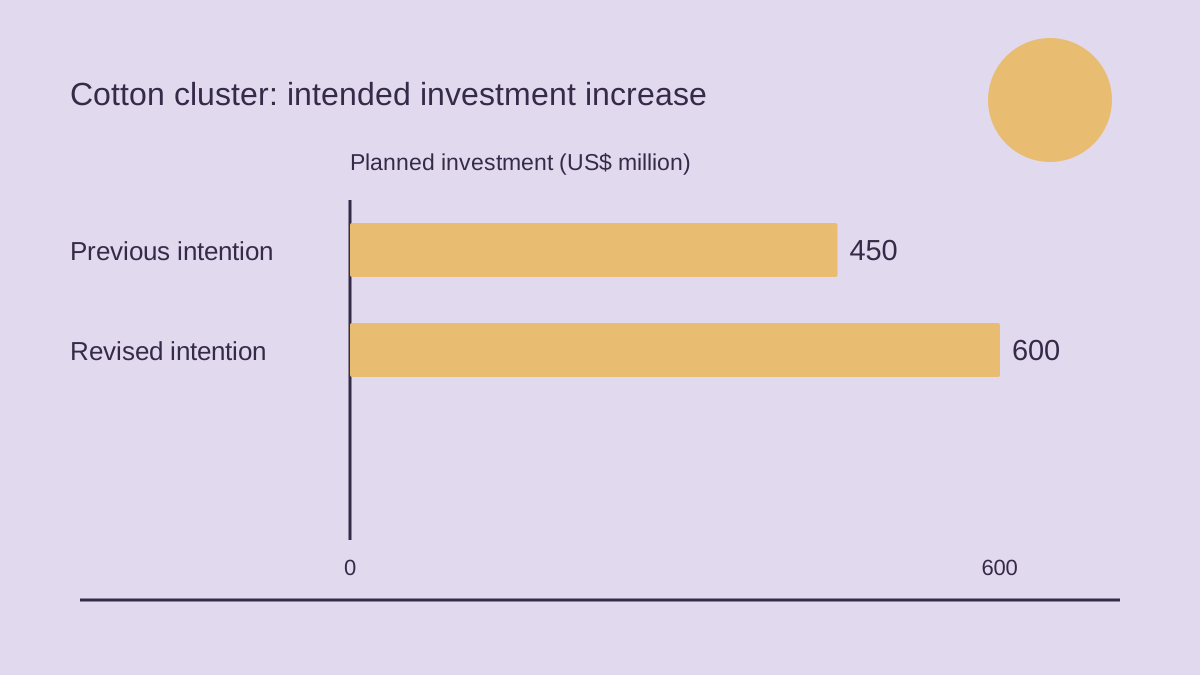
Interfax reported on January 12, 2026, citing Kazakh Invest, that China-based Xinjiang Lihua intended to raise its Turkestan-region cotton-cluster investment in Kazakhstan from $450 million to $600 million. Some facilities were operating; equipment work at other stages continued. Full commissioning remained a first-quarter 2026 expectation. The practical question is whether the proposed stages can work together, rather than merely add their separate capacities.
A cluster contains several states of progress
A larger investment intention can expand a project proposition without establishing a larger operating result. The assessment should therefore retain separate states for committed development, available equipment, accepted operation and completed customer output. The reported project included unequal readiness across its facilities. Treating all those facilities as one completed production system would erase that distinction. A future account should identify which observations support each state, rather than attach the strongest completed milestone to every part of the cluster under the same investment headline.
This separation would also help interpret the commissioning target. A target could organise further work while its completion remains a question for observations. The date should not become proof of fulfilment merely because it appears in a project account. A stage could achieve its own accepted operation before the complete system demonstrates a linked service. Both achievements would matter, but they would support different conclusions. Preserving their dates and boundaries would allow the cluster to show genuine progress without assuming the broader result that still needs evidence.
The project map should distinguish connected and parallel routes
A cluster label need not describe one linear route. Some proposed outputs might enter another assessed stage, while others might serve a separate final customer. A project map should identify these relationships before combining capacity figures. A facility supplying a distinct market would have its own service question; a facility feeding another stage would also have an interface question. This article does not assert an undocumented material route within the reported project. It proposes a map that could make the intended relationships assessable rather than presumed from geographic proximity.
The map should retain a branch even if that branch does not contribute to the selected linked-production outcome. Removing it would conceal part of the investment proposition; adding its output to that outcome would answer the wrong question. A future record could therefore show the complete development programme and a separate route for each assessed service. The reader could see which facilities belong to a particular output claim, which support another claim and which relationships remain unassessed. That structure would make the cluster's breadth intelligible without turning breadth into proof of integration.
The receiving stage defines whether an output is useful
An upstream output would become an accepted interface result when the intended receiving stage accepts it against its requirement. Production at the sending stage would not alone establish that result. The evaluation should identify the transferred material, receiving requirement and observation of acceptance. This is not a prescribed technical specification for cotton processing. It is a boundary for evaluating a proposed connection. Without that boundary, one stage could report a favourable output while the next stage's ability to use that output remains outside the evidence.
The record would also need to preserve unresolved or rejected transfers. Their presence would not automatically establish the cause of a mismatch, but their exclusion would weaken the account of integration. A future comparison could distinguish physical availability, acceptance and actual assignment to the selected task. These states could occur at different times. Keeping them separate would help a project identify whether the next question concerns the sending stage, the receiving decision or an incomplete connection between their records, instead of treating every stored output as completed linked production.
The clocks of supply and processing need a joint account
A proposed route would need to compare when inputs are available with when the receiving process requires them. Annual totals would not necessarily answer that scheduling question. An assessment should therefore retain the timing boundary appropriate to the intended service. This article does not establish a particular seasonal pattern or prescribe a production schedule for the project. It identifies the difference between having enough aggregate material in a planning period and having accepted material available for a defined task at the required point within that period.
A linked schedule could show observed availability, agreed receiving periods and unresolved intervals. If a stage is still being prepared, the record should not presume its future operating rhythm. A conditional schedule could be useful, provided its dependencies remain explicit. Once observations become available, they could replace the relevant assumptions. That would allow the project to examine the continuity of the selected route without converting a planned sequence into a measured result. The account would grow with the stages rather than assume that all stages already share one established operating clock.
Summed capacities do not establish a transferred output
Capacity figures from different stages can describe different quantities, products or assessment periods. Adding them would not automatically produce a meaningful measure of the linked route. A comparison should first identify the common outcome, if one exists, and the evidence connecting each stage to it. If the quantities cannot be reconciled, the report should retain separate figures. This would avoid presenting a large arithmetic total as proof of a production service whose material relationships have not been established in the available project record.
Consider an explicitly fictional interface, unrelated to measured performance at Turkestan. In one invented period, a sending stage prepares twelve lots meeting its own requirement, while the intended receiving stage accepts eight of those lots for a selected task. Adding twelve and eight gives twenty, but the completed interface outcome is eight accepted transfers. Four prepared lots remain outside that completed outcome. The invented quantities do not describe cotton yields or the project's capacities; they demonstrate why a stage total and an accepted transfer total should not be combined as if they were independent finished outputs.
Storage should preserve the interface question
Material held between stages would need an identity and an acceptance status in a linked assessment. A stored quantity could represent available accepted input, material awaiting a receiving decision or another assigned use. Those categories would have different implications for the selected route. The record should not treat them as interchangeable solely because they occupy the same location. This article reports no particular inventory condition in the cluster. It proposes an account that could distinguish those conditions if observed during the assessment of a stage interface.
The account should also connect the stored material with its eventual outcome. If it later enters the selected task, the record could show that connection. If it is reassigned or remains unresolved, the selected route's result should retain the difference. A stage should not receive credit twice for the same material merely because it is recorded at preparation and again at release. A reconciled history would make the intermediate stock useful for understanding continuity, rather than an unexplained quantity that enlarges an apparent result while leaving the receiving service unclear.
Standalone operation and cluster operation need different evidence
An individual facility could demonstrate accepted operation for its own task before an integrated route is assessed. That would be a real milestone, but its scope should remain clear. A cluster-level claim would need observations connecting that facility with the other stages relevant to the claim. The assessment should not penalise the standalone achievement for being narrower, nor should it convert the narrower achievement into evidence of every proposed connection. The distinction would give each completed stage a precise role in the development account.
A future report could therefore maintain a stage record and an interface record. The first would identify what the facility has demonstrated; the second would identify what the connection has demonstrated. An incomplete interface would remain visible even when both facilities have successful separate observations. The missing evidence could concern their relationship rather than either facility's isolated ability. Naming that question would help the programme choose further work that tests integration directly, instead of repeating independent demonstrations and assuming their combined presence establishes a connected production service.
Each branch should end at its own customer requirement
A development programme with parallel product branches would need a defined acceptance endpoint for each branch. A final customer acceptance could support one commercial result, while a transfer to an internal receiving stage could support another. Both could be valuable without being added into one undifferentiated output claim. A future assessment should show the requirement behind each endpoint. This article provides no actual customer contracts or claims that every proposed branch already has an accepted buyer. Such conclusions would require their own identified commercial evidence.
The branch account should also retain a change in the intended destination. Material originally assessed for one task should not silently carry that task's acceptance into a different offer. Some observations might remain relevant, while the new destination would require a separate decision about its requirement. Recording that transfer would make commercial adaptation visible without pretending that an early acceptance covered every later use. The cluster could then explain its several services through their individual evidence, with the overall programme organised by relationships rather than by a single universal success label.
Shared resources should be assessed against shared demand
Neighbouring stages could propose sharing a resource or service. The practical value would depend on the demands they place on it and the periods when those demands overlap. A comparison should therefore identify the shared boundary before making a resource-efficiency claim. Separate successful stage observations would not alone establish successful simultaneous service. This is a proposed evaluation condition, not a statement that a particular shared-resource constraint exists in the reported cluster. The project would need observations for the arrangement it actually intends to use.
The assessment could retain both the quantity supplied and the accepted tasks supported during the observed period. A high utilisation figure might be relevant without establishing that every required task was met. A reserve might support a documented requirement without automatically being unnecessary expenditure. The interpretation would depend on the selected service. Keeping that relationship visible would help the project explain a shared arrangement accurately and would prevent an investment description from turning into an unmeasured claim about resource saving merely because several facilities are located within one development programme.
Expansion needs a traceable version of the route
A larger programme could change the size of stages, their timing or their relationships. The assessment should preserve the earlier route and identify the changed proposition. Evidence for one arrangement might remain useful, but its transfer should be explained rather than assumed. A stage expanded in isolation would not necessarily have demonstrated the new linked service. This article does not claim that such a mismatch occurred. It identifies why a larger investment intention creates a need to connect the changed development scope with the scope of the operating evidence.
A route history could show which observations belong to the earlier arrangement, which directly concern the new arrangement and which remain unresolved. That would support development rather than require every previous observation to be discarded. The key would be the stated relationship between versions. A reader could then assess the new proposition without receiving an unexplained collection of favourable results from different stages of the programme. The larger plan's credibility would rest on the evidence connecting its current form, not simply on the accumulation of milestones under a shared project name.
An interface ledger can make the programme assessable
A concise ledger could connect stage progress with the proposed route's service outcome. The following entries describe a suggested evaluation structure, not existing project procedures, completed production records or technical operating instructions:
- The selected route and any parallel branches excluded from its output claim.
- Sending and receiving stages, their current states and their observed readiness dates.
- Transferred material identities, receiving requirements and accepted outcomes.
- Timing dependencies, intermediate stock states and unresolved intervals.
- Shared-resource boundaries and the tasks supported during assessed demand.
- Route revisions, relevant earlier evidence and the next question requiring an observation.
A complete set of headings would not establish a complete interface. Entries would need supporting records and clear statements of absence. A planned stage should remain planned, and a missing receiving decision should remain missing. This would let the programme show where connected operation has evidence and where the next commitment still depends on an unresolved relationship.
The broader claims require broader observations
A linked production account would not alone establish every economic or environmental consequence of the cluster. A future expenditure comparison would need an identified boundary and accepted service denominator. A resource-saving proposition would need observations appropriate to its own boundary. A jobs claim would require its own evidence rather than follow automatically from a larger investment intention. This article gives no measured result for those wider outcomes. Their prospective relevance should remain separate from the narrower evidence about whether selected stages can complete an accepted material transfer.
The strongest future case would connect identified routes, ready stages, traceable material and repeated accepted interfaces, with separate records for each final service and wider outcome. The reported larger commitment supplies a reason to examine that system, while the unequal stage states show why the assessment cannot begin with presumed completion. Until the connections are demonstrated, investment intentions, standalone operation and cluster operation should remain distinct conclusions. That distinction makes the programme's next task concrete: identify the interface that limits the intended service and obtain the evidence that would justify the next linked-production commitment.
Sources: Interfax English.




Leave a comment