
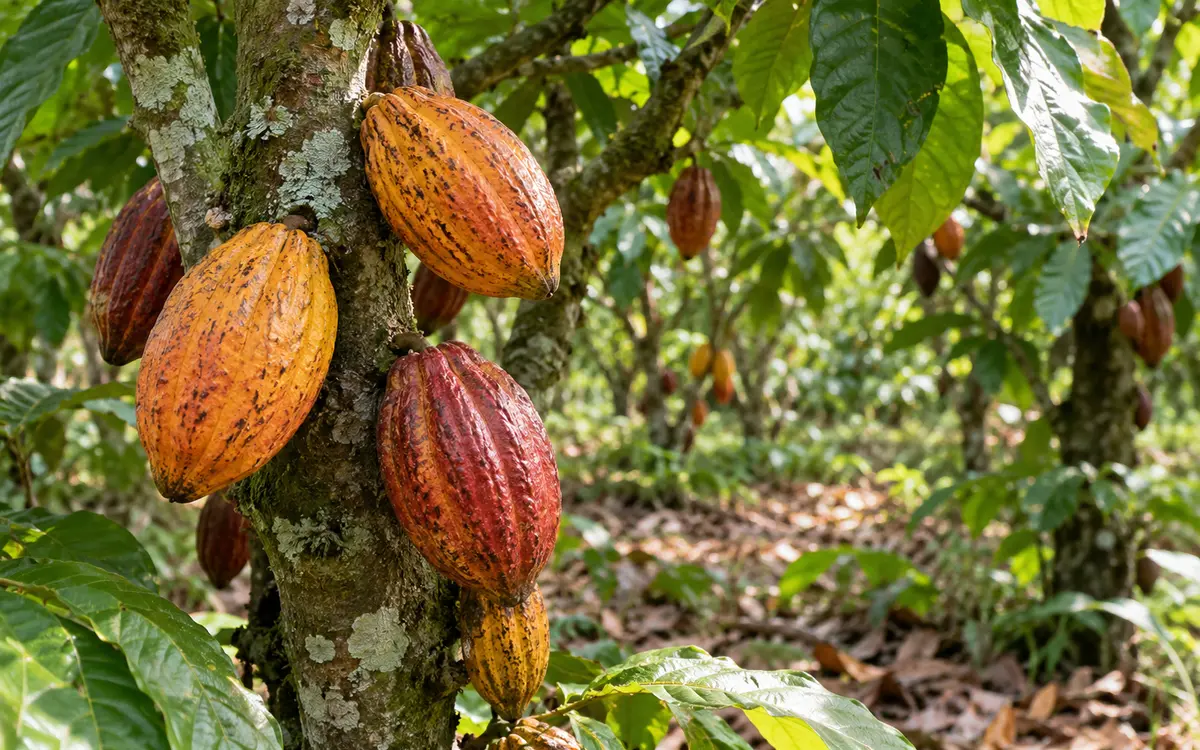
ANTARA reported on September 11, 2026, on a programme to renew smallholder cocoa plantations and develop downstream processing in Indonesia. The report also described raw-material shortages affecting processors and a phased land programme running from 2025 to 2027. Those propositions have different endpoints. A land target records intended work; a processor needs accepted material at a defined time. Connecting them requires a supply timeline with evidence at each transition.
A land programme and a processing requirement are different accounts
A programme could make progress on its land objective while a processor's supply requirement remains unresolved. The two findings would not be contradictory. They concern different outcomes and different observation boundaries. An evaluation should therefore retain the area or plots assigned to the programme separately from the material accepted for processing. This article does not claim that the announced programme has already delivered a particular harvest increase. It asks how a future record could connect development work with the operating requirement that gives downstream investment its practical purpose.
The connection should be stated rather than inferred from the presence of both objectives in one announcement. A land record would need an identified subject and progress state. A supply record would need an identified lot, receiving requirement and accepted delivery period. The relationship between them would form another part of the evidence. A project could then explain where progress has been observed, where a transfer remains conditional and which observation would justify extending its claim beyond the activity already recorded on participating land.
The programme should preserve the identity of its cohorts
A phased programme would need to distinguish the groups entering at different stages or times. Combining them into one total could make their progress difficult to interpret. A future assessment should connect each participating group with its initial record, the work assigned and the observations subsequently obtained. This is a proposed evaluation structure, not a description of the programme's internal procedures. Its purpose is to prevent an early result in one group from becoming an assumed result for every group covered by the wider development target.
A cohort record would also retain a change in participation or scope. If a plot leaves the assessed programme or its planned work changes, the record should show that change. A revised denominator would need an explanation rather than silently improve the apparent completion rate. This would allow the programme to adapt without losing the evidence history. Readers could distinguish progress on the original assigned population from progress on a later revised population, each with its own relevant question and its own observed boundary.
Work recorded on land is not the same as accepted supply
An activity record would establish what was observed at the selected programme stage. It would not alone establish all later agricultural or commercial outcomes. The assessment should name the endpoint attached to that record and the further observations needed to connect it to processor supply. This article provides no planting instructions or predicted time to a particular yield. Those would be different technical questions. Its analytical concern is that an observation of programme work should retain its actual meaning rather than be translated automatically into a harvest or delivery claim.
The programme could therefore report several states without forcing them into a single success label. Registered participation, recorded work, verified stage completion and accepted material delivery would each have an identified denominator. A difference between the states could define the next assessment. It should not be hidden by reporting only the largest total, nor interpreted automatically as failure of the whole programme. The value of the record would lie in showing how an initial development commitment is, or is not yet, connected to the intended supply outcome.
A fictional progress record shows the denominator problem
Consider an explicitly invented programme with 100 registered plots. In a fictional reporting period, work is recorded on 40 plots and the selected stage is verified on 25 of those plots. No accepted processor-delivery observation has yet been attached to that record. These numbers do not describe the reported national programme or actual cocoa productivity. They identify three different accounts: registration, recorded activity and verified stage completion. The missing delivery observation remains missing; it is not evidence that a particular quantity of harvest has or has not been produced.
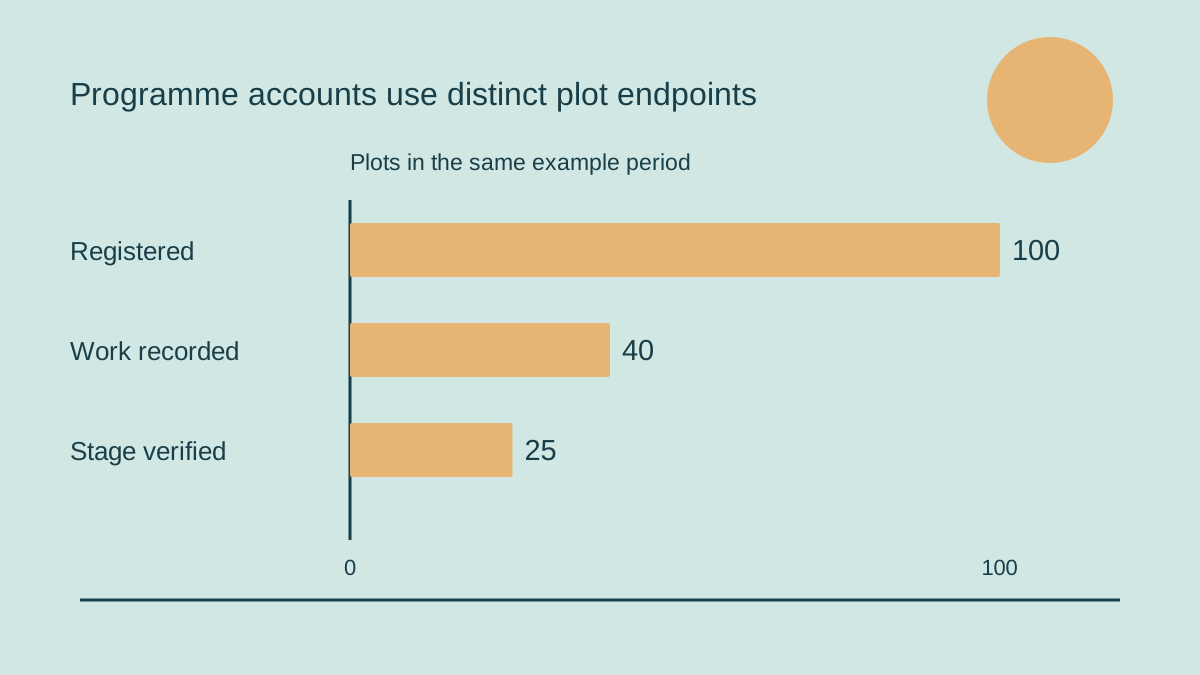
Calling the programme complete because all 100 plots are registered would erase the later questions. Calling it commercially productive because 25 plots have a verified stage would make a different unsupported inference. Equally, describing all the recorded work as worthless would ignore a genuine intermediate result within the example. A useful assessment would preserve progress and its limits. The next observation would depend on the intended claim: further stage evidence for a development claim, or an identified accepted delivery for a claim about downstream supply.
The processor needs its own receiving endpoint
A processor's operating requirement should be defined independently of the programme's land measure. A receiving account would identify the material, the agreed requirement and the point at which acceptance is observed. This article does not supply a cocoa specification or describe a particular plant's purchasing procedure. It proposes a commercial boundary. Without that boundary, a material movement could be counted as a fulfilled supply service while the recipient's decision about its intended use remains unresolved. The record should distinguish availability from accepted receipt for the selected processing task.
A future comparison would also retain rejected or unresolved lots alongside accepted lots. Their presence would not automatically establish a cause or a general product disadvantage. Their exclusion would, however, leave the accepted-supply account incomplete. The programme could investigate the relationship between participating plots, material lots and receiving outcomes, with each connection supported by its own record. That would make the downstream proposition assessable without assuming that every recorded development activity eventually contributes an equivalent quantity of accepted material to the selected processor.
The supply timeline should keep observation and expectation separate
A programme timeline could combine observed events with expected future events, but the two should have different states. A target date would organise work without establishing its fulfilment. A processor considering future supply would need to identify which quantities and periods have observations and which remain assumptions. This article forecasts neither a harvest date nor the size of a future supply improvement. Its point is that a timeline should expose the dependence of the supply proposition on future evidence rather than conceal that dependence beneath one programme completion date.
If an expectation changes, the record should retain the earlier expectation and explain the revision. That would allow the assessment to follow development without retrospectively rewriting the original proposition as though it had always matched the later result. The processor could then see the current commitment alongside the evidence supporting it. The programme's value would not depend on avoiding every revision. It would depend on making the relationship between commitments, observations and unresolved periods clear enough to support the next planning decision.
Interim sourcing is a distinct decision
A processor's current requirement and a programme's future contribution would need separate planning records. If current supply remains unresolved while development continues, an interim proposition would have its own material identity, timing and acceptance boundary. This article does not prescribe an actual sourcing route or claim that a particular interim arrangement is available. It identifies why the future programme cannot automatically stand in for the present operating account. A prospective contribution could be valuable while leaving the current receiving requirement as a separate question for evidence.
The comparison should also avoid counting an interim supply as programme output without a demonstrated connection. A processor might record accepted material from an independently assessed arrangement while the programme continues to build its own evidence. Both records could be useful, provided their roles remain distinct. If the sourcing arrangement later changes, the account should identify the transition. This would help a downstream investment assessment distinguish continuity achieved through current supply from continuity expected from future development, rather than crediting one proposition with the other's observed result.
Grower participation needs a separate outcome record
A programme aimed at smallholders should retain the difference between participation and the result experienced by a participant. A development activity could be recorded without establishing a particular income outcome. A future assessment would need to identify the participant boundary, the commitments made and the observations relevant to the selected outcome. This article reports no measured income increase or universal benefit for participating growers. Such a claim would require evidence appropriate to that outcome, rather than be inferred automatically from a land target or a processor's proposed expansion.
The grower account and the processor account could then be connected without being collapsed. An accepted delivery could support a supply conclusion while the wider participant result remains unresolved. Conversely, a verified programme activity could support a development conclusion without demonstrating the processor's receiving requirement. Keeping both would make the programme's several objectives more intelligible. It would also help identify whether the next assessment concerns participation, the material link or the commercial outcome, instead of treating progress on one objective as proof of every other objective.
Aggregated progress should retain its local differences
A national total could summarise programme activity while hiding differences among assessed groups or locations. A future report should retain the records needed to understand those differences before presenting the aggregate. The question is not whether an aggregate is inherently misleading. It is whether the aggregate's interpretation remains consistent with the observations it combines. A processor considering supply from one assessed group would need evidence relevant to that group, rather than presume that the national average establishes the outcome for every proposed receiving arrangement.
Repeated observations in comparable settings would ask about repeatability, while observations in changed settings would ask about transfer. A programme could examine both, provided it states the distinction. An additional group would not automatically repeat an earlier one, and an additional period would not automatically carry the same assessed conditions. Retaining those relationships would make expansion useful for evidence rather than merely for a larger headline total. The reader could see which conclusion has repeated support and which conclusion rests on a first observation in a newly introduced setting.
The downstream investment should follow the assessed supply proposition
A proposed processing investment would need an identified supply proposition against which its intended service is assessed. A national development objective would not alone establish that proposition for a particular facility. The assessment should connect the required material, receiving periods and accepted service with the evidence available from the programme or other assigned supply. This article does not claim that any facility should expand or that a particular investment would be profitable. It defines the relationship needed to evaluate the proposed connection between development and downstream operation.
A conditional account could show how the investment proposition changes when a supply assumption changes. It should preserve that assumption as an assumption until observations replace it. A calculation would not establish the missing supply merely because it produces a precise result. The practical value would be to identify the observation most relevant to the next commitment. That would connect further programme work with a real operating decision, without turning a prospective land programme into a guaranteed material stream or a completed economic outcome for the proposed processor.
A supply-transition ledger can connect the stages
A concise ledger could connect programme progress with the downstream requirement while preserving their different endpoints. The following entries describe a proposed assessment structure, not existing government procedures, eligibility guidance, agronomic instructions or records of completed programme deliveries:
- Participating cohorts, their assigned work and any documented scope changes.
- Observed development stages and the denominator attached to each result.
- Material-lot identities connecting programme observations with receiving decisions.
- Processor requirements, accepted deliveries and unresolved observations.
- Separate current supply and expected programme-contribution periods.
- Participant outcomes, aggregate differences and the next evidence decision.
All the headings could be present while the connection remains incomplete. The ledger should state where an observation is absent and where a future event remains expected. That would allow it to guide the next assessment without presenting a well-organised plan as proof that the intended supply transition has already occurred.
The wider case needs a chain of observed transitions
A complete economic account would need an identified boundary and outcome denominator. Expenditure per plot assigned would answer a different question from expenditure per verified development stage or per accepted material delivery. A future comparison should preserve resources committed to unresolved work within the chosen boundary. An environmental proposition would need its own observations rather than follow automatically from the programme's renewal label. This article offers no measured saving, harvest forecast or environmental result. It identifies the accounts required to distinguish prospective relevance from demonstrated outcomes.
The strongest future case would connect identified cohorts, verified work, traceable material and repeated accepted processor deliveries, with separate evidence for participant outcomes and wider effects. Until those transitions are observed, the land programme and the operating supply requirement should retain their own states. The reported initiative provides a reason to examine the relationship, while the shortage proposition explains why the receiving endpoint matters. A supply timeline would make the next task precise: identify the unobserved transition limiting the proposed service and obtain the evidence that would justify the next development or processing commitment.
Sources: ANTARA News English.




Leave a comment