

A factory electrification project should be judged against a defined operating baseline. Changing equipment can be an important step, but the business result depends on the service delivered, the energy measured and the costs included. If those definitions change during a retrofit, an apparently favourable comparison may answer a different question from the one that justified the investment.
On July 18, 2024, Manufacturing Dive reported Schneider Electric's planned $23.8 million upgrade of its Seneca and Hopkins factories in South Carolina, United States. The report described electrification of heating, ventilation and air-conditioning systems as part of the work. It did not provide measured post-retrofit savings for the two sites.
The useful commercial question is what evidence would connect the planned upgrade to a defensible operating result. The following analysis proposes that evidence chain. It does not estimate the company's actual savings, prescribe an engineering design or turn a future goal into an achieved outcome.
Define the service that the replacement must maintain
The starting point is the service being purchased from the building system. A factory needs an agreed operating condition, and the investment comparison should explain how the old and new arrangements meet it. The definition should identify the areas served and the periods represented, rather than treating the equipment name as a complete description of the task.
A baseline also needs a responsibility boundary. If the proposed system serves both production and other spaces, the project should state how those demands enter the account. If an area is excluded, the comparison should preserve that exclusion in both periods. Otherwise a reduction could reflect a smaller measured service rather than a better way of supplying the original service.
The production team should be part of defining this boundary. It can identify which conditions matter to the operation and which changes need review before commissioning. That contribution would keep the project connected to factory use without assuming that every building-system observation establishes a manufacturing benefit.
Keep the baseline recoverable after the equipment changes
The baseline should be recorded before it becomes difficult to reconstruct. Its purpose is to preserve the starting condition and the evidence used to assess the investment. A later recollection that the previous system was expensive is not enough to support a quantified result. The record should state what was measured and which observations remain uncertain.
A useful baseline would distinguish recorded values from estimates. Where an estimate is necessary, its method and limitation should be visible. This would allow a reviewer to judge how much of the later conclusion depends on assumptions. It would also prevent an estimated starting value from being presented as an equally precise counterpart to a measured value after the retrofit.
The project should retain the version of the baseline used at approval. If better evidence later changes it, the revised account can be valuable, but the change should be explained. Keeping both versions would make it possible to understand whether an apparent improvement came from the equipment, a corrected baseline or a different comparison boundary.
Connect each meter to the claim it supports
A measurement plan should identify the quantity represented by each observation. Whole-site consumption and consumption assigned to the retrofit answer different questions. If the business claims a result for the upgraded system, it should explain how the measurement represents that system rather than assume that every change in the factory total belongs to it.
Shared equipment requires an allocation rule. The rule should identify the service covered and the reason for dividing the measured quantity in that way. An allocation can support analysis when its limits are clear; it should not be described as a direct observation of a quantity that was never separately measured.
The same principle applies to the post-retrofit period. The project should preserve comparable definitions and explain any change in instruments or accounting. A new measurement arrangement may improve future oversight while making a direct comparison with older records more limited. Acknowledging that limitation would make the conclusion easier to assess.
Separate the equipment change from other operating changes
A factory can change in several ways during a project. The evaluation should record the changes relevant to the comparison, including the service schedule and the agreed production basis. This is a proposed analytical discipline, not a claim that any particular change occurred at the two reported facilities.
If production or occupied space changes, the reviewer needs to decide whether the earlier and later observations still describe the same task. One response could be to compare like-for-like periods; another could be to use a stated adjustment whose basis is supported. Either approach needs an explanation that a commercial reader can follow.
The alternative is to report a narrower observation. A lower measured total may be worth recording even when it cannot be attributed entirely to the retrofit. It should then remain a site-level observation with its limits, rather than become a precise equipment-saving claim. Clear attribution preserves useful evidence without asking it to answer an unsupported question.
Use output intensity with a defined denominator
An intensity measure can help describe an operating comparison, but its denominator matters. The project should define the unit of output and explain whether it represents the same product or service in both periods. Combining unlike outputs into one count can conceal a change in the task being performed.
Consider a completely hypothetical example in abstract units. A period uses 100 energy units and produces 50 accepted output units, giving two energy units per accepted unit. A later period uses 80 energy units and produces 40 accepted units, also giving two. The total has fallen, while the selected intensity remains unchanged. These are not observations from Schneider's factories.
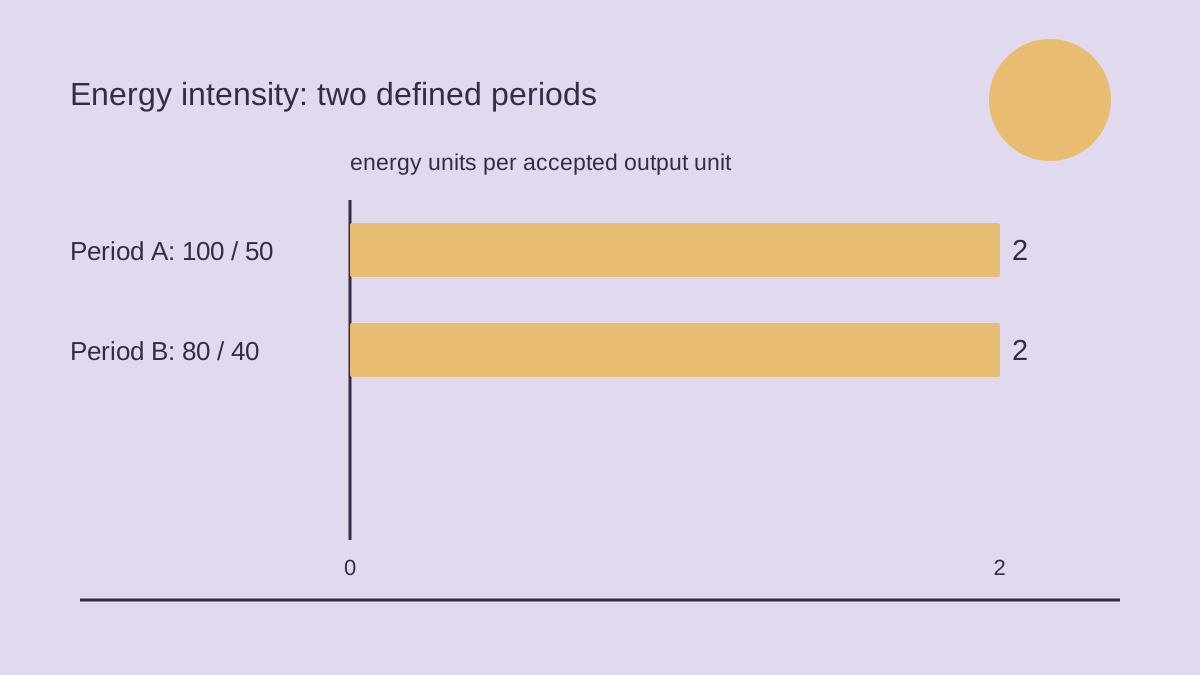
The example does not make either measure wrong. It shows that each supports a different statement. A business review should therefore decide which question its measure answers and preserve both the numerator and denominator. A lower site total, a changed intensity and an equipment-specific saving should not be treated as interchangeable conclusions.
Evaluate bills separately from physical energy quantities
A physical energy comparison and a cost comparison require connected but distinct records. The cost account should explain the price and billing conditions applied to the measured quantities. A change in the bill should not automatically be attributed to a change in consumption if the relevant price conditions have also changed.
For an investment decision, the proposed model should state which conditions are observed, contracted or assumed. It should identify the consequence of an assumption changing before a delivery period. This would let a reviewer assess the project's dependence on an operating scenario without presenting that scenario as a current fact.
The post-project report should use the same distinction. A measured reduction in expenditure can be reported for its stated period. Its explanation should preserve the separate effects the evidence supports rather than claim that the equipment accounts for the entire amount. That would also make later updates comparable when commercial conditions differ.
Include the complete route to an operating system
The retrofit account should include the work required to put the new arrangement into accepted service. Equipment purchase alone may not describe the complete project. The proposed scope should identify installation, checks, handover and whatever associated work the agreed arrangement requires, with an owner for each responsibility.
If part of the work belongs to another budget, that location should be stated. Moving a cost between accounts does not establish that it disappears from the factory's investment. The review should be able to reconstruct the complete route even where several teams manage different parts of it.
Comparison with an alternative should use the same responsibility boundary. A proposal that includes commissioning and operational handover should not be placed beside a bare equipment quote as though both purchase the same result. A consistent scope would make the price discussion more useful before construction or installation begins.
Give commissioning a recorded acceptance decision
Commissioning should have an agreed task and an acceptance record. The project team should identify the conditions represented by the check, the observations required and the person authorised to accept the system. Completing installation and accepting operation are different milestones and should remain distinct in the schedule.
If a check succeeds within a defined scope, its conclusion should stay within that scope. It should not establish unlimited future performance or every operating condition the site could encounter. The team can decide what additional observation is needed when the operating range changes or a previously untested service is requested.
The acceptance record should also connect to the cost account. An installation that still requires corrective work has a different project status from one that has entered agreed service. Recording that difference would prevent an investment review from treating unfinished obligations as completed benefits.
Plan the changeover alongside factory continuity
The proposed installation schedule should identify how the factory will maintain the agreed service during the change. It should state any temporary arrangement and the responsibility for releasing each stage. This is a planning question, rather than an assertion that the reported project required any particular interruption.
A temporary arrangement belongs in the account where it is needed for the project. Its costs and duration should be visible instead of becoming unexplained factory expenditure outside the retrofit. The same applies to planned work that is moved into an existing maintenance window: the account should explain the benefit and the responsibilities that remain.
A staged changeover can support a staged decision if the evidence permits it. The project should specify what would allow the next stage to proceed and what would require revision. That would connect the schedule to observed readiness rather than rely on an opening date as evidence that every transition has succeeded.
Make maintenance part of the service proposal
A complete operating account should identify maintenance obligations and the party responsible for them. A supplier's equipment delivery and the site's ongoing service are different responsibilities. The proposal should clarify training, documentation and the conditions under which a later issue will be assessed.
Expected maintenance costs should be labelled as expectations until operating evidence supports them. A lower estimate may help select a project for further review, but it cannot be reported as a realised annual saving. The site should retain the record needed to compare its later experience with that estimate.
The handover should also make the evidence usable by the operating team. A measurement that exists only in a commissioning file may not support routine review if the team cannot reproduce its meaning. Clear ownership of measurements and records would help keep the original investment question visible after the project team leaves.
Keep energy, emissions and business return as separate conclusions
An energy result, an emissions result and a financial return require their own defined accounts. They may be related, but one is not automatically proof of the others. The review should identify the evidence and assumptions used for each conclusion instead of allowing a general sustainability description to replace them.
An emissions comparison would need a stated boundary and a consistent interpretation of the quantities included. Any method or factor used should be identified, along with its limitations. This analysis does not supply those factors or calculate an actual emissions result for the reported project.
The investment return would similarly need the complete expenditure and the benefits attributed within their limits. A benefit counted in more than one category should not be added twice without explaining the distinction. A transparent model would make the decision reviewable even when some outcomes remain uncertain.
Aggregate two sites only after defining each site
A programme covering two factories needs site-level records before a combined conclusion. The reviewer should understand which service and period each record represents. A single programme total can be useful, but it should not hide differences in the stages completed or the evidence available at each location.
If one site has entered accepted service while the other remains under development, the report should preserve that distinction. A completed observation at one cannot establish a completed outcome at the other. The investment account can still describe the full programme while keeping measured results and future expectations separate.
The aggregation rule should also explain how site quantities are combined. Different product counts or service definitions may need separate presentation rather than one unexplained intensity. A reader should be able to return from the programme headline to the site records supporting it.
Use a review sequence that can change the decision
A useful review does more than list encouraging indicators. It identifies what evidence permits the project to move forward, what calls for a targeted correction and what would change the original business case. These decisions should be assigned before results are selected for reporting.
- Record the original service and measurement boundary.
- Keep the complete project scope and responsibility account.
- Accept commissioning against a defined operating task.
- Compare later operation using consistent quantity and period definitions.
- Report financial and environmental conclusions only within their supporting evidence.
This sequence would give the planned retrofit a testable commercial pathway. A result that differs from expectations could still teach the factory which part of its model needs revision. Preserving that result would be more useful for later investments than presenting every equipment change as an automatically successful programme.
The credible milestone is an operating comparison
The reported investment gives a reason to examine how factory electrification should be evaluated. It does not settle the operating outcome. The next persuasive milestone would link a defined baseline, an accepted system, comparable later measurements and a complete cost account.
If that link can be maintained over subsequent operation, the project would have evidence supporting a more specific business conclusion. Until then, its expected benefits should remain expectations. The value of a measured retrofit baseline is that it lets a factory discover what changed and explain the result without relying on the equipment change alone.
Sources: Manufacturing Dive.





Leave a comment