

A dock and a cold store can change the prospects of a fishing village, but their value depends on the service connecting a landed catch to a buyer. ANTARA reported on 15 September 2025 that Indonesia had selected 65 locations for the first phase of its Red and White Fishing Village programme. The announced budget was Rp1.34 trillion. Funding for another 35 locations was being proposed, rather than reported as completed construction.
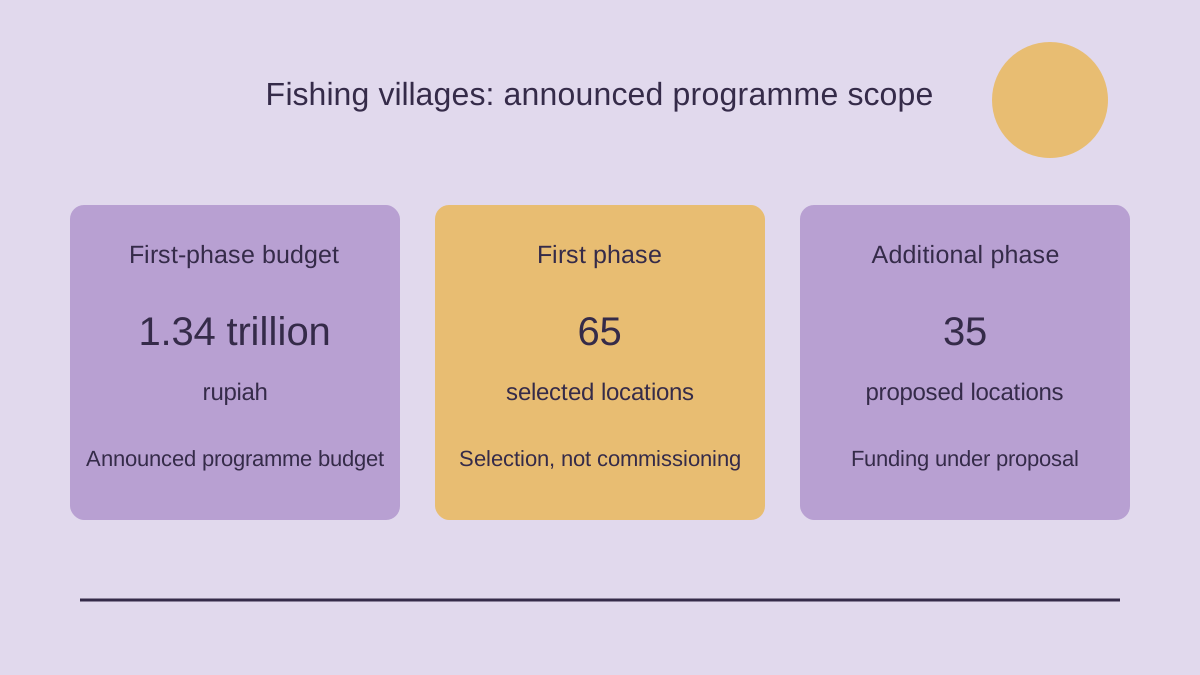
The fisheries ministry's statement describes facilities including docks, ice production, cold storage and training, alongside support for local management. This creates an infrastructure programme with an operating question at its centre: who will maintain the equipment, coordinate its users and connect preserved fish to a paying market? The analysis below examines those questions from the position of the September announcement, without assuming later completion or income results.
Preserving a catch is a different task from increasing it
Infrastructure can support several objectives. It may help preserve a catch, make handling more orderly or enable access to another buyer. Those outcomes should be distinguished from an increase in fishing activity. Selling more usable fish from the same landed quantity is a different economic change from landing more fish.
The distinction matters when judging a programme's contribution. If less product is lost between landing and sale, value could rise without requiring a larger catch. Conversely, a larger catch does not guarantee greater retained value if handling and market access remain constrained. An evaluation should therefore record both quantities and their different meanings.
Resource management remains a separate boundary. The existence of new storage or a more attractive market should not be treated as evidence that additional catch is environmentally sustainable. The programme announcement refers to fisheries governance, but it does not provide a site-by-site demonstration of sustainable expansion. A commercial assessment can examine better handling while leaving resource decisions to their appropriate evidence and management processes.
The chain begins before the cold-store door
A cold store operates within a sequence. Fish arrives, is received and identified, enters the appropriate handling route, waits where necessary and eventually leaves for a buyer. Ice, containers, staff, electricity and transport have to be available at relevant points. A building does not connect those activities by itself.
The operator should map the intended flow at a particular location. Who requests space? Who receives the fish? Who records the quantity and condition? Who arranges collection? Defining these questions helps identify whether a missing service could leave otherwise useful equipment underused.
A delay before receipt can matter as much as a delay inside storage. Similarly, a product that leaves an operating facility may still face a transport gap. The useful unit of evaluation is the complete route to the agreed buyer, not simply the amount entering one building. This is an analytical framework, not a report of deficiencies at the selected villages.
Capacity needs a calendar as well as a volume
Storage capacity describes how much can be held at a time. Annual throughput describes how much passes through over a period. The relationship depends on how long batches remain and how often space becomes available. A facility with substantial capacity can have low throughput if customers leave product there for long periods.
Arrival patterns also matter. A steady annual average could conceal short periods when many users need service together. The operating plan should account for the timing of arrivals, expected holding periods and departures. A schedule based only on an annual quantity may overlook the point at which the service becomes congested.
Shared facilities therefore need a booking and allocation method. The rules should make clear how users obtain space, what happens when demand exceeds availability and how a delayed collection affects others. An allocation arrangement that users understand can be as important to practical utilization as the capacity printed in an equipment specification.
A hypothetical loss calculation clarifies the objective
Consider a purely illustrative landing of 100 units of fish. Suppose 80 units reach buyers through an existing route and 20 do not. If a different handling route allows 90 units to reach buyers from the same landing, the improvement is 10 units of usable sales volume. It is not an increase in the quantity caught. These numbers are not observations from the Indonesian programme.
The extra volume also does not equal extra income automatically. It may require ice, handling, transport or storage fees. The sale price could change with the product specification or buyer. An economic assessment would compare the additional revenue with the additional costs and identify who receives or pays each amount.
The example shows why a report should separate landed quantity, accepted sales quantity, unit price and service costs. Combining them into a single statement that infrastructure raises income would make it difficult to understand the cause of any change. A fisher may benefit from better preservation while facing a different cash-flow requirement, and both effects deserve attention.
The buyer defines the commercial destination
Preserved fish needs a customer with an agreed requirement. A facility may help satisfy that requirement, but it does not create a purchase contract merely by opening. The local operator needs to know the products buyers want, the quantities they can take and the arrangements under which they collect or receive deliveries.
Market access can involve coordination rather than a new piece of equipment. Several small batches might need to be documented and assembled for a buyer's order while preserving their identities. Delivery timing may have to match transport availability. These are possible business tasks for the operating plan, not claims about a particular cooperative's current practices.
A purchaser's rejection or request for clarification should also have a route back through the records. Knowing which batch was affected and where it passed allows a manager to investigate. Without that connection, an operator might have a functioning store but little information about why a sale failed or which part of the service needs adjustment.
A service fee must support continuing operation
Public investment can fund a facility's creation, while continuing operation requires recurring resources. Electricity, staff, maintenance and administration need an account. The management arrangement should identify whether users pay for these services, whether another party supports them and how the arrangement changes if utilization differs from expectations.
A low visible fee may be attractive to users, but it is not enough to show that the operating service is financially sustainable. The account should make any support visible and distinguish it from a service that covers its own costs. This allows managers and funders to understand what must continue for the facility to remain available.
The fee structure also affects access. A charge based on quantity may have different consequences from a charge based on time held or a fixed membership payment. There is no universal structure implied by the announcement. The relevant test is whether the rules are understandable, support the service and fit the intended users without hiding significant expenses elsewhere.
Electricity and maintenance belong in the readiness test
A cold-chain facility requires more than the installation of equipment. The operator must establish that the supporting services and maintenance arrangements are available for its intended operation. A commissioning decision should therefore consider utilities, support responsibilities and the response when a component is unavailable.
The plan should identify who receives a fault report, who can arrange repairs and how users are informed of a service interruption. It should also define the responsibilities for product already held at the facility. These are governance questions; this article does not supply technical storage settings or replace specialist handling procedures.
Preventive maintenance has an economic role as well. Planned downtime can affect capacity available to users, while an unplanned interruption may affect several batches together. Recording those events helps distinguish insufficient demand from a facility that cannot provide service when demand arrives. The two situations call for different management responses.
Shared ownership needs visible decision rules
Facilities intended for many fishers can create questions about priorities, charges and representation. A management body needs rules for approving expenses, allocating services and resolving disputes. Users should know who has the authority to decide and where they can raise a concern.
Those rules become particularly important when a facility serves people with different landing volumes or schedules. A large user might provide a stable share of throughput, while smaller users may be central to the programme's local purpose. An explicit service policy helps the operator consider both without relying on informal preferences.
Reporting should be accessible to the people affected. A concise record of service availability, fee income, operating expenditure and outstanding maintenance would allow users to understand the facility's position. It would also help funders assess whether support reaches an operating service rather than stopping at completed construction.
Cash flow can shape whether users participate
Even when a service improves the likely sale result, users may need to pay for some activities before the buyer pays them. Holding fish, arranging transport or consolidating an order can create a timing gap. A participation assessment should therefore examine when costs arise and when revenue arrives, rather than only compare their final totals.
The operator could ask prospective users how they currently sell and which payment arrangements they can manage. This would help distinguish a useful service that is difficult to access from one that does not meet demand. It is a proposed evaluation question, not a claim that a particular financing product is required or already offered.
Payment terms between the operator, users and buyers should be explicit. If a dispute delays payment, the records should identify the affected batch and responsibility. Clarity about those terms helps prevent a preservation service from unintentionally shifting an unclear commercial risk onto the smallest participants.
Construction, commissioning and utilization are separate milestones
The September announcement identifies a development programme and selected locations. A completed building would represent one milestone. Commissioned equipment would represent another. A service regularly used by fishers and connected to buyers would represent a later operating outcome. A progress report can show each stage separately.
The distinction is useful because delays have different causes. A building awaiting utility connection needs a different response from a commissioned facility without an operating manager. A staffed facility with little demand needs another assessment. Reporting only the number of completed locations could conceal these differences.
Budget figures should follow the same discipline. An announced first-phase budget, a proposal for another phase and money spent on a functioning service are different measures. The Rp1.34 trillion figure does not, by itself, show the operating cost or the net income effect at any one village.
Measure the route, not only the installed assets
An operating evaluation could begin with quantities received and sold, time spent in each stage, service availability and the costs paid by users. It should also record the basis of comparison: the previous route, its conditions and any changes in buyers or prices. Otherwise a market price movement might be attributed to a new facility.
It would be useful to distinguish product not sold from product sold through another route. A user may choose a different buyer for commercial reasons, and that does not necessarily mean the facility failed. Records should help explain the decision instead of force every outcome into a single category.
The objective is an understandable account of what changed. A facility may improve preservation, access or coordination without producing every intended benefit immediately. A good evaluation can identify a narrower result and the remaining constraint, rather than treat an investment as either a complete success or a complete failure.
Training should follow the service responsibilities
The ministry includes training and local management in its programme description. From an operating perspective, training should be connected to the roles the facility actually needs. Staff receiving batches, maintaining records, arranging collections and managing expenditure face different tasks. A single general session would not demonstrate that every role is ready.
The operator needs a way to preserve those capabilities as personnel change. Documentation, supervision and a clear handover can help maintain the service when an experienced person is absent. The relevant outcome is whether the necessary task can still be performed, not simply how many people attended an event.
Users may also need an explanation of the service rules and the information required at receipt. An understandable process can reduce avoidable delays and disagreements. This is a suggested implementation principle, rather than evidence that a specific training programme has already delivered a measured improvement.
A practical readiness file for each village
A location-level file would connect the infrastructure programme to the service it intends to provide. It should identify the users, expected arrival pattern, buyer route, operating responsibilities and recurring resource requirements. The file can then be updated as the equipment is commissioned and actual service data become available.
- Map the route from landing and receipt to the agreed buyer.
- Distinguish storage capacity from expected throughput and holding time.
- State booking, allocation, fee and payment rules.
- Identify utility, maintenance and interruption responsibilities.
- Connect batch records to collections, sales and any clarification.
- Separate construction completion from commissioning and regular use.
- Report preserved sales quantity and net user costs against a stated comparison.
This file would not need to promise the same outcome at every location. It would make differences visible and provide a basis for resolving them. A village with good demand but a transport gap has a different need from one with available equipment but unresolved management.
A more distant buyer is not automatically a better buyer
Storage may make a wider market conceivable, but the comparison should follow the whole sale. A higher quoted price at a distant destination may require additional transport, handling and waiting. The user needs the amount retained after those expenses, not only the price before delivery.
A route assessment should therefore identify who arranges transport, how a load is assembled and what happens if collection is delayed. If several users share a vehicle, they need an understandable way to allocate its cost. The operator should also clarify whether it merely provides storage or takes responsibility for organizing a sale. Those are different services with different obligations.
The comparison can include an existing nearby market as a real alternative. Some batches may be more appropriately sold locally, while others can justify a coordinated delivery. This article does not prescribe a destination for any particular catch. It identifies the need to compare routes using the same quantity, product requirement and account of costs. A wider choice can be valuable even when the most distant route is not selected, because the user can evaluate alternatives on clearer terms.
The operating account should cover quiet periods
A facility's annual account should include periods when fewer users need it. Some expenses may continue while fee income falls. The management plan needs to explain how those periods are supported and how the service remains ready when demand returns. An estimate based only on a busy period would not describe the recurring operating requirement.
The same principle applies to staffing and maintenance schedules. A quiet period may offer an opportunity for planned work, but the operator should communicate any change in availability to users. It should also record whether low throughput reflects the landing pattern, a chosen closure or a service fault. These causes have different implications for the next year's plan. This is a proposed accounting distinction, not evidence of seasonal results at the announced locations.
Infrastructure creates an opportunity for a service
The first-phase announcement gives an investment framework for strengthening fishing communities. Its commercial outcome depends on turning facilities into a coordinated route that users can access and buyers will use. Preserving product, allocating shared resources and maintaining the service are recurring activities rather than construction events.
As of September 2025, the defensible conclusion is that the selected locations and budget create a programme to evaluate. The benefit to fishers must be demonstrated through operating evidence. A functioning cold chain would show that more of a catch reaches an appropriate market, that users understand its costs and that the service remains available after the opening ceremony.
Sources: ANTARA News; Indonesian Ministry of Marine Affairs and Fisheries.





Leave a comment