

Research on turning red mud into iron-based alloys raises a business question that begins after the laboratory has produced a material: who will accept it, in what form, and at what cost? On July 1, 2025, Interfax reported a study involving MISIS University in Russia and partner institutions. The university described trials of ten mixtures using two types of residue and alloys with compositions close to soft magnetic materials. Potential electrical applications remain prospects, rather than qualified commercial sales.
The reported work supplies a research premise, not a completed recycling business. This analysis considers the evidence a prospective project would need to connect residue treatment with an accepted product. It does not estimate the researchers' production costs or claim that a particular industrial route has already passed customer qualification.
The product market defines the useful output
A recycling proposal can be organised around the amount of waste processed. A materials business also needs to know how much of its output a buyer will accept. These quantities are related, but they answer different questions. A tonne entering a process is evidence of throughput. It is not automatically a tonne of saleable alloy, nor proof that the remaining material has a satisfactory destination.
The first commercial task would therefore be to define a product with a prospective buyer. That definition might include composition, physical form and properties relevant to the buyer's manufacturing process. The appropriate requirements would depend on the application. A broad description of possible use in electrical equipment cannot replace a specification for an individual customer.
This changes the meaning of a successful trial. Producing an alloy demonstrates one step. Producing repeated lots that meet an agreed requirement demonstrates another. Obtaining paid acceptance demonstrates a third. An assessment that treats all three as the same milestone would make the commercial case appear more advanced than the evidence supports.
Composition is a starting point for qualification
The reported research concerns materials whose composition is close to a potentially useful alloy family. For a buyer, that may justify further evaluation. It does not remove the need to establish the properties required in use. The distinction is especially important when the proposed value depends on a functional characteristic rather than simply recovering an element.
A qualification programme would need to identify which measurements matter, how samples are selected and who decides whether a lot passes. The project should agree these questions before declaring a production target. Otherwise it could build capacity for a material that is convenient to make but inconvenient for the intended customer to purchase.
The buyer's process also belongs in the discussion. A material may be supplied in a form that requires additional preparation before it can be used. If that preparation carries a cost, the supplier and buyer need to decide who pays it. A headline value for the alloy would be misleading if it omitted a necessary step between production and acceptance.
Feedstock variability becomes an operating question
The study's use of two residue types shows that feedstock is part of the research question. An industrial project would need its own evidence about the material it can actually obtain. Results from selected samples should not be read as proof that every stored or newly generated residue will behave in the same way.
The commercial response would be a documented feedstock definition. That could specify the source, sampling approach and acceptance conditions for incoming material. It should also explain what happens when a delivery falls outside the agreed range. Rejecting, blending, treating or storing a delivery would have different consequences for cost and scheduling.
These are possible controls, not procedures reported to be in use by the research team. Their purpose is to connect the input a plant pays to handle with the product it promises to supply. A feedstock contract that guarantees volume but leaves quality undefined could transfer uncertainty into every later production stage.
A complete balance includes the residual streams
A claim of useful conversion should describe more than the desired alloy. An industrial assessment would account for the incoming residue, other process inputs, the accepted product and the remaining streams. The boundaries need to be explicit so that a reduction in one stockpile is not confused with the disappearance of all material requiring management.
The project would need to determine the character and destination of each residual stream. Some might have a use; others might require treatment, transport or disposal. Those outcomes cannot be assumed from the fact that a useful alloy has been produced. Nor does the presence of a marketable fraction establish that every remaining fraction is harmless.
A balanced evaluation would keep product revenue and residual-management obligations in the same model. If an obligation is excluded, the apparent margin may reflect an incomplete boundary rather than a competitive process. This is an accounting principle for assessing a proposal, not an assertion about an unreported waste stream in the laboratory work.
Energy should be measured against accepted output
The reported conversion route does not disclose an industrial energy bill. Any business comparison would therefore need measured or justified assumptions for the proposed scale. A unit cost attached only to feed throughput would be insufficient if the proportion meeting the buyer's requirement changes.
A more useful denominator would be the amount of accepted product, with the operating boundary stated alongside it. The assessment should specify which preparation, conversion, finishing and handling steps are included. A narrow measurement can still be informative, but it should not be presented as the cost of an entire supply chain.
Comparisons would also need a consistent basis. A laboratory campaign and a continuously operated plant may have different patterns of start-up, downtime and utilisation. The business case should explain how it moves from observations at one scale to assumptions at another. An announced technical possibility does not establish the size of those differences or their financial direction.
A hypothetical margin shows why rejection matters
Consider an illustrative commercial model, using abstract monetary and product units. This is not a reconstruction of the reported study. Suppose a project incurs a total cost of 140 monetary units for a production campaign and expects to sell 50 accepted product units at a price of three each. Revenue would be 150 and the campaign margin would be ten.
If only 40 units are accepted at that price and the cost remains 140, revenue falls to 120 and the margin becomes a loss of 20. The example assumes that rejected output has no revenue and that costs do not change. It does not describe physical mass yield, actual alloy prices or the treatment of specific residues.
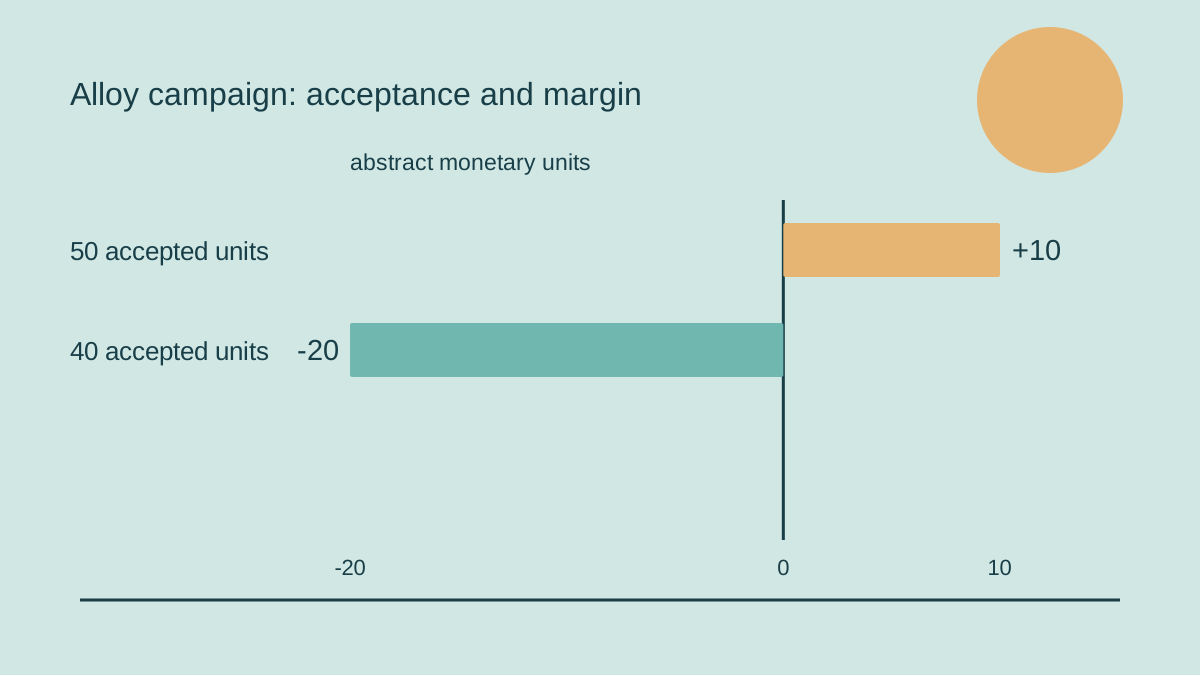
Under those simplified assumptions, the project needs more than 46.67 accepted units to cover the campaign cost. The point is not the particular threshold. It is that buyer acceptance can determine the economics even when the same production campaign has taken place. A material-development programme should therefore examine rejection and rework alongside the quantity it can produce.
Avoided treatment cost is a separate value
A residue-processing project may seek value from two sides: a customer purchases a product, and a residue holder may avoid some existing management cost. A proposal should identify whether both sources of value actually belong to the project. Neither should be counted simply because the process has been described as recycling.
If a residue holder pays a processing fee, the agreement would need to define the service covered and the obligations that remain with each party. If the project instead buys the residue, the financial direction is different. These alternatives affect revenue, working capital and responsibility for material that cannot be processed as expected.
The assessment should also guard against double counting. An avoided cost attributed to the residue holder is not automatically cash received by the alloy producer. A combined social or site-level benefit may be relevant, but it should be distinguished from the revenues available to finance a particular operating company.
Customer trials require time and material
Even if an early sample appears promising, a supplier would need to understand how the prospective buyer evaluates a new material. The required process may involve more than a single test. Its duration and sample demand belong in the project schedule and budget, rather than being treated as an incidental activity after construction.
During that period, output may not yet be sold at the price assumed for qualified commercial product. A financial model should make the distinction visible. Trial material, retained samples and production used for evaluation could carry costs without creating the same revenue as regular accepted deliveries.
These considerations do not imply that the reported alloys will fail qualification. They explain why a potential application is different from an established market. A credible next-stage proposal would show how evidence will be collected, what acceptance would mean and which decision follows if the customer requests a change.
Location affects the complete delivered cost
A process might be developed near the residue source, near an existing industrial site or near a prospective buyer. Each arrangement could place different activities inside the project boundary. A comparison should include the movement of incoming material and finished product, together with any intermediate handling that the proposed location requires.
The purpose is not to assume that transport dominates the economics. It is to prevent a laboratory production cost from being mistaken for a delivered product cost. A buyer purchases material at an agreed place and condition. Expenses required to reach that point should remain visible, even when they are paid by a different party.
The same applies to infrastructure shared with an existing operation. Shared equipment or services may support a proposal, but the model should state which capacity is available and how costs are assigned. A benefit from a particular location should not be transferred unchanged to another site without evidence.
Environmental benefit needs its own comparison
The research identifies a possible useful destination for a residue. Assessing environmental benefit would require a comparison between defined alternatives. The proposed route would need to be evaluated with its inputs, operating demands, product use and remaining management obligations. A valuable output alone does not complete that comparison.
The alternatives should also be described fairly. The assessment should identify what would happen to the residue without the proposed project and what conventional product the new alloy might replace, if any. Assuming replacement before a buyer has accepted the material could overstate the benefit attributed to the product.
No quantified environmental advantage can be calculated from the July announcement alone. That does not make the research unimportant. It means that material feasibility and a complete environmental comparison are different evidence tasks. Keeping them separate allows later measurements to strengthen the case without turning an early result into an unsupported lifecycle conclusion.
Working capital connects production with payment
A positive campaign margin would not establish that the project can pay its bills on time. Money may be required for incoming material, preparation, operating inputs, staff and transport before a customer accepts the finished product. The model would therefore need a cash timetable alongside its calculation of revenue and cost. This is a proposed assessment, not a description of the researchers' financing.
The relevant interval would begin when the project incurs an obligation and end when it receives the corresponding payment. Customer testing may extend that interval. So may retaining a disputed lot while the parties investigate a result. The same output could consequently have different funding requirements under immediate payment, payment after acceptance or payment after a further agreed period. The issue is not only the sale total but when funds become available for the next campaign.
A developer should also distinguish stock held for normal operations from material that is waiting for a decision. Combining them would conceal the reason cash remains tied up. A prospective financier would need to understand the expected amount, the assumptions governing its release and what happens when acceptance takes longer than planned. An annual profit forecast alone would not answer those questions. The financing timetable therefore needs its own assessment even when the complete-cost model already shows a positive result.
Contracts should identify who carries each uncertainty
A project connecting a residue holder and an alloy buyer could leave uncertainty between their agreements. The incoming material might have a definition different from the one assumed in the customer's product specification. Before committing to scale, the developer would need to establish whether these obligations are compatible. This is a commercial design question, not a statement of a particular legal requirement.
The agreements would also need to identify responsibility for material awaiting acceptance, an out-of-specification delivery and an interrupted operating campaign. The analysis does not prescribe a legal allocation. It asks that the allocation be explicit in the project account, because an obligation does not disappear when another party is assumed to handle it. Uncertainty can affect money, timing and the next delivery decision even when a technical trial succeeds.
Any proposal for fees or shared benefits should make the underlying service clear. Is the residue holder purchasing treatment, selling feedstock, or participating in a jointly developed operation? Is the customer buying qualified product or funding evaluation material? Different arrangements would change the financial model. Describing all of them as a partnership would provide too little information to understand who pays, who accepts and which party retains the unresolved risk. These differences need separate review before expected revenue is entered into the model.
Reporting units should survive the move between scales
A commercial update would need to explain the basis of its quantities. Incoming wet material, a measured dry residue and accepted finished product should not be combined under an undefined tonne. A project could report any of these measures usefully, provided the basis is clear and the accompanying comparison uses the same definition. Otherwise an increase in handled material might appear to be an increase in saleable product without evidence of that link.
The same discipline belongs in reporting value. A quoted price may concern material at the production site or product delivered to a customer. It may apply to an accepted specification or to an unqualified trial lot. An apparent change in price can therefore reflect a different transaction rather than an improvement in the process. The assessment should identify the scope before drawing a conclusion.
For progress reporting, a short record linking the period, quantity basis, acceptance status and cost boundary would be more informative than a single headline total. It would allow a later campaign to be compared with an earlier one without quietly changing the denominator. This would strengthen the investment discussion by making changes in qualification, yield or commercial terms visible instead of merging them into an unexplained margin. This supports a verifiable comparison but does not itself promise an improvement in any measure.
A staged investment decision can preserve options
A prospective developer could organise the next stage around a sequence of questions rather than a single large capacity announcement. The first stage would establish the feedstock and product requirement. The next would test repeated production and acceptance. A further stage would examine the complete operating boundary at a relevant scale.
- Define the incoming residue and the intended saleable product.
- Agree customer acceptance criteria and the evidence needed to meet them.
- Account for preparation, conversion, finishing and residual management.
- Compare accepted output and complete costs over the same period.
- Separate technical readiness, buyer qualification and investment approval.
Such a sequence would not guarantee a successful project. It would make the reason for proceeding, changing direction or stopping clearer. An unfavourable result at one stage can be useful if it prevents a later investment from depending on an assumption that has already been contradicted.
The next milestone is evidence of an accepted product
The July 2025 research offers a route worth investigating, while leaving commercial performance unestablished. The central business question is not whether an alloy can be named as an output. It is whether a defined operation can repeatedly supply material that a customer accepts, while covering the complete costs and obligations of processing the residue.
The strongest next update would therefore connect a specified feedstock, a reproducible product, customer evaluation and a complete operating account. It would identify what has been demonstrated and what remains an assumption. Until those links are established, a recycling business should remain a prospective application of the research, not a result presumed from the production of laboratory alloys.
Sources: Интерфакс Россия; University MISIS.




Leave a comment