
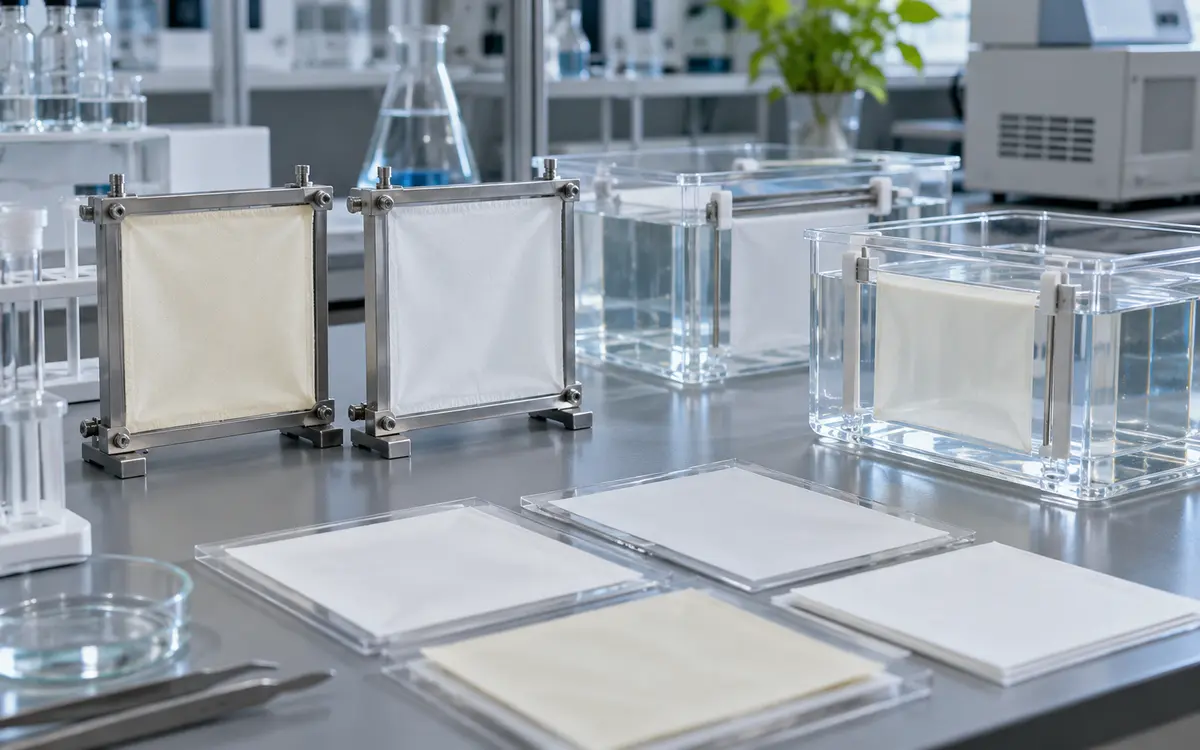
Scientists from three institutes of the Russian Academy of Sciences have developed a method for making flat polypropylene filtration membranes, Interfax reported on 8 July 2024. The work brings together the Institute of Solution Chemistry, the Institute of Petrochemical Synthesis and the Institute of Macromolecular Compounds. The announcement presents a research route towards domestic membrane production in Russia, rather than the opening of a manufacturing plant.
Changing how the porous structure forms
The method combines cooling with the action of a nonsolvent, a liquid used to induce separation of the polymer from its solution. In the original research abstract, the authors compare water, isopropanol, 1-hexanol and 1-decanol. Their central finding is that the choice strongly affects the thin surface layer facing the liquid bath, while its influence inside the membrane is less pronounced.
That distinction makes the study more specific than a general claim that one polymer can filter a liquid. It concerns how processing conditions shape the part of the membrane through which a substance must first pass. The chemistry of the starting material and the structure created during preparation are separate parts of the result.
A material study does not establish every use
The researchers describe the resulting materials as mainly suitable for microfiltration. That classification should not be confused with a promise to remove every dissolved substance from water. A membrane's suitability depends on what must be separated and under which operating conditions.
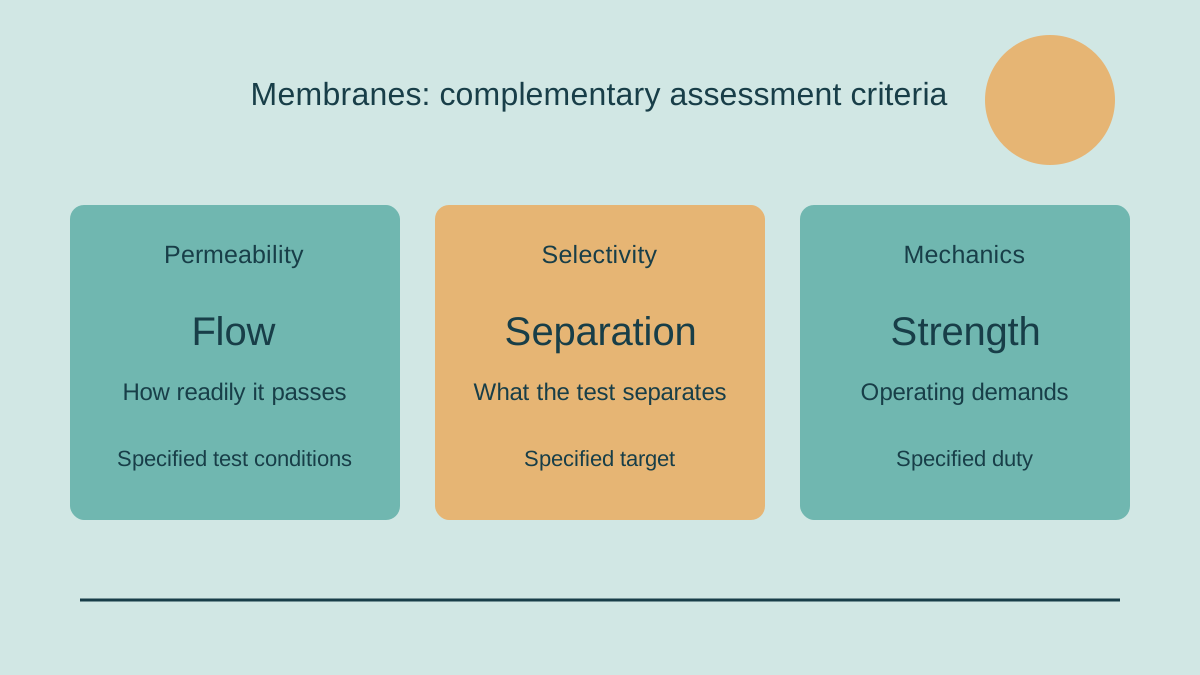
- Permeability describes how readily material passes through.
- Selectivity describes the separation achieved in a particular test.
- Mechanical properties describe whether the membrane can withstand its operating demands.
A useful comparison therefore needs all three kinds of information. A high flow alone does not establish good separation, and strong separation alone does not show whether a process has enough throughput.
From a preparation method to a product
Interfax reports that the authors hope to attract industrial interest. The announcement does not identify a commercial line, an agreed supply volume or a launch date. Those remain different questions from whether the laboratory method can produce a membrane. The reported advance is a way to control formation of the material; development of a reliable filter product would also require a specified duty, reproducible manufacture and testing in that duty.
Sources: Интерфакс-Россия; Institute of Solution Chemistry — original paper abstract.



Leave a comment