

A material that responds to visible light presents an interesting treatment question, but a treatment business must deliver an agreed result for an agreed stream. The distance between those propositions is the subject of qualification. It includes what is measured, what happens to the treated stream, how the material is managed and what the complete operation costs. A promising catalyst observation cannot supply all of those answers by itself.
On March 12, 2026, Interfax reported research in Novosibirsk, Russia, on modified titanium-dioxide photocatalysts made using sheep wool as a biological template. Researchers reported activity in organic-molecule degradation under visible light. The wool is burned out during manufacture; the proposal is not a wool filter installed in water treatment.
The following analysis concerns a possible wastewater application. It proposes questions for evaluating that application without claiming an operating installation, drinking-water approval or measured process economics. The reported laboratory premise is the starting point. The rest is a conditional framework for deciding what a treatment operator would need to know.
Define the stream before defining the product
A treatment proposal should identify its incoming stream and the condition required at the outlet. A general reference to organic contamination is too broad to become an operating commitment. The prospective operator needs a defined application, a measured starting condition and a stated endpoint against which a trial can be interpreted.
The proposed endpoint should belong to the customer's actual next use or handling step. An exploratory material test and an accepted treatment service are different deliverables. A trial may demonstrate enough to justify further research while leaving the customer's outlet requirement unresolved. That is a useful development result, provided the supplier does not describe it as completed commercial qualification.
The boundary should also state where the proposed operation begins and ends. If preparation, separation or later treatment is necessary to obtain the promised outlet, those operations belong in the proposal. They should not disappear merely because the new material is the most interesting part of the development.
Keep the observed molecule separate from the whole outlet claim
A measurement concerning a selected molecule answers a particular analytical question. The commercial conclusion should stay within that question unless additional evidence supports a wider statement. A decrease in a selected measurement should not, without a suitable basis, become a claim about every substance in the stream or every aspect of the outlet's acceptability.
A qualification plan should therefore specify the measurements needed for the intended endpoint and the interpretation of each. It should explain whether the claim concerns a selected compound, a broader measured property or the complete agreed outlet specification. This is an evidence requirement, not an assertion that the reported experiment observed any particular unmeasured product.
The parties should also decide how an ambiguous result is handled. If one endpoint improves while another remains unresolved, the trial report should preserve both findings. Declaring the operation successful on the basis of the favourable result alone would leave the operator unable to judge whether the delivered service meets its actual requirement.
Make the analytical record support the conclusion
The proposed trial should have a sampling and measurement plan before its outcome is known. The plan should identify the sampling points, the timing, the relevant method and how results below or near a measurement limit will be expressed. These choices help determine what the eventual comparison can legitimately say.
A missing value should not be silently treated as zero, and an unresolved result should not be converted into complete removal. The report should distinguish a measured change from a statement that the method cannot resolve the remaining quantity. This distinction protects the commercial interpretation even when the underlying material result is encouraging.
Where different methods are used before and after treatment, their compatibility should be explained. Otherwise an apparent change may be difficult to interpret. A customer should be able to trace the treatment claim back to the observations that support it rather than receive only a headline percentage disconnected from its measurement conditions.
Use comparisons that answer the application question
A proposed qualification programme should distinguish the contribution being claimed from the other conditions of the test. Relevant comparisons could examine the chosen illumination condition and the presence of the proposed material, provided the programme defines what each comparison is meant to establish. This is a request for an interpretable experiment, not a recipe for operating a reactor.
The comparison should use the stream and endpoint relevant to the application. A selected demonstration can help explain a mechanism while still requiring a separate customer trial. The commercial team should not replace that second task with a claim that the first demonstration represents every stream the operator might encounter.
The baseline treatment route should also be explicit. If the prospective customer already uses another process, the comparison should cover the same accepted service. A new material should not be credited with an advantage because its test omits an operation included in the baseline or uses a less demanding outlet condition.
Qualify the actual stream rather than its description
An application pilot should use a stream representative of the proposed service and record the range of incoming conditions it covers. The shared label wastewater does not establish that two trials represent the same purchasing question. If the incoming condition changes, the team needs a reason to believe the previous result remains applicable.
A prospective operator should therefore define the accepted incoming range and the response to material outside it. That response might be another qualification step, a different service agreement or a refusal to make the original claim. The choice belongs in the operating proposal rather than becoming an improvised explanation after an unsuccessful delivery.
Repeating a trial across the agreed range would help connect the laboratory premise to a commercial promise. The record should retain unsuccessful observations as well as selected successes. Without the full record, a buyer cannot determine whether the proposed endpoint is repeatable or merely achievable under one favourable selection.
Give illumination an operating account
The reported response to visible light creates a reason to investigate illumination choices. It does not establish that illumination is free or that a complete process has a lower energy bill. A commercial proposal would need to describe the chosen light arrangement and connect its operating cost to accepted treatment output.
If the proposal relies on natural light, its delivery assumptions should state how the service commitment is supported when the assumed illumination is unavailable. If it uses an artificial source, that source belongs in the capital, operating and maintenance account. Neither option can be evaluated from a material description alone.
The comparison should also avoid crediting the catalyst with a result caused by a changed test boundary. The relevant question is what the complete proposed route would require to deliver the same endpoint as the baseline. A visible-light response may become part of an advantage, but the advantage needs its own operating evidence.
Connect treatment time to accepted throughput
A treatment operation needs a schedule as well as an endpoint. The proposed trial should connect the time required for its accepted result to the quantity that can be delivered under the agreed conditions. A favourable observation without this connection does not establish production capacity for a service contract.
The schedule should include whatever preparation, exposure, checking and release the proposed route requires. It should distinguish equipment occupancy from waiting for an analytical decision. If release takes longer than the treatment step, the business may need capacity or inventory for that waiting period. Omitting it would overstate the rate of accepted delivery.
A capacity proposal should name the stream specification represented by its rate. Capacity established for one incoming range should not be transferred to a different range without evidence. This would keep a development forecast connected to the customer's actual service rather than to the fastest isolated observation.
Define how the catalyst belongs to the process
A prospective producer needs to choose the material form represented by its treatment proposal. A research material supplied for testing and a component ready for an operator's equipment are different commercial products. The delivery document should state what the operator receives, what preparation remains and what evidence applies after that preparation.
The treatment boundary should also explain how the material is retained or managed and what the outlet claim assumes about it. If another operation is required before the stream is released, that operation belongs in the service route. This does not assert that a particular separation problem occurred in the study; it identifies a responsibility that any complete proposal must resolve.
Changes in delivered form should be reviewed against the supporting evidence. An attractive handling arrangement cannot inherit a research result solely by using the same chemical name. The producer should establish whether the changed component still supports the endpoint before selling the original performance claim with a different physical product.
Treat repeated use as an additional claim
A claim about repeated use should identify what is repeated, what preparation occurs between uses and how acceptance is checked afterward. A single successful treatment observation cannot define the number of services that an operator can obtain from a delivery. The proposed reuse schedule needs evidence of its own.
If the plan includes a restoration step, its material use, energy, time and resulting output condition belong in the account. The operator should know whether that step is performed on site, provided by the supplier or still under development. An unqualified restoration proposal should not be treated as an available service simply to reduce the calculated cost of replacement.
The end of the material's accepted service should also be defined. The decision might depend on an agreed performance check or another supported release rule. Whatever the rule, the commercial model should connect the number of accepted services to it. Otherwise a low unit cost could depend on a lifetime that has not actually been established.
Include manufacture and residual management in the environmental question
The wool's role in manufacturing should be kept distinct from the treatment product. A biological template can be a research choice without making the completed process environmentally superior. A comparison would need the complete proposed route, a consistent accepted-output basis and evidence for the operations included within that boundary.
The account should cover making the material, preparing the service, operating it and managing its remaining streams. A proposed benefit at one stage should be presented at that stage until the full comparison is available. It should not be enlarged into a whole-process claim by omitting another operation whose requirements remain unknown.
Residual handling needs a defined destination and responsibility. A possible recovery route is not an actual recovery credit, and a proposed disposal arrangement is not a verified operating cost. Both should be supported before they enter a completed environmental or financial comparison. The research announcement alone supplies no basis for calculating a whole-process saving.
Calculate cost per accepted service
Consider an entirely hypothetical example in abstract accounting units, unrelated to the study's measurements. A trial costs 84 cost units and processes 40 service units. If 28 units meet the agreed endpoint, the cost per accepted unit is three. Dividing by all 40 units would give 2.1, but that figure would describe processed quantity rather than accepted service.
If only 21 units are accepted at the same total cost, the accepted-unit cost becomes four. This example gives no real water volume, pollutant concentration, light requirement or price. It illustrates why the endpoint must enter the commercial denominator before a material observation can become a claim about treatment economics.
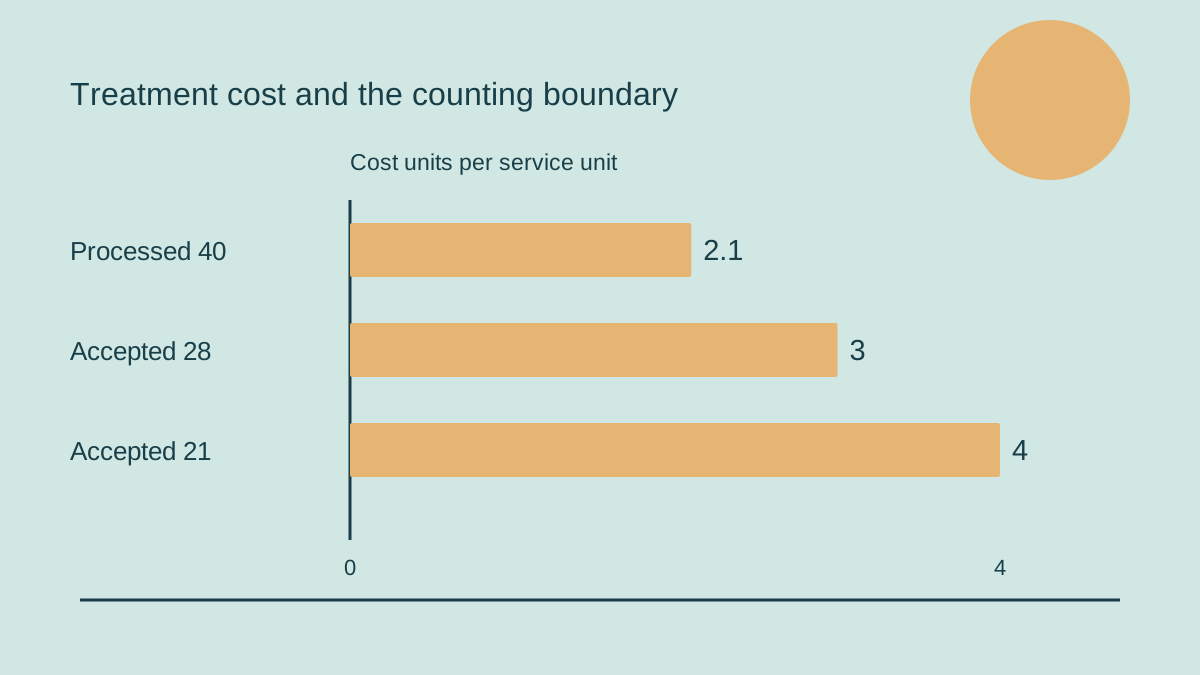
The complete calculation should identify development expenditure separately from repeat operating expenditure and explain the treatment of rejected output. It should also show whether any assumed reuse or recovery credit has been qualified. That transparency would let a buyer distinguish a verified operating proposal from a development model whose important inputs remain open.
Place the new step inside the customer's complete route
A proposed photocatalytic step should be evaluated in relation to the customer's existing treatment chain. The developer needs to identify which operation it would replace, supplement or enable, and what changes would be needed elsewhere. A component improvement may be valuable without replacing the entire system.
The comparison should preserve the same inlet and accepted outlet where it claims the same service. If the new proposal changes either boundary, the report should explain that change rather than present the costs as directly interchangeable. The buyer can then decide whether a different service is useful and what additional work it would require.
Integration time and responsibility belong in the pilot decision. A prospective operator should know who checks compatibility with the surrounding process and who authorises the first release. These are proposed purchasing questions, not evidence that a customer installation has been built or that the reported catalyst has entered routine operation.
Make the pilot's next decision explicit
A pilot should close a defined uncertainty rather than merely produce another demonstration. The supplier and operator should agree which evidence would permit a repeat trial, which would justify a service proposal and which would require a revised application. This turns development work into a sequence of assessable decisions.
- Define the incoming stream and accepted outlet.
- Specify measurements and comparisons before the result is known.
- Connect illumination, time and material management to accepted throughput.
- Account for reuse, manufacture and residual handling within their stated limits.
- Document the release decision and the conditions of a repeat service.
The agreed decision should remain attached to the exact material batch and configuration tested. A positive result can be valuable within that scope. Broadening it to another stream or service requires checking the changed claim, rather than treating the original pilot as evidence for every possible application mentioned in the research report.
Explain how shared equipment enters the comparison
A proposed installation may share equipment with other operations. The account should explain which cost belongs to the tested service and how that assignment is made. A trial that uses an available light source or an existing analytical service can be informative without representing the cost of a dedicated commercial installation. The difference should remain visible when development results are used in an investment proposal.
For a shared operation, the supplier and operator should decide whether the service requires additional capacity or uses capacity that would otherwise be available for another task. This is an accounting and scheduling question, not a measurement supplied by the research report. Assigning no cost merely because equipment is already present could hide a constraint on the buyer's other work. Assigning the whole cost to a small development trial could also obscure the intended comparison. A stated allocation rule would let the reader assess either choice.
The same transparency is needed when comparing a pilot with a projected larger service. The projection should identify which assumptions change, which observations remain applicable and which costs have not yet been checked. Larger scale should not be presented as proof that an unresolved operation becomes negligible. Instead, the proposal should state the remaining test and the consequence of a less favourable result. That would allow a commercial reviewer to understand where the estimate is supported and where the next decision still depends on new evidence.
Preserve the evidence when the product changes
A delivery identifier should connect the manufactured batch, the qualification record and the customer's receipt. If a supplier changes the preparation, material form or release test, it should state which earlier conclusions remain supported and which need review. A shared product name does not provide that review by itself.
The parties can agree a proportionate change procedure. Some changes may need only a document correction, while others may require a targeted comparison or a fresh application trial. The important point is to decide the category before the next delivery is represented as equivalent. This would prevent the evidence record from silently drifting away from the product being sold.
The useful next milestone is a complete application result linked to repeatable accepted service and its full operating account. If those elements can be demonstrated, visible-light photocatalysis would have a clearer treatment proposition for the chosen stream. Until then, the material remains a research candidate whose commercial and environmental implications need their own evidence.
Sources: Интерфакс Россия.



Leave a comment