
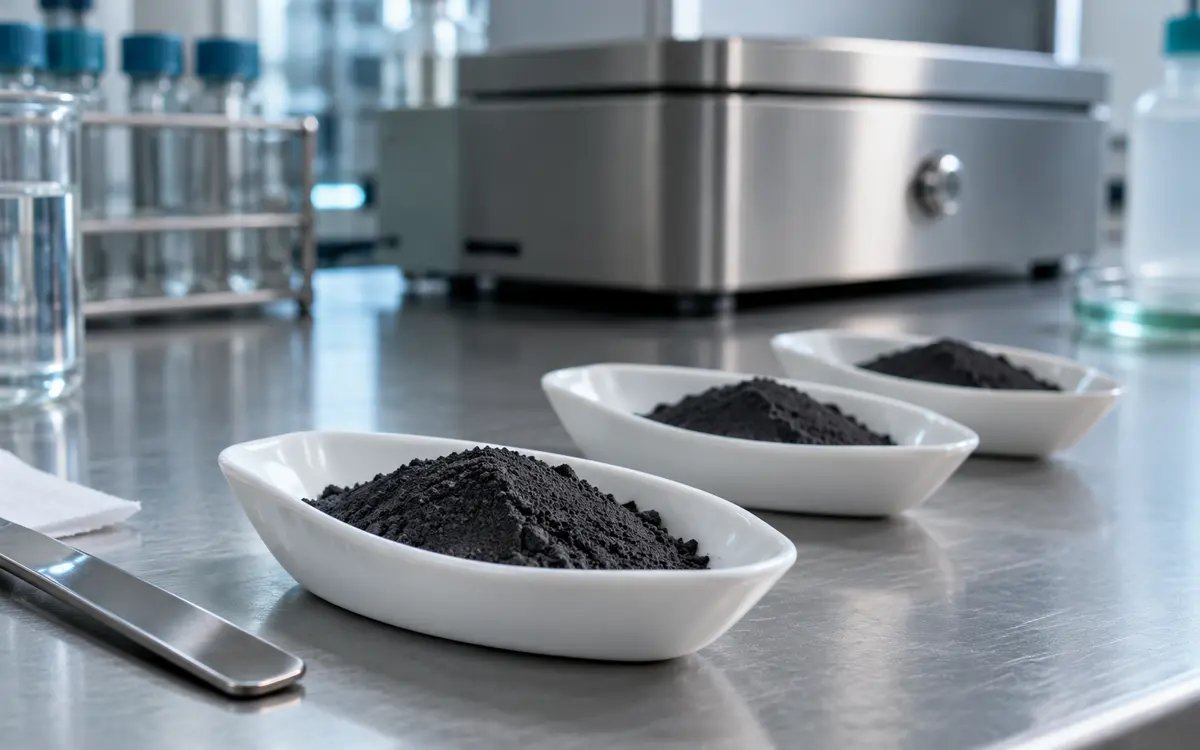
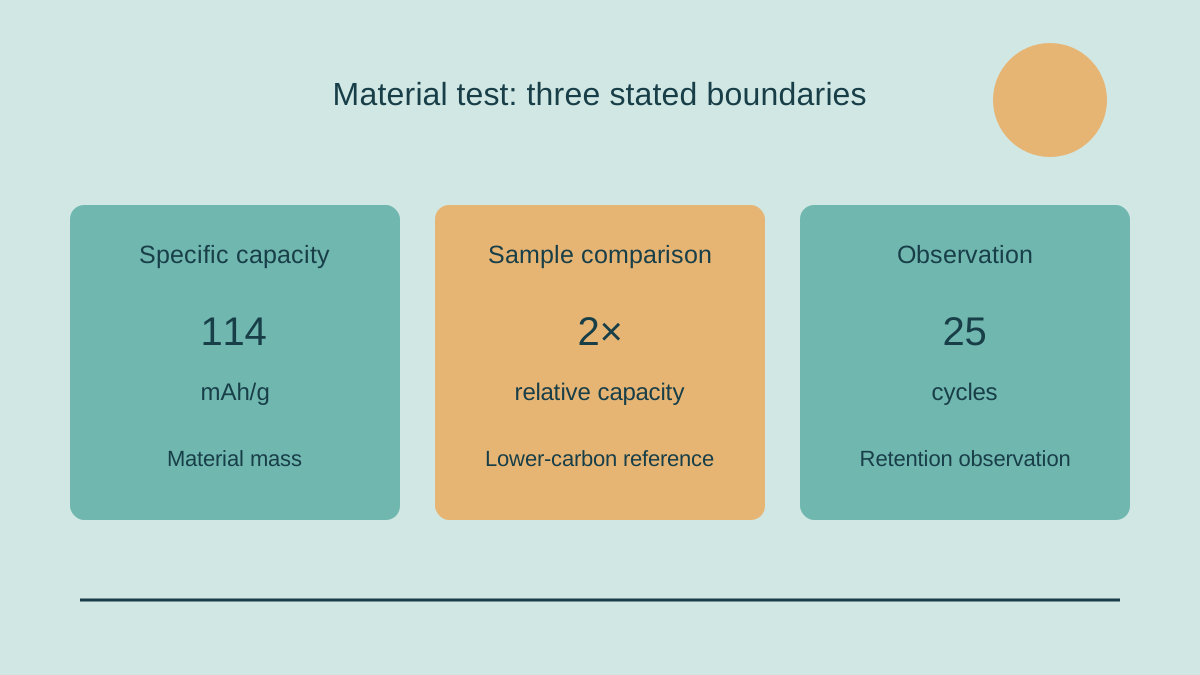
A June 15, 2026 Interfax report describes carbon-coated lithium vanadium phosphate studied in Vladivostok, Russia. The reported specific capacity was 114 milliampere-hours per gram, twice that of samples with less carbon. Researchers also reported full capacity retention after 25 cycles. These are material-test comparisons. Turning them into a claim about how long a gadget operates would require a separate, complete-device comparison.
Identify what the reported ratio compares
A statement that a result has doubled is incomplete without its reference. Here, the reported comparison concerns samples with different carbon content. A commercial reader should preserve that reference instead of silently replacing it with the battery already used in a phone or another device. The source supplies a reason to investigate the material; it does not establish a replacement comparison against every existing commercial battery.
The reference belongs alongside the result in any development discussion. A test record could identify the samples being compared and the basis on which their quantities were measured. If a partner later chooses a different reference, the resulting comparison would answer a different question. Both comparisons could be useful, but they should remain separately identified so that a favourable ratio does not acquire a broader meaning as it moves through a presentation.
Keep the mass basis visible
A capacity expressed per gram needs a defined mass basis. A proposed evaluation programme could specify which material is included in that denominator and how the quantity is determined. This is especially relevant to a comparison involving a changed coating, because the reader needs to know whether both samples have been assessed on compatible terms. The historical figure should retain its stated unit; it should not be relabelled as a complete battery energy density.
The next development record could distinguish the prepared material, an electrode containing that material and a complete cell. Each could have its own measured quantity and its own purpose. A favourable result on one basis would not automatically establish the result on another. Maintaining these separate records would let a partner see what has been demonstrated and identify the additional information needed before considering an application trial.
Use charge capacity without inventing an energy result
The reported specific capacity is not a complete record of energy delivered to a gadget. An application study would need to define the complete cell and the conditions under which its output is measured. That study would also need to identify the intended comparison. The material announcement does not supply those details, and they should not be filled in with an assumed commercial cell configuration or an invented operating result.
A programme could therefore keep the original material comparison in one record and place a proposed complete-cell comparison in another. The first would preserve the observed result and its reference; the second would state the evidence still to be collected. This structure would make the research useful without treating the absence of complete-cell information as proof of either success or failure. It would also make the next experimental question more precise.
Treat the cycle count as a boundary
The reported retention observation covers 25 cycles. Its cycle count is part of the result, not a detail that can be omitted when the finding is summarised. A statement about retention within that observation should not become a statement about indefinite operation. An industrial partner considering a later programme would need to define the duration and conditions relevant to its own question rather than assuming that the reported interval covers them.
A proposed longer evaluation could preserve the original observation while adding new records at defined stages. If a later result differs, the team could then ask whether conditions, sample identity or observation duration changed. Keeping the earlier and later records visible would be more informative than combining them into a single claim about life. The historical report does not establish a complete service-life assessment, and this analysis assigns none to it.
Define the intended device comparison
A device-runtime enquiry could begin by identifying the device, its operating task and the result to be measured. Without that definition, two runtime observations might reflect different workloads or configurations rather than a meaningful comparison of batteries. A development partner could specify which aspects of the device would remain unchanged and which proposed battery change would be evaluated. This would create a test question that can actually be interpreted.
The comparison would also need an explicit endpoint. A device operating until one defined condition is reached should not be compared against another device stopped at a different condition without explanation. This is a proposed framework for future evaluation, not a report that the researchers have tested a particular gadget. The material result alone does not establish a device configuration, an operating workload or a completed runtime observation.
A hypothetical runtime example
Consider a hypothetical device that operates for 10 hours under one defined workload. Suppose a proposed replacement arrangement is tested under a different workload and operates for 20 hours. These invented values are not results from the Vladivostok research. Although the second duration is twice the first, the comparison would not isolate the effect of the replacement because the workload changed. The ratio would therefore need a narrower description than a general claim of doubled runtime.
A second hypothetical comparison could hold the workload and endpoint constant, but it would still need records of the two complete arrangements being tested. The purpose of the example is to show that a runtime ratio requires its own experimental boundaries. It does not calculate a runtime from the reported material capacity, or suggest that the material has been installed in a commercial device. An interpretable application result would have to be observed within the defined comparison.
Record the coating change as a development variable
The carbon-content comparison provides a specific starting point for a development enquiry. A proposed programme could identify the prepared material and the procedure revision used for each sample. If further changes are introduced, the record could distinguish the coating-related change from other changes in preparation. This would help a partner understand whether a later observation belongs to the same comparison or to a revised development question.
It would be misleading to assume that the favourable sample establishes every possible coating arrangement. A programme could instead state which arrangement has been evaluated and what remains open. If a partner proposes another preparation route or another material combination, it would need its own record. The historical result would remain relevant as evidence of the reported comparison, while the partner's proposal would remain a separate question until evaluated.
Investigate independent preparations
A manufacturing discussion could ask whether separately prepared samples would show comparable results under a defined procedure. Repeated measurements of one sample and results from independent preparations should be distinguished. The first can help characterise an identified specimen; the second can contribute evidence about preparation repeatability. An apparently extensive dataset would be easier to assess if these relationships were visible instead of being combined under an undifferentiated sample count.
For each preparation, the record could identify the input lot, the procedure revision and the samples selected for assessment. It could also preserve deviations from the intended procedure. This would not amount to a claim that a commercial production process exists. It would provide a way to investigate whether the material result can support a repeatable development route, which is a different question from whether one selected specimen produced a promising observation.
Connect acceptance criteria to the next decision
A trial programme would benefit from criteria that correspond to the decision being considered. A criterion for sending a sample to a partner need not be the same as a criterion for approving a recurring supply arrangement. The team could identify the limited purpose of each decision and the evidence required for it. This would make an early acceptance meaningful without presenting it as final approval for every application.
- Identify the reference sample and preserve the basis of the reported comparison.
- State the mass denominator and keep material, electrode and cell records separate.
- Retain the observation duration and cycle conditions alongside retention results.
- Define a complete-device workload and endpoint before discussing runtime.
- Distinguish independent preparations from repeated measurements of one specimen.
These proposed checks are an original structure for discussing development evidence. They are not reported laboratory procedures, customer requirements or regulatory rules. Their role is to connect a claim to the information needed to assess it. A group and its partner could adapt the checks to an actual programme without implying that the historical article has already resolved the next-stage questions.
Keep rejected and uncertain observations visible
A trial can produce observations that are difficult to interpret or samples that do not meet the proposed description. Recording those outcomes would help distinguish a consistent route from a selected favourable case. The programme could explain why a sample was excluded and whether exclusion occurred before or after its result was known. That sequence matters when a partner considers how representative the surviving observations are.
An uncertain observation could be retained with its reason for uncertainty. A repeat measurement would then address an identified issue rather than serve as an opportunity to remove an inconvenient number. If two observations remain inconsistent, the record could say so and identify the proposed next investigation. Such transparency would make the material comparison more useful for a development decision even when it prevents a simple claim of universal performance.
Plan the sample handover
A prospective sample handover could connect the physical material to its identity, preparation record and intended evaluation. The receiving partner would then know which question the sample is meant to answer. A handover without that information could generate interesting observations that nevertheless cannot be connected to the reported comparison. A defined handover would support an interpretable programme without claiming an established commercial product or an available production quantity.
The participants could also agree how observations would be returned and how changes made by the receiving partner would be recorded. A sample modified after receipt should retain a record of that modification so that its result is not silently attributed to the original material. This is a proposed collaboration arrangement. It does not describe an existing service offered by the researchers or promise a particular response, quantity or timetable.
Separate application interest from safety approval
A promising capacity comparison can motivate an application enquiry without answering every question that an application would raise. A partner could identify the operating context and the evidence required for its own programme. The historical material observation should not be interpreted as an approval of a complete battery or a conclusion about safe use in a particular device. No such approval or safety outcome is reported in this analysis.
The same distinction applies to commercial availability. Interest in a potential application does not establish that qualified material, a complete cell or a finished device can be supplied. An enquiry could separate a research sample from a proposed development collaboration and from recurring production. Each would require its own confirmation. This would preserve the usefulness of the reported result while avoiding an unsupported transition from laboratory interest to a product claim.
Assess the next investment through a defined uncertainty
A prospective development commitment could be framed around the uncertainty it is intended to resolve. For example, the next programme might investigate preparation repeatability or a defined electrode arrangement. It need not attempt to answer every commercial question at once. The investment discussion could identify the required record, the decision it would support and the limitations that would remain even after a favourable result.
This approach would prevent a favourable material ratio from becoming the sole justification for an assumed production outcome. It would also avoid dismissing an early result because a finished gadget has not been demonstrated. The relevant question would be whether the proposed next work can produce useful evidence about an identified development step. A clear answer could support continuation, revision or a pause in that particular programme without changing what the original material experiment reported.
Preserve a useful result without enlarging its claim
The reported cathode comparison is most useful when its reference, unit and observation duration remain attached to it. These details make the finding a defined starting point for further work. Removing them might produce a more dramatic sentence, but it would make an industrial decision less informed. A complete-device runtime claim would need evidence collected for that purpose, rather than an inference from a material capacity ratio.
The next practical record could connect the material sample, the preparation comparison, the proposed electrode or cell evaluation and the application question. Such a record would let a partner follow the development reasoning without assuming an operating factory, a qualified battery or a demonstrated gadget benefit. The central question remains whether a promising material comparison can survive a sequence of defined, interpretable evaluations and support an application-specific conclusion on its own evidence.
Sources: Интерфакс Россия.



Leave a comment