

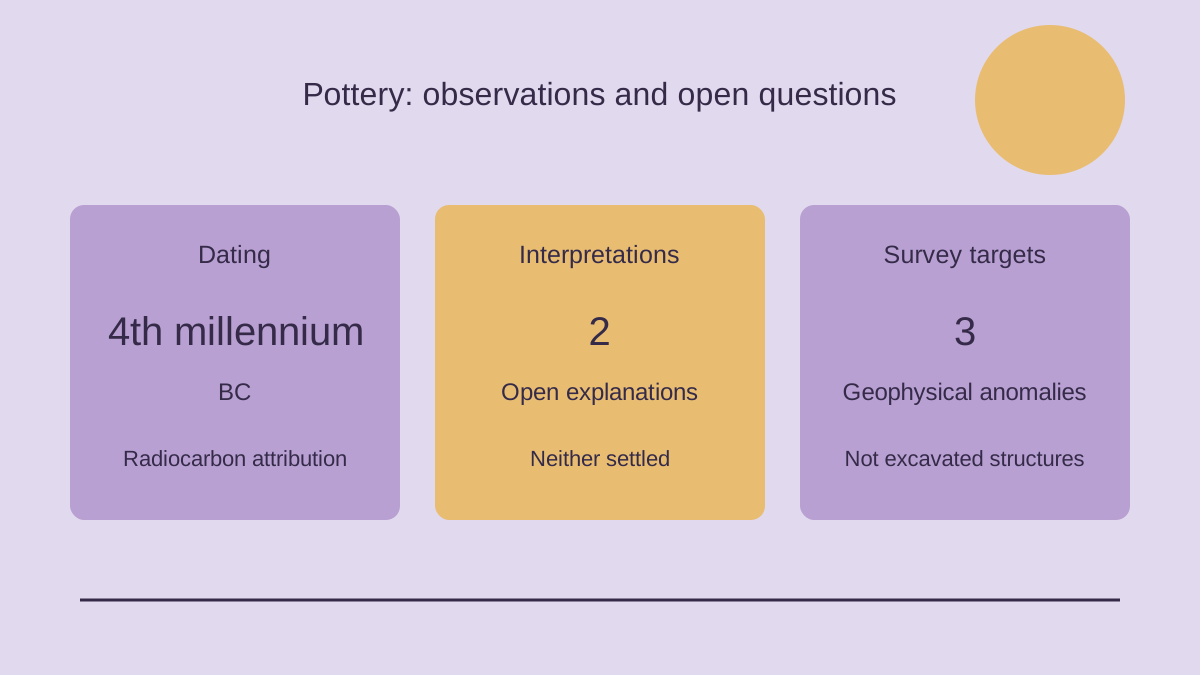
Unusual pottery from the Ust-Tartas site in the Novosibirsk region of Russia has raised a question about cultural classification. Speaking to journalists on 20 November 2025, archaeologist Vyacheslav Molodin described two possibilities: a previously unrecognised culture or an early stage of the Ust-Tartas culture. Interfax reported flat-bottomed vessels with textile impressions and a checkerboard-like ornament. Molodin placed the pottery in the fourth millennium BC on the basis of radiocarbon dating. He also reported three nearby geophysical anomalies.
A find and its interpretation
The significant feature of the announcement is the coexistence of a concrete find and an open explanation. The pottery has been described, but its place in the cultural sequence has not been reduced to a single conclusion. Calling the discovery proof of an entirely new culture would remove the alternative that the researcher explicitly retained.
The two explanations would lead to different comparisons. An early phase of a known culture would need to be considered alongside its later material. A separate cultural grouping would require an account of what distinguishes it. The unusual appearance of an object makes that comparison worthwhile; it does not, on its own, tell the reader which explanation should prevail.
Questions for the next stage
Three questions help separate the reported observations from the interpretation still being developed:
- Which characteristics recur across the vessels, rather than appearing on a single object?
- How do those characteristics compare with material already assigned to the known culture?
- What will investigation of the nearby anomalies add to the context of the pottery?
These are questions raised by the report, not claims that the answers are already available. In particular, an anomaly identified by a survey is a target for investigation. It should not be described as another excavated structure before the relevant field evidence has been presented.
Dating does not settle every classification question
A date gives the discussion a chronological position. Cultural attribution asks an additional question about how the material relates to other finds. Keeping the two apart avoids turning a reported age into automatic confirmation of a cultural label.
The announcement consequently adds an important problem to the study of the site rather than closing it. Further evidence could strengthen one explanation, change the comparison or require a more cautious description. Preserving that uncertainty is part of reporting the discovery accurately.
Source: Interfax, 20 November 2025.
Sources: Интерфакс.






Leave a comment