
A prototype can be an important scientific achievement without yet being a replacement that another laboratory can install with confidence. The difference lies in the evidence accompanying it. A comparison must say what was measured, under which conditions, against which reference and with what remaining uncertainty. Otherwise, an encouraging result can travel much further in a headline than it can in an engineering decision.
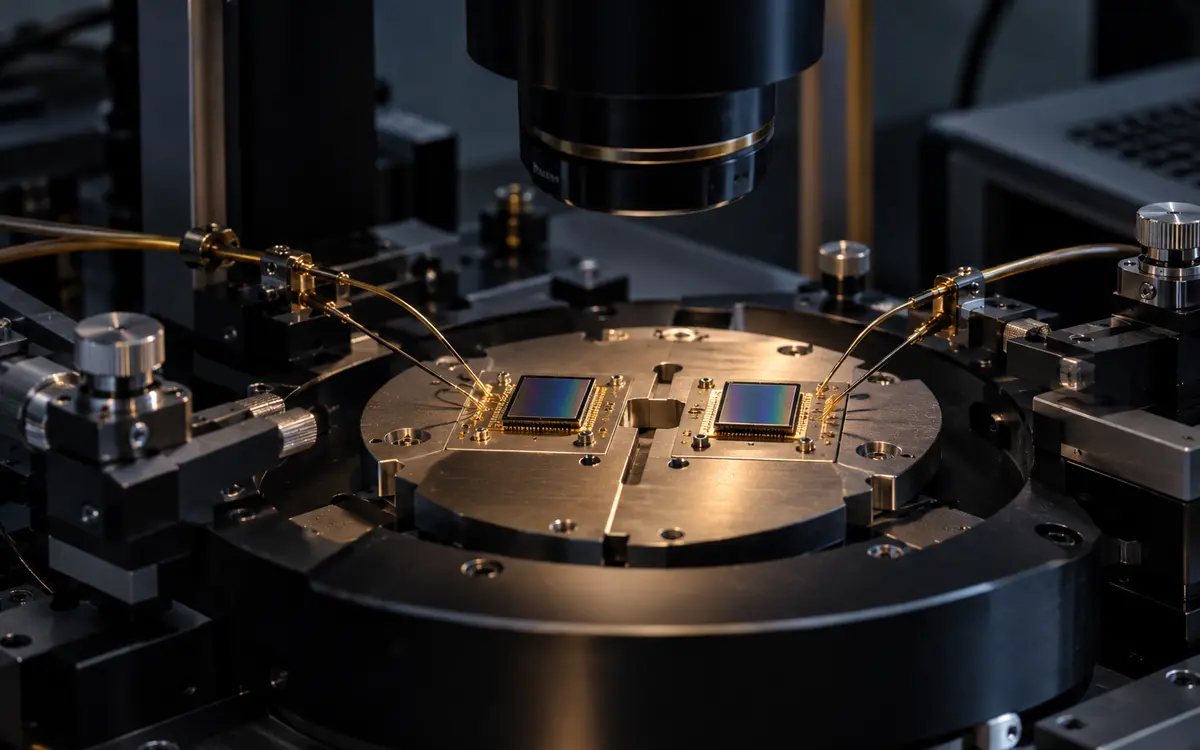
On 27 November 2024, Interfax reported that researchers at Tomsk State University had developed silicon microstrip sensors for detectors intended for SKIF in Russia. Prototype detectors assembled by the Budker Institute of Nuclear Physics were undergoing tests. This was a report about development and evaluation, not a declaration that every intended application had been qualified.
The university's account supplied a useful detail: researchers were comparing current–voltage characteristics of a domestic prototype and an overseas counterpart. That makes the announcement a starting point for a broader question. How should a comparison of physical devices be organised so that its conclusion remains meaningful outside the team that performed it? The framework below is an editorial analysis of that question, not a description of undisclosed results from these trials.
Start with the decision the measurement must support
“Does the new detector work?” is too broad to be a useful acceptance question. A development team might need to decide whether to proceed to another prototype. A beamline team might need to decide whether to schedule a trial. A purchasing team might need evidence before accepting a production batch. Those decisions require different levels of confidence and different supporting records.
A useful first statement would identify one intended use and the property that matters for it. For example, a team might ask whether a prototype's electrical response stays within an agreed envelope during a defined laboratory test. Passing that test could justify the next experiment. It would not automatically establish performance under every radiation exposure, mounting arrangement or operating schedule.
Writing the decision before collecting results also limits retrospective enthusiasm. If a device performs impressively on one characteristic but misses the characteristic needed by the user, the original requirement remains visible. The team can revise its design or its intended application without pretending that a different success answered the original question.
Keep the sensor, assembly and result separate
A sensor is not the whole measurement chain. It sits inside an arrangement that may include connections, a power supply, readout electronics, software and a method for interpreting the recorded signal. A statement about the final output therefore needs to identify the configuration that produced it. Changing one element can change the meaning of the comparison even when the sensor itself is unchanged.
Consider a hypothetical laboratory that compares two sensors using different readout settings. If one output fluctuates less, that observation alone does not isolate the cause. The difference might belong to the sensor, the electronics or the settings. A carefully documented comparison would either hold the relevant elements constant or explain why differing configurations are appropriate to the intended use.
This distinction is practical for later handover. The receiving laboratory needs more than a component label. It needs to know which assembly and settings the evidence describes, and which changes would require another check. Configuration records turn a successful demonstration into something that can be examined and repeated.
A comparator is useful without being an absolute reference
An established device can provide a valuable comparison because users already understand its behaviour in an application. Yet agreement with that device does not by itself establish an absolute value for the quantity being measured. Both devices could share a common influence or be interpreted through the same unsuitable procedure.
The NIST measurement handbook describes calibration as relating an instrument's response to reference standards or a designated measurement process. That distinction helps separate two claims: matching a comparator and establishing a measurement relative to a reference base. A report should state which claim its experiment actually supports.
For an early development test, relative comparison may be exactly the right objective. It can reveal whether a new device behaves differently under matched conditions and identify where investigation should concentrate. The limitation is not a reason to dismiss the test. It is a reason to name its purpose accurately and avoid presenting relative agreement as a complete calibration certificate.
Define the tested range before showing a smooth curve
A graph can look persuasive while covering only a narrow part of the range that matters to a future user. The horizontal axis, test points and operating conditions therefore deserve as much attention as the appearance of the fitted line. Readers need to distinguish measurements taken within the tested range from values inferred beyond it.
Suppose, purely as an illustration, that two devices agree at three central settings but no measurements were collected near either operating limit. That result supports a statement about the measured settings. It supplies no direct observation of the endpoints. Extending the same line across the entire diagram would make the presentation more complete visually while leaving the evidence unchanged.
The handbook's discussion of calibration data collection stresses coverage of the relevant range and repeated measurements. These principles do not provide a universal test schedule for a particular detector. They do explain why a comparison report should make its coverage explicit and why an attractive curve cannot substitute for a record of where data were actually collected.
Arrange comparisons so that time does not choose the winner
Imagine testing device A early in a session and device B much later. If the surrounding conditions change between those measurements, the difference between outputs combines a device difference with a time difference. A report that treats the entire difference as a property of the devices would be drawing a stronger conclusion than the arrangement supports.
One possible design is to alternate measurements between devices while recording relevant conditions. Another is to repeat a reference measurement before and after each sequence. The appropriate arrangement depends on the equipment and the scientific question. The central requirement is to identify what could change during the comparison and make that change observable.
This is especially useful when a team receives an unexpected result. A time-stamped sequence can help distinguish a repeatable device effect from something associated with a particular session. Without the sequence, investigators may have only two averages and no way to reconstruct why those averages differ.
Distinguish an offset from variable behaviour
Two simple hypothetical examples show why one headline measure is insufficient. In the first, a device repeatedly reports 102 units when the designated reference value is 100. In the second, repeated readings alternate between 96 and 104 units. The second example has an average of 100, but its individual readings vary more. These invented numbers describe different measurement problems.
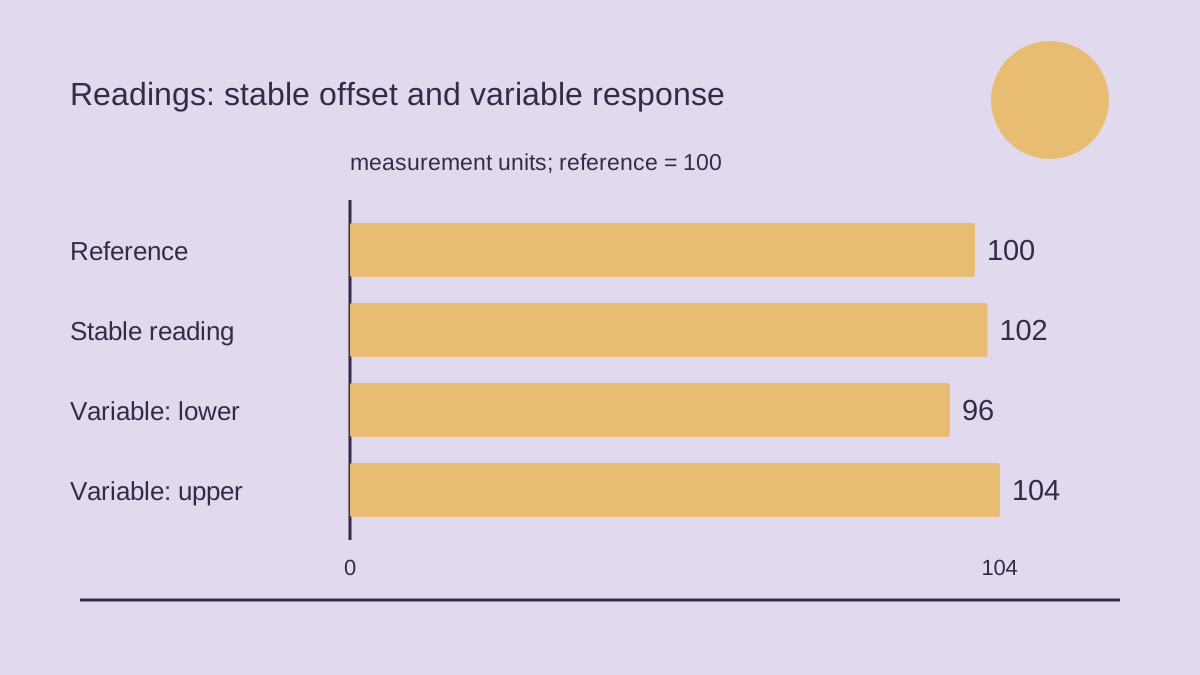
A correction for a stable offset and a response to unstable readings are not interchangeable actions. Subtracting two units could address the first example under its stated assumptions. The same arithmetic would not remove the variation in the second. The NIST handbook similarly warns that calibration does not inherently improve an instrument's precision.
A comparison should therefore retain both the central result and the variation behind it. That gives the next team a chance to judge whether the observed behaviour fits its purpose. An average presented without the underlying spread can conceal information that matters more to the user than the average itself.
Look at what the model leaves unexplained
Fitting a curve is a way to summarise observations. It is not a reason to stop examining them. A model can follow the overall trend and still miss a pattern that becomes visible when measured values are compared with fitted values. The remaining differences help show whether the model is simplifying the data in a useful way or hiding a systematic mismatch.
The handbook recommends examining residuals during model validation. For a detector comparison, the practical editorial question is straightforward: can a reader inspect the disagreements as well as the successful fit? A chart of the main relationship and a record of departures from it serve different purposes, and one should not silently replace the other.
An unusual observation should also remain traceable. Investigators may discover a documented equipment fault or transcription error, but deleting inconvenient points without an explanation changes the evidential record. A reproducible report records exclusions, reasons and the effect of those choices on the conclusion.
Do not let the average hide individual channels
Where a device contains multiple measuring elements, an overall average may answer a different question from the one an application asks. A hypothetical assembly with mostly similar channels and one unusual channel can have an acceptable mean while still creating a problem at a particular location. Whether that matters depends on the intended measurement and the agreed acceptance rule.
This does not mean that every early report must publish an exhaustive channel catalogue. It means that the level of aggregation should be deliberate. If the eventual user needs consistent behaviour across an array, the development programme should eventually provide evidence at that level. If a limited subset is sufficient for an experiment, the report should identify that subset.
The same reasoning applies to selecting a particularly successful specimen. A result from one assembly is evidence about that assembly. Extending it to every future unit requires further evidence about manufacturing consistency. Prototype performance and batch acceptance are related questions, but they are not the same decision.
Write an acceptance rule that another team can apply
A useful rule connects the intended use, measured property, tested conditions and decision threshold. It also says how uncertainty and incomplete evidence will be handled. The threshold should come from the requirements of the application, rather than being chosen after seeing the most flattering result.
A concise acceptance record could answer the following questions:
- Which device and configuration were evaluated?
- Which property was compared, and against what reference or comparator?
- Which range and conditions were covered?
- What repeated measurements and exclusions underlie the result?
- What next action does the evidence permit, and what remains untested?
These questions create a boundary around the conclusion without reducing the value of the work. A prototype may legitimately pass a development milestone while remaining unsuitable for routine deployment. Recording that milestone precisely makes progress easier to evaluate and prevents later readers from mistaking an intermediate decision for final qualification.
Preserve the route from raw readings to the conclusion
A later reviewer should be able to follow how recorded observations became the published comparison. That requires retaining raw readings, units, configuration identifiers and the processing steps used to produce the final figures. A spreadsheet containing only the last average is a weak substitute for that chain.
Software versions and analysis settings matter because they form part of the calculation. If a team changes a correction or a filtering choice, it should be possible to identify which results used the old method and which used the new one. Otherwise, a later comparison can accidentally mix incompatible outputs while keeping the same column heading.
The handover package need not be complicated to be useful. Clear filenames, an explanation of the columns and a short account of the processing can greatly improve reviewability. The important feature is that another technically competent person can reconstruct the result without relying on the memory of the original operator.
Treat repeated checks as part of using the result
A comparison describes a measurement system at a particular stage. A receiving laboratory should identify which later changes would make the original evidence insufficient for its purpose. Replacing electronics, changing the mounting arrangement or adopting a new analysis method are examples of changes that may deserve review; they are not claims about what happened in the reported prototype project.
The handbook's discussion of calibration failures highlights the importance of stable response over time. For the present analysis, the implication is organisational as well as technical: somebody must own the decision to recheck a configuration. A report that is carefully produced but never connected to change control can gradually lose its relevance while continuing to circulate as proof.
This is why an evidence package should carry a version and a defined scope. It tells users both what they may rely on and when they should ask for an updated comparison. Maintaining that connection is part of making research usable.
What the November announcement establishes
The reported work places prototype sensors and detector testing on the development path. The university's description identifies an electrical comparison being conducted, which is more informative than an unsupported claim of universal replacement. It does not publish the complete measurements, acceptance thresholds or application-wide qualification needed to settle every question raised above.
The next useful evidence would therefore be a scoped result that another team can interpret: a defined configuration, a clear comparison method and a conclusion limited to the tested conditions. That would allow the significance of the prototype to rest on inspectable measurement work, while keeping the remaining development tasks visible.
Sources: Интерфакс Россия; Томский государственный университет; NIST/SEMATECH measurement handbook; NIST — calibration data collection; NIST — calibration failure modes; NIST — model validation.





Leave a comment