

Computing and swimming appear to belong to different parts of the economy. Put them in neighbouring rooms, however, and one activity can supply something the other needs: heat. Octopus Energy's generation arm announced a £200 million investment in Deep Green on 15 January 2024. Its statement describes supplying recovered computing heat to pools while obtaining cooling for servers. The Guardian reported the investment that day. The announcement raises a practical question for the United Kingdom: what must be true for this exchange to become a dependable local service?
The following analysis considers that operating model as it stood at the announcement. It does not assume that planned installations have been completed or that a funding headline represents money already spent at every location. A useful assessment has to follow the heat, the computing service and the contracts separately, then examine where they meet.
Two services share a physical interface
A pool operator buys the ability to maintain suitable water and building conditions. A computing customer buys processing, storage or another digital service. Neither normally wants to become responsible for the other business. Heat recovery introduces a connection between them without removing their different priorities. A pool cannot simply accept any temperature or interruption, and a server operator cannot promise that every workload will follow a leisure centre's timetable.
The relevant economic benefit is the heating expense that the pool actually avoids, together with any cooling expense avoided by the computing operation. These benefits must be compared with the added cost of connecting, controlling and maintaining the arrangement. A warm pipe is evidence of heat transfer. It is not, on its own, evidence that the combined service costs less over its lifetime.
This distinction helps explain why a partnership can be promising without being automatic. One party may save money while the other pays for extra equipment. The commercial agreement has to make the exchange sustainable for both. Otherwise a successful engineering demonstration could leave an unresolved funding problem once repairs, insurance or renewal become necessary.
Useful heat is the quantity that matters
Heat produced by equipment, heat captured by a recovery system and heat that displaces another source are three different quantities. Some energy may be unavailable at the required time or temperature. Some may be lost between the equipment and the pool. Some may reach a building that does not need it. Evaluating only the first quantity would overstate what the pool receives.
A clear measurement boundary therefore matters. The parties could meter energy at the transfer interface and separately record what reaches the heating circuit. They would also need a way to identify when the existing boiler or another backup source provides heat. This makes it possible to distinguish a functioning recovery unit from a reduction in purchased fuel.
Temperature is part of the product. A volume of warm water with little temperature difference from the receiving circuit may have a different practical value from the same energy delivered at a more useful temperature. A site assessment should establish the temperatures required for each duty and identify whether additional equipment is needed. No conclusion about that equipment can be drawn merely from the investment amount.
Matching demand hour by hour
Annual totals can conceal a poor operational match. A computing unit might produce substantial heat over twelve months while the pool needs much of its heating at different times. The relevant comparison is the overlap between available recoverable heat and demand at a useful temperature. A building's operating calendar, cleaning closures and maintenance periods should therefore be considered alongside the computing schedule.
Consider an entirely hypothetical hour. Suppose a unit offers 100 kilowatt-hours of usable heat at the agreed interface, but the receiving system needs only 70. Without another user or suitable storage, at most 70 can displace heating during that hour. The remaining 30 should not be counted as a pool saving. These figures illustrate an accounting method; they are not measurements of a Deep Green installation.
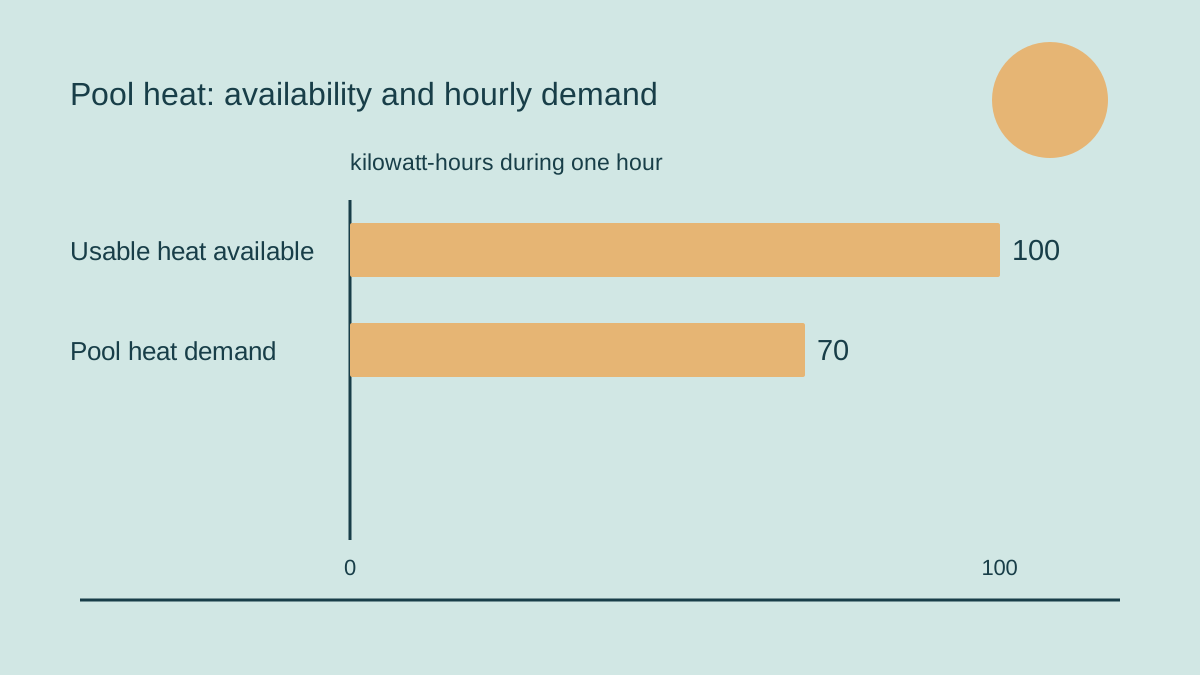
If demand instead reaches 120 kilowatt-hours, the same offer leaves a 20 kilowatt-hour requirement for another source. The arrangement might still provide substantial value, but backup remains necessary in this example. Both cases show why a single percentage for annual heat recovery says little about what happens during a difficult hour.
Storage could change the match by moving heat between times, but it would introduce capacity limits, losses and another maintenance responsibility. It should be evaluated as part of a particular design. It is not reasonable to assume that storage solves every mismatch, or that every leisure centre has the space and budget for it.
The computing customer remains a customer
Locating servers beside a pool does not alter the basic questions a business asks about a computing service. Can it obtain the required performance? Who supports it when something fails? What happens to data during maintenance or a change of supplier? The heat arrangement may improve the economics of a location, but the computing offer still has to satisfy its own users.
A potential customer would need to assess connectivity, security arrangements, service continuity and the suitability of the offered workloads. These are evaluation questions, not claims that the announced project has shortcomings. They prevent a heat benefit from being treated as a substitute for a complete digital service specification.
The provider also needs to understand the effect of workload changes on the heating side. If processing demand declines, the heat available to the pool could change. A contract might define a minimum service, a notification procedure or another response. The appropriate arrangement depends on the actual business model. The investment announcement alone does not reveal those terms.
Procurement starts with responsibilities
For a pool operator, an attractive offer should lead to a site assessment and a responsibility map. Equipment ownership, access rights, maintenance duties and the cost of auxiliary electricity need to be identified. These details determine whether the proposed saving remains a saving after all relevant expenses are included.
Access deserves particular attention because a leisure centre is a working public building. A computing maintenance visit and a swimming lesson can compete for space, parking or staff attention. The agreement should explain who authorises access, how work is scheduled and which party restores any affected building services. Such practical arrangements belong in the operating plan before installation begins.
A public purchaser would also want a clear account of alternatives. Continuing with existing equipment, upgrading heating controls or procuring another heat source might produce different costs and risks. Comparing options using the same time period and service requirement helps avoid a decision driven only by a striking investment headline.
A heating saving needs a credible baseline
To estimate avoided expenditure, the operator needs an account of what would otherwise have been purchased. Last year's bill may be a starting point, but a bill combines usage with prices. A price change can lower expenditure without reducing energy demand, while an increase in opening hours can raise consumption even after an efficiency improvement.
A better comparison would record relevant conditions: operating hours, water temperature requirements, attendance patterns where useful, outdoor conditions and changes in other equipment. The aim is not to build an unnecessarily elaborate model. It is to avoid attributing every movement in expenditure to the recovery system.
The operator should distinguish gross avoided heating costs from net financial benefit. Auxiliary power, servicing charges, building modifications and any contract payments can affect the latter. If heat is offered without a separate charge, that describes one term of the exchange; it does not prove that every associated activity is costless.
Reporting both energy and money helps readers understand the result. Energy data describe the physical change, while financial data show the effect of tariffs and contractual terms. Publishing only a percentage reduction makes it difficult to compare sites with different sizes, opening schedules or starting costs.
Continuity requires a plan for both sides
The partnership joins two systems that may need maintenance at different times. A heating interruption can affect pool operations, while an equipment interruption can affect computing customers. A shared incident procedure should identify who receives alarms, who diagnoses the problem and which party is allowed to change settings.
Backup arrangements need to be tested against an ordinary failure scenario. If the computing equipment stops providing heat, can the pool maintain its required service? If the pool closes or cannot accept heat, can the computing equipment continue operating safely? These are separate questions. Solving one does not establish that the other has been solved.
The answer might involve existing heating equipment, an alternative cooling route or a temporary operating restriction. This analysis does not prescribe a particular technical solution. It identifies the obligation to define and verify a solution at each site, including the resources needed to use it during an actual incident.
The environmental comparison has boundaries too
Using heat that would otherwise be rejected can reduce the need for another heating source. A defensible environmental assessment nevertheless needs to specify the comparison. What heating source is displaced? What additional electricity does the recovery arrangement require? Would the computing workload have run elsewhere, and under what conditions?
These questions matter because the pool and the computing provider could both claim benefits from the same exchange. A shared accounting method should explain which outcome is counted by each party and avoid presenting a single avoided emission twice as two separate reductions. The appropriate treatment depends on the assessment boundary and purpose.
No precise carbon saving follows from the investment amount. An installation count is also insufficient. A measured quantity of useful heat, an identified displaced source and a documented electricity requirement would offer a stronger basis. Until those are available, environmental potential should remain a conditional description rather than a site-specific numerical result.
Scaling means finding compatible sites
A repeatable equipment design can help expansion, but sites are not interchangeable. Electrical capacity, space, heating circuits, connectivity and access arrangements may differ. A deployment pipeline should therefore separate an interested operator from a technically assessed site, an agreed contract and an installation that has completed commissioning.
Counting each stage separately would show where the model encounters friction. A large number of enquiries with few qualified sites might point to unsuitable buildings. Qualified sites without contracts might indicate unresolved commercial questions. Installed units without reliable measured heat would require an operating response. These are possible diagnostic patterns, not reported outcomes for this company.
Financing should be assessed against the same stages. Funds committed to a business, equipment purchased and cash spent on commissioned projects are different measures. A funding announcement can support the opportunity to expand without demonstrating how quickly buildings will be connected or how much benefit each will receive.
What an operator should ask before signing
A concise decision file can turn the idea into an assessable proposal. It should contain the site's existing heating baseline, the expected heat profile, a computing service specification and a schedule of responsibilities. Assumptions should be visible so that an operator can revise the estimate when actual operating data arrive.
- Define the heat delivery interface, required temperature and metering method.
- Compare hourly heat availability with the building's demand and closure calendar.
- Identify all added expenses and the party responsible for each.
- Specify backup, incident response and maintenance access for both services.
- Agree how savings will be calculated and when performance will be reviewed.
- Document equipment ownership, contract changes and arrangements at the end of the agreement.
Exit terms belong in the proposal because buildings and computing equipment can have different renewal schedules. If the contract ends, the pool needs to know how its heating service will continue and who pays for removal or restoration work. A clear exit arrangement can make the initial partnership more credible by reducing uncertainty for both sides.
Commissioning should produce an operating record
The point at which equipment begins transferring heat is a useful milestone, but acceptance should describe what was tested. A commissioning record could identify the conditions under which the interface delivered the agreed temperature, how controls responded to changing demand and whether the backup sequence worked. This would give subsequent maintenance staff a reference for normal operation.
Training should also have an owner. Pool staff need to understand which indicators they can monitor and which settings require a specialist. Computing staff need to know how a building closure or heating fault is communicated. An instruction that depends on one person's memory is vulnerable when that person changes role or is absent.
A review period can connect commissioning to commercial evaluation. Rather than decide from a short demonstration, the partners could agree a period covering relevant variations in demand. The resulting record should separate downtime, unavailable heat, unused heat and backup heating. This makes a disappointing result easier to diagnose and a good result easier to substantiate.
There is also value in agreeing the format of information before collecting it. Meter readings without timestamps may be difficult to match with opening hours. Incident records without a description of the affected service may obscure the consequence. A modest, consistent set of records can therefore be more useful than a large collection of measurements that cannot be compared. These are suggested acceptance practices, not a description of an existing company contract.
A local exchange must earn its place
The January announcement provides a reason to examine heat recovery as a business relationship between computing and public leisure facilities. Its strongest potential lies in giving a by-product a nearby use. The practical test is whether that use remains dependable and worthwhile under the actual site's operating conditions.
A good project would demonstrate useful heat at the agreed boundary, a reliable computing service and a net benefit measured against an explicit alternative. It would also remain understandable when one system is being serviced or the other changes its schedule. Those are the conditions that turn an appealing exchange into infrastructure an operator can rely on.
Sources: The Guardian; Octopus Energy.






Leave a comment