
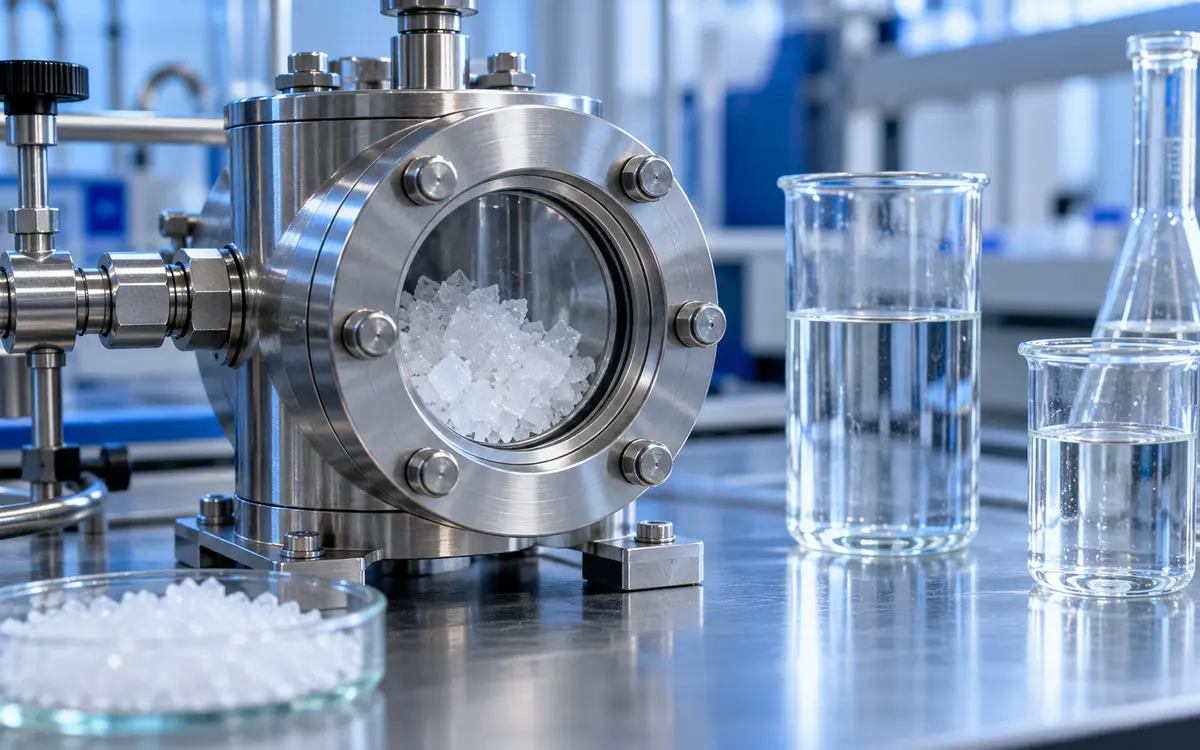
A new way to form gas hydrates offers a research route towards desalination, but a water purchaser ultimately needs an entire treatment service. Interfax reported a Novosibirsk development on 6 November 2024: researchers use a temperature difference within an experimental chamber, with gas boiling and condensing, to encourage hydrate formation. They describe a method that does not require additives to accelerate that stage. For industry in Russia, the commercial question is how the formation step could fit into a reliable process producing water of an agreed quality.
The Russian Academy of Sciences' account places the work in a research and scale-up sequence. It describes laboratory observations and larger experimental units, while a laboratory apparatus and a subsequent technology demonstrator remain development milestones. The announcement therefore supplies a basis for assessing a process concept. It does not establish the price of industrial water or demonstrate a continuously operating commercial desalination plant.
A crystal formation result is one part of a water service
The proposed route involves forming a water-containing solid, separating it from the remaining liquid and obtaining water from the separated material. In the researchers' account, the remaining liquid becomes concentrated. Their experiments use R-134a or sulphur hexafluoride as hydrate-forming gases. These details identify what a future process assessment must follow: water, dissolved material, working gas and the energy used by the equipment.
A buyer would not purchase crystal growth as an isolated event. It would purchase a quantity of water delivered at a defined quality, with an operating schedule and a cost. A technology that improves the formation stage could be valuable, yet the improvement has to survive the other stages. Separation, handling and restoration of working conditions may affect the complete result.
This is a general process assessment, not a claim that a particular obstacle has defeated the Novosibirsk method. Research announcements often identify a promising mechanism before all engineering steps have been integrated. Keeping those stages visible makes the scientific advance easier to evaluate rather than diminishing its significance.
Draw the boundary around every material stream
The assessment should begin by identifying what enters and leaves the proposed plant. Feed water enters, but there may also be working gas, wash water and materials used during maintenance. Product water leaves, together with a concentrated stream and any other discharge. Gas that returns to the process should be distinguished from gas that must be replaced.
A complete boundary prevents the apparent yield from being inflated by an uncounted input. For example, if clean water is used to wash separated material, that input belongs in the calculation. The washing step may improve quality, but the quantity of water it consumes affects the net amount available to a customer. Both effects matter, and they should be recorded together.
The same reasoning applies to intermediate inventory. Material remaining inside equipment at the end of a trial cannot automatically be counted as a delivered product. A comparison between trials should either bring inventories to a comparable state or show the difference. Otherwise a change in stored material could look like an improvement in water recovery.
A simple balance exposes the right questions
Consider a deliberately hypothetical trial using 100 units of feed water and 5 units of clean wash water. Suppose it delivers 40 units of accepted product water and leaves 65 units in a concentrated stream, with no other water inventory change. The delivered output is 40 units, but the net product beyond the clean water supplied is 35. These numbers are an illustration, not a reported result of the research.
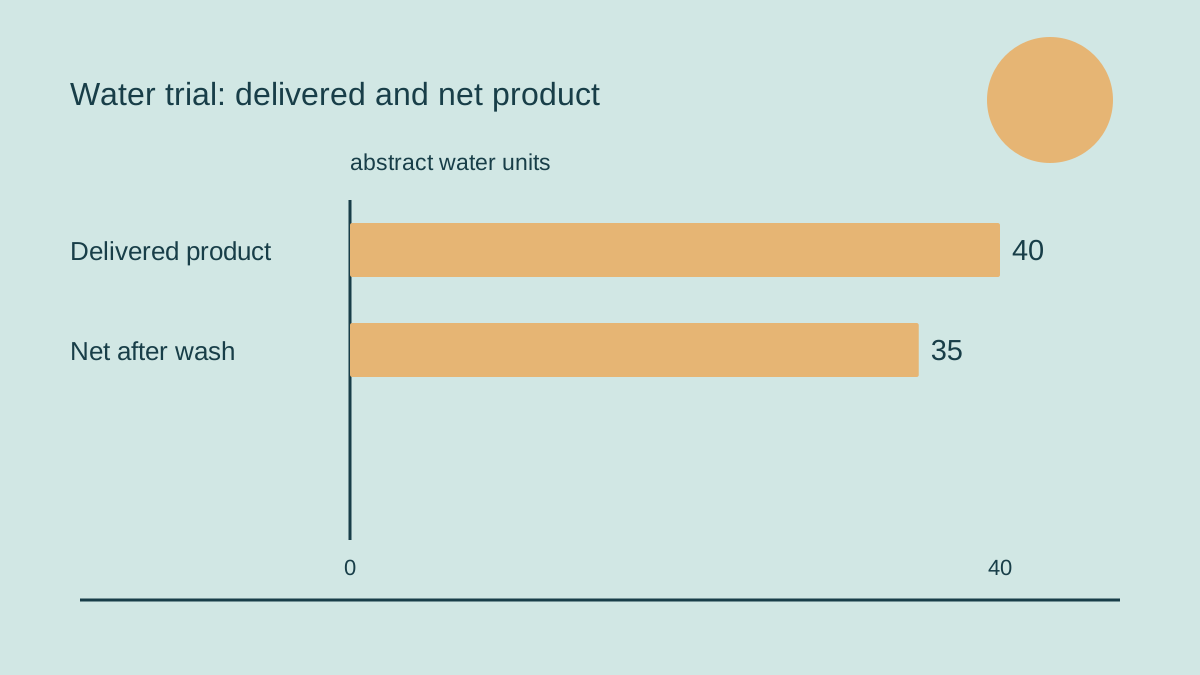
The example shows why a percentage needs a stated denominator. Dividing product by feed gives one description. Subtracting the wash input gives another useful description. Neither tells the entire story about quality or cost. A useful report would show the underlying quantities so that a purchaser can apply the definition relevant to its operation.
If some water remains in solids, piping or storage, the balance needs those terms too. It is not necessary to force every uncertainty into a single exact number. Reporting an uncertainty range and explaining unmeasured inventory is more informative than presenting an apparently precise recovery percentage that cannot be reconciled with the streams.
Product quality must be specified before performance
The word clean can describe an experimental observation without defining an industrial specification. A purchaser needs to identify which substances are relevant, which limits apply to the intended use and how samples will be collected. Water for one manufacturing duty may face different requirements from water for another duty. A general desalination claim cannot substitute for that agreement.
Quality should be assessed after the complete proposed sequence, rather than only at an intermediate point that will undergo further handling. The plan should identify where samples are taken and how they represent ordinary operation. Startup water, steady operation and a change in feed conditions may need to be distinguished when interpreting a trial.
Separating the solid from concentrated liquid is especially important to the evaluation because carried-over liquid can affect the final product. This is a question for measurement and process design. The announcement does not provide a complete customer acceptance protocol, and no claim of drinking-water approval follows from the research result.
Energy belongs to the complete cycle
The method uses a temperature difference. An industrial energy account would therefore need to record the resources used to maintain that difference, alongside circulation, pressure management, separation and other relevant equipment. An improvement in one mechanism should not be treated as a measured reduction in the whole plant's energy requirement until the complete boundary has been evaluated.
Heating and cooling can be discussed as separate duties even when a design seeks to recover energy between them. Recovery might reduce an external requirement, but its contribution should be measured or calculated for the proposed configuration. Simply identifying both a hot region and a cold region does not establish that their duties cancel.
Reporting energy per unit of accepted product would connect the engineering result to a purchaser's needs. Reporting only energy per batch could hide a change in yield. A comparison should also identify the quality achieved and the time required, since a low-energy trial with little usable output may have a different economic meaning from a productive continuous process.
The working gas needs its own account
A gas used to form hydrates is part of the operating system, even if it is intended to circulate repeatedly. A future assessment should identify the quantity initially charged, the quantity returned after each cycle and the amount requiring replacement. Without that account, an attractive water balance might conceal an unmeasured material cost.
Product handling and gas recovery also have to be considered together. The analysis should establish how the proposed process separates the water product from its working fluid and how that separation is verified. It should not assume complete recovery because the gas is described as reusable, nor assume unacceptable loss without measurements.
The choice of gas could affect equipment, operating conditions and environmental assessment. This article does not assign a numerical emissions result or declare one experimental choice commercially preferable. It identifies the need to compare candidate working fluids on a consistent boundary, including the resources required to retain and reuse them.
Throughput is more than the speed of formation
A rapid growth stage can be an important advance, but the production rate of an integrated process also depends on what happens before and after it. Feeding the apparatus, establishing conditions, removing the formed material, separating liquid and returning the equipment to its next operating state may all occupy time. A purchaser needs the rate of accepted water leaving the process.
Scaling a chamber's volume does not automatically scale every other part by the same factor. The arrangement for moving material and transferring heat can change with geometry. A larger experiment should therefore answer a specific question about performance, rather than merely display more material. The appropriate question might concern repeatability, handling or the stability of an operating condition.
A useful record would separate productive operating time from cleaning, maintenance and interruptions. This would show the difference between a rate measured during a favourable interval and the output available over an ordinary operating schedule. Neither measure is inherently wrong, but they serve different decisions and should not be exchanged without explanation.
Concentrated liquid remains an output to manage
Recovering product water leaves another stream whose composition and volume matter. A proposed plant needs a destination for that stream and an account of any treatment or transport required. Moving material into a smaller volume does not remove the need to manage it. The cost of that management belongs in the same commercial comparison as the water product.
A concentrated stream might contain something worth recovering, but possible value and contracted revenue are different things. A buyer for a secondary product would require specifications, quantities and delivery arrangements. Until such a route has been established, it would be premature to offset water production costs with an assumed sale.
Feed variability could change both the product and the concentrated stream. A trial programme should therefore describe the feed it used and explain the intended range of conditions. The purpose is to identify the relevant operating envelope, not to infer that one successful sample represents every water source an industrial purchaser might consider.
Maintenance can change the production balance
A future operating trial should include the return to service after maintenance. If equipment needs cleaning, the evaluation should record the time, water and materials consumed, together with the condition of the first product after restart. Otherwise a result obtained between interruptions could be mistaken for the result of a complete recurring schedule.
The same record should show whether cleaning restores the earlier performance and whether any component needs replacement. These are questions to test, not reported failures of the experimental method. Their economic significance is that maintenance changes both sides of the unit-cost calculation: it can add expenses while reducing the accepted output over the period. Including it early makes the scale-up discussion more useful to an industrial customer.
A pilot should have a defined commercial question
A demonstrator can be designed to answer several questions, but priorities should be explicit. One project may focus on repeated operation of the formation stage. Another may integrate separation and gas recovery. A third may examine a particular customer's feed and product requirements. Describing the objective prevents a result from being judged against a promise it never made.
For a commercial assessment, the pilot should produce a connected record of input, accepted output, energy, operating time and maintenance. These observations provide the basis for estimating a larger process, while the estimate should preserve uncertainty about components that have not yet been demonstrated. A calculation is useful when its assumptions can be inspected.
Responsibility for acceptance should also be clear. Researchers can document the experiment, an engineering partner can assess equipment implications and a potential purchaser can define the water requirement. Those roles contribute different evidence. Combining them does not mean that one observation automatically satisfies every technical and commercial decision.
Compare alternatives on the same service
A fair comparison with another desalination route would use the same feed, required product quality and delivery schedule. It would account for the resources and remaining streams of each route. Comparing a hydrate formation experiment with the all-inclusive cost of an operating alternative would not answer the question of which complete service is preferable.
The relevant alternative might include continued use of an existing water supply, another treatment configuration or a change in the customer's water use. The analysis should state which alternative it examines. An industrial purchaser needs a decision for its location, rather than a universal ranking of technologies detached from the required service.
Equipment expenditure and operating expenditure should be considered over an agreed period. A low operating requirement may justify additional equipment, but that conclusion depends on utilization, maintenance and the value of reliable supply. Conversely, a lower initial price may be less attractive if it creates recurring costs. The research announcement provides no basis for inventing those prices.
Evidence that would make the next decision possible
The next useful step is an evidence package that connects the promising mechanism to the water purchaser's specification. It should show what has been measured, what remains an engineering estimate and which milestone would resolve each important uncertainty. This would make discussion between researchers, equipment suppliers and industrial users more concrete.
- A reconciled water and working-gas balance, including wash inputs and changing inventories.
- Product analysis at the intended delivery point, with a stated sampling method.
- Energy use across the full proposed cycle per unit of accepted output.
- Operating records covering repeated runs, interruptions and maintenance.
- A defined route for the concentrated stream and other process outputs.
- A scale-up estimate whose assumptions, unresolved components and acceptance milestones are visible.
Such a package would also improve the interpretation of unsuccessful runs. An interruption attributed to separation calls for a different response from a difficulty in maintaining formation conditions. Recording where performance changed is more useful than reducing every run to a verdict that the technology either works or does not work.
The cost denominator must be accepted water
A cost estimate needs the same output definition as the performance record. If a trial produces water that does not meet the agreed specification, the estimate should explain whether it can be treated further and at what additional resource requirement. Counting all intermediate water as a saleable product would make the apparent unit cost smaller without improving the service offered to a customer.
Utilization is another important assumption. Equipment-related expenses spread over a large annual output will produce a different unit estimate from the same expenses spread over a small output. A model should show the operating hours and accepted production on which it depends. This allows a reader to distinguish a technological improvement from a more optimistic assumption about how often the equipment runs.
For illustration, imagine an annual fixed expense of 100 accounting units. At 50 units of accepted water, its contribution is 2 accounting units per unit of water; at 25 units, it is 4. This calculation excludes variable expenses and is not a forecast of the Novosibirsk project. It simply shows why an annual operating record belongs beside an equipment quotation when discussing cost.
A transparent estimate would keep uncertain inputs adjustable. Instead of announce a single industrial price before the process is integrated, the team could identify which assumptions most affect the result and design the next experiment to resolve them. That turns the cost model into a research planning tool as well as a future purchasing aid.
From a research mechanism to a purchase specification
The Novosibirsk work introduces a method worth examining within a broader process-development programme. The decisive commercial measure, however, is accepted water delivered reliably at a defensible cost. Formation behaviour, material recovery and operating conditions each contribute to that outcome, and each needs its own evidence.
As of the November 2024 announcement, the appropriate conclusion is that the research creates a route for further testing. A complete industrial price must wait for a complete process account. Keeping that distinction clear allows the mechanism to receive credit for what has been shown while giving potential users a practical way to assess what remains to be established.
Sources: Интерфакс; Russian Academy of Sciences.



Leave a comment