

A recycled solar-glass factory needs two commercial definitions before its investment can be assessed: the input it can accept and the finished product a customer will accept. A proposed circular route connects those definitions, but does not make them identical. Receiving retired panels would establish a feedstock activity; delivering qualified glass would establish a different manufacturing result. The business case needs evidence for the whole route between them.
On February 29, 2024, Manufacturing Dive reported Solarcycle's planned $344 million solar-glass factory in Cedartown, Georgia, United States. The project was described as using material from recycled solar panels, with construction expected during 2024 and production planned for 2026. Those were prospective milestones, rather than evidence of operating output.
The following analysis examines the commercial questions such a project would need to answer. It does not supply a glass recipe, calculate Solarcycle's actual yield or confirm that a customer has qualified the planned factory's production. Its purpose is to distinguish a credible manufacturing pathway from an announcement of future capacity, using a complete input-to-customer account.
Start with the product a buyer is purchasing
The investment model should describe the finished glass product, the agreed delivery unit and the scope of the customer's acceptance. A buyer could be purchasing a defined component rather than a general quantity of recovered material. In that case, the model needs to connect recovered inputs to that component, without assuming that an upstream recovery result proves downstream suitability.
A proposed specification should have an identified owner and a controlled version. If the customer changes it, the factory needs to understand which assumptions about equipment, inspection and accepted output must be reconsidered. The relevant question is not whether one specification sounds demanding, but whether the chosen specification is the one used throughout the business case and qualification exercise.
The delivery boundary should also remain visible. If further work is required before the customer can use the glass, the account should identify who performs and pays for that work. Calling an intermediate material a finished product would otherwise move an obligation outside the reported factory while leaving it inside the real supply chain.
Define acceptable retired-panel feedstock separately
The feedstock proposal needs its own acceptance rule. The plant should state what material it is prepared to receive, what information accompanies it and what happens when a consignment falls outside the agreed description. This would define the intended supply transaction without pretending that every retired panel is interchangeable within the proposed process.
A supplier's offered quantity and a factory's accepted quantity should be recorded separately. If incoming material requires sorting, preparation or rejection, that stage belongs in the route. The commercial model should not begin with an accepted-input number while treating the cost of reaching that number as somebody else's unexplained activity.
Feedstock acceptance should connect to the downstream product definition. A restriction at receiving may be justified by the product the plant intends to manufacture. If that connection cannot be explained, a reviewer should ask whether the input rule reflects a demonstrated process requirement or an untested assumption. The distinction matters when evaluating which supply commitments can support the proposed output.
Give the supply contract a usable quantity and period
A feedstock contract should explain the quantity committed, the delivery period and the unit used to establish compliance. A total covering several years cannot automatically support a particular month's production plan. The project needs a schedule that connects its proposed consumption of accepted material with the deliveries the counterparty is actually obliged to make.
The contract should also state where title, handling responsibility and acceptance decisions sit. These are proposed review questions, not assertions about Solarcycle's existing contracts. A factory model would be easier to assess if it showed which party bears the consequence when offered material differs from the agreed description or arrives outside the agreed period.
An optional quantity should remain optional in the model. It may support a scenario, but it should not become firm supply merely because it appears in a spreadsheet. Separating committed, expected and possible deliveries would allow the project to explain its operating range without presenting every prospective supply relationship as a completed procurement result.
Build a material account across the complete route
The proposed route should show the stages between incoming panels and delivered glass. At each boundary, the account should identify the quantity received, the quantity advanced and the disposition of the remainder. The purpose is to make the route reviewable, rather than assume that an input total becomes an equal quantity of saleable glass.
Where material returns to an earlier stage, the account should distinguish that internal movement from fresh input and final output. Counting the same quantity every time it passes a measurement point could inflate the apparent activity. A controlled account would retain the history of the movement while preventing repeated handling from being reported as additional finished production.
Unresolved material should remain unresolved in the record until its disposition is known. The model can propose recovery or another destination, but a proposed destination is not a completed shipment or a realised credit. This distinction would help a reviewer identify which portions of the route have evidence and which still depend on future operating decisions.
Use accepted output as the denominator
The cost per unit should name the product and its acceptance status. Gross production, inspected production and customer-accepted delivery can represent different quantities. The project needs to choose the quantity answering its commercial question and preserve the reconciliation to other measures, rather than use whichever count gives the most attractive result.
Consider a purely hypothetical example in abstract units. A route incurs 120 cost units and produces 60 units before the final acceptance decision. Its gross cost is two per unit. If only 48 units are accepted within the defined period, the same cost divided by accepted output is 2.5. These figures are an illustration, not Solarcycle measurements or an estimate of its performance.
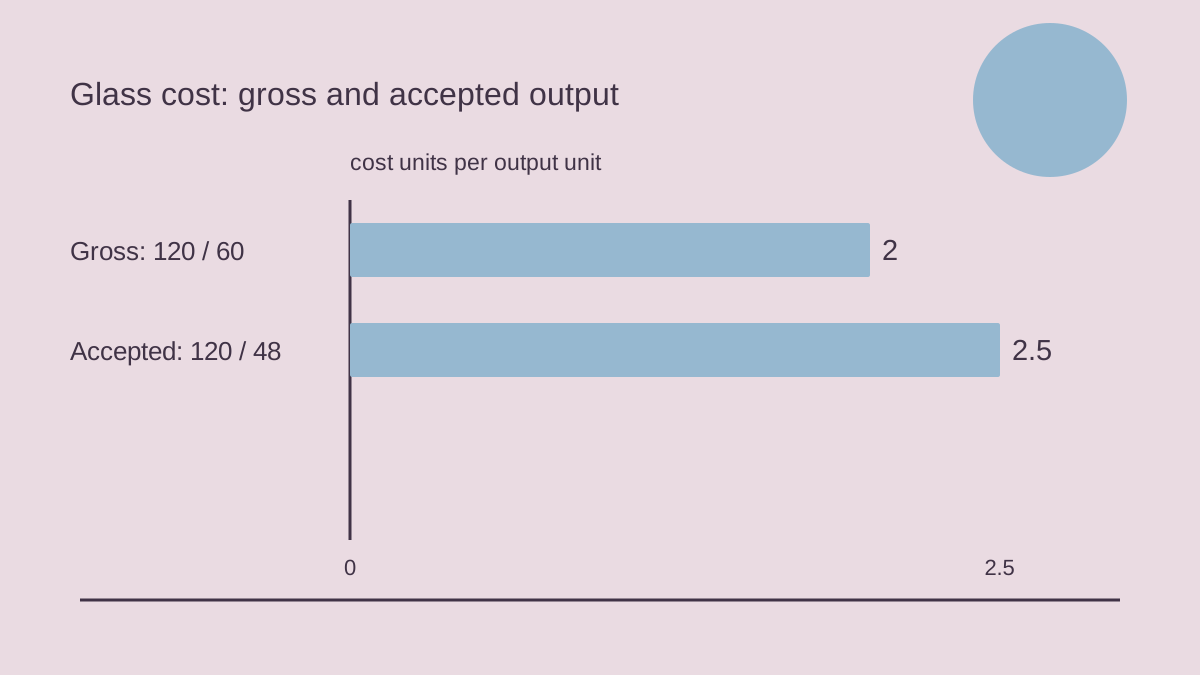
The example does not establish an expected rejection rate. It shows why a denominator must stay connected to the buyer's transaction. A business case using gross output can still be informative, but it should not be described as a delivered-product cost without the additional account. The next useful evidence would reconcile the quantities rather than conceal the difference.
Treat qualification as a defined decision
A customer qualification exercise should identify the proposed product, the evidence requested and the decision the exercise can support. The project should distinguish an initial sample from a repeatable operating supply. A successful result at one stage should retain its actual scope, without becoming an assertion that every later batch or production condition has already been accepted.
The qualification plan should explain how the sample connects to the proposed manufacturing route. If the route or product definition changes afterwards, the parties need a stated process for deciding whether the earlier result remains applicable. This would allow a reviewer to follow the chain between a technical observation and the commercial delivery proposed in the investment case.
The decision should be recorded with its conditions. A conditional approval may be valuable, but it remains different from unrestricted acceptance of regular supply. Keeping that distinction would help the factory schedule further work and would help the customer understand what its procurement commitment relies on. Neither side benefits from a label that hides unfinished obligations.
Connect repeatability to the supply variation being proposed
The operating proposal should identify which variations in accepted input it intends to accommodate. It should then explain what evidence supports the claimed range. A result for one documented input group cannot establish performance for every material the plant might encounter. A narrower supported range can be commercially useful when its limitations are visible.
Where the model assumes a broader input range, the project should identify the work needed to examine that assumption. It could schedule defined trials and preserve the results, including outcomes requiring a change in receiving rules. The important discipline is that future work remains future work until its evidence is available and reviewed against the intended product.
A repeatability account should also distinguish routine operation from a specially prepared demonstration. Both can provide useful information, but they answer different questions. The factory should be able to explain which conditions its observation represents and which responsibilities would be needed to reproduce it within the planned delivery schedule.
Keep complementary materials inside the account
If the proposed manufacturing route requires additional materials, their quantity, acceptance and cost should remain part of the model. Recycled input does not by itself define the full manufacturing bill. The reviewer needs the proposed complete recipe account, with its evidence and uncertainties, rather than a claim that the origin of one input settles the composition of the finished product.
This analysis does not specify which additions the actual project would use. It identifies a responsibility the project would need to address for its chosen route. Any asserted composition would require its own evidence; it should not be inferred from the general description of recycled glass or supplied as an invented detail in the investment narrative.
The same boundary applies to changes in purchasing conditions. If a proposed input substitution changes the route or product, the model should show the resulting review rather than assume that a lower purchase price preserves all other conditions. An apparently favourable upstream transaction would need to remain compatible with the accepted downstream product.
Separate collection economics from glass economics
The collection activity and the glass-manufacturing activity should have understandable accounts even when managed within one business. Each has a defined service, cost boundary and output. A combined programme total can be useful, but it should allow a reviewer to locate the stage supporting a proposed benefit or carrying a particular obligation.
Where a model includes a receiving fee or an input purchase payment, its direction and conditions should be explicit. The account should not assume that every consignment produces the same commercial transaction. This is a proposed modelling requirement, not a statement about the company's actual prices, arrangements or margins.
An internal transfer value should also be distinguished from an external sale. It can organise management accounts without proving that an outside customer will pay the same amount. Keeping those meanings separate would prevent a circular-route model from creating an apparent revenue twice, first at an internal movement and again when the final product is delivered.
Include storage, transport and timing
The route should identify how incoming material and finished goods move between the agreed transaction points. The project needs a delivery unit, a handling responsibility and a schedule compatible with its proposed operating plan. Proximity alone cannot establish those arrangements, and an announcement of a location does not supply their commercial terms.
Inventory should be assigned a status. Material received, material awaiting acceptance and product awaiting customer release represent different commitments. A factory model should explain the stage at which each becomes usable for its proposed operation or sale. A large stock count without that explanation cannot independently establish production readiness.
The cost account should include the agreed storage and transport obligations within its boundary. If another party supplies a service, the arrangement should still be identified. The commercial review can then compare alternatives delivering the same result, rather than reward a proposal simply because part of its route is absent from the visible factory account.
Describe capacity in a unit connected to delivered glass
A capacity statement should identify what the facility produces and the assumptions connecting that product to any downstream capacity expression. Glass output and the electricity-generating capacity of modules are different descriptions. A reviewer should be able to see the conversion basis, the product configuration and the acceptance boundary before comparing such statements.
If that basis is unavailable, the analysis should preserve the narrower claim supported by the evidence. It can describe a planned glass factory without treating a module-related capacity expression as measured electricity generation. Omitting an unsupported conversion is preferable to creating a precise-looking operating number that the project has not demonstrated.
Rated capacity also needs separation from actual deliveries. A proposed annual capacity is a planning measure, while accepted output for a defined period is an operating observation. The business case should identify the conditions assumed for reaching its target and the evidence that would later show what was achieved.
Keep environmental conclusions within their evidence
A recycled-material route can be examined without presuming a verified environmental advantage. Any comparison would need an identified alternative, a defined boundary and evidence for the quantities included. The origin of a material alone does not complete that account. A proposed comparison should explain what is measured, what is estimated and what remains outside its scope.
The same principle applies to a circularity description. The project should identify the actual destination of material and the stage at which it re-enters the intended product route. Planned recovery, recovered intermediate and accepted new glass should remain separate milestones. A claim should stop where its supporting observation stops.
This analysis does not calculate a carbon result or claim that the planned factory has demonstrated environmental superiority. It proposes the account needed before such a conclusion could be assessed. Keeping the question open allows later operating evidence to support a specific result rather than asking the investment announcement to establish it in advance.
Use milestones that test the business case
A useful development schedule should connect each milestone to a decision. Construction progress, equipment installation, route demonstration, product qualification and recurring customer delivery are different stages. The project can report each honestly without treating the first completed stage as proof that the entire supply chain has entered commercial operation.
- Define the product and customer acceptance boundary.
- Record committed feedstock quantities and delivery periods.
- Reconcile material through the proposed manufacturing route.
- Demonstrate the scope and repeatability of qualification.
- Compare complete costs against accepted delivered output.
- Keep environmental claims separate until their evidence is available.
This sequence would make a revised decision possible when a result differs from the model. A changed receiving rule, product scope or delivery schedule need not invalidate all work already completed, but its effect should be visible. The value of the review is its ability to expose that effect before a conditional assumption becomes an unqualified commercial promise.
The commercial endpoint is an accepted delivery
The reported Cedartown project provides a reason to examine the route from retired panels to new solar glass. It does not establish the later operating outcome. A defensible business case would connect acceptable feedstock, a documented route, qualified product and complete delivered cost, keeping the historical launch plans separate from future evidence.
If the project later demonstrates that connection repeatedly under its defined supply conditions, it would support a more specific commercial conclusion. Until that evidence is available, planned capacity should remain planned capacity. The central question is whether the factory can turn the material it is committed to receive into the product its customer is committed to accept.
Sources: Manufacturing Dive.


Leave a comment