

Manufacturing Dive reported on September 3, 2026 that GE Appliances planned to convert Building 5 at its Louisville, Kentucky campus in the United States from refrigerators to dryers, moving production from Mexico. Refrigeration there was expected to end in early 2027, with dryer production starting later that year. These were prospective milestones.
A conversion has an outgoing business as well as an incoming one
A building conversion is often described through the equipment that will occupy the space next. That makes the new product visible, but leaves the departing product's obligations in the background. A useful analytical frame holds both together. The outgoing operation has existing orders, unfinished work and customer references. The incoming operation has a proposed product, a commissioning path and a future delivery promise. Closing the first production schedule does not automatically close the first business relationship.
This distinction does not establish how the announced conversion will be managed. It identifies evidence that would make a future assessment meaningful. A transition could have orderly physical progress and still leave an ambiguous customer commitment. Conversely, a delayed new line would not by itself prove that existing customers had lost supply. The question is which obligations remain open, where their next accepted handoff is expected, and whether the evidence follows them across the change.
The old product needs a destination for each unfinished obligation
Consider an existing refrigerator order in a hypothetical conversion. Its customer may be waiting for a defined model in a particular delivery period. A stock item, an unfinished unit and an unallocated component are different possible resources for meeting that order. They cannot be added together as though each were an equally available finished appliance. An inventory total becomes commercially informative only when its condition and assignment can be connected to the obligation it is meant to cover.
Moving an obligation to another production location would also need a reference that survives the move. A customer agreement belongs to the promised product and delivery terms, rather than to the outgoing building number. If an alternative location is proposed, the assessment would ask whether the intended product configuration, quantity and customer acceptance still match. This is a conditional continuity question, not evidence that any particular order has been transferred or that an alternative plant has spare capacity.
Inventory covers time only under a stated demand assumption
A buffer can appear reassuring because it exists before a line stops. Its usefulness nevertheless depends on the demand it can actually serve. The same total stock could cover a long period for one narrow product mix and a short period for another. A claim about months of cover therefore needs both an eligible stock base and a demand assumption. Neither a warehouse count alone nor a sales forecast alone establishes the bridge between the outgoing and incoming arrangements.
The distinction matters particularly when the mix changes. A surplus of one configuration may coexist with an uncovered commitment for another. Reserved stock cannot be counted again as freely available supply without changing the earlier reservation. An item awaiting a decision may remain visible in physical inventory while being absent from accepted delivery capacity. Clear assessment preserves these categories instead of turning every piece of material into an interchangeable contribution to continuity.
The incoming line has several different starting points
A new line can have equipment installed before it has produced an acceptable unit. It can produce a demonstration unit before it has completed a normal customer order. It can fulfil an initial order before repeat production becomes predictable. These are separate observations, even if a project schedule places them close together. A statement that production has started should identify the observed activity, so that a reader can distinguish a physical run from an accepted commercial handoff.
For an analytical account, the relevant chain runs from a defined product through the available production process to an identified delivery. A problem at one point need not invalidate every preceding observation. Installed equipment can remain installed while a product trial is unresolved. A delivered unit can remain delivered while the repeat schedule is uncertain. Recording the narrow fact allows progress and remaining work to coexist without declaring the whole operation either complete or unsuccessful.
A transferred product needs a stable reference
Relocating production introduces a comparison between a previous arrangement and a proposed one. That comparison is weak if the product itself changes without being identified. A difference in observed performance might come from the location, a revised configuration, a different customer mix or a changed operating period. A stable reference makes the question specific: which version of which product is being compared, under what acceptance conditions, and for which intended delivery?
This is not a claim that a relocation must reproduce every feature of an earlier process. A manufacturer may intend to change the product or the process. The analytical requirement is to name the change so that the comparison does not silently switch its subject. Continuity then means preserving the obligations that remain applicable while showing which new proposition is being tested. A shared product label is useful shorthand, but cannot carry that entire evidential burden.
People moving through the transition face a separate learning sequence
Employment continuity and readiness for a new production task answer different questions. A worker may remain employed throughout a conversion while spending part of the period learning a new activity. Participation in learning does not by itself establish performance under normal production conditions. At the same time, an unfinished learning sequence does not prove an employment interruption. Keeping these observations separate prevents a staffing claim from becoming an unsupported claim about immediate operating readiness.
A hypothetical workforce account could distinguish retained roles, assignments during the conversion, demonstrated competence for a defined task and unresolved support needs. Those categories would describe a transition without inventing individual experience or a universal learning period. Assessment would also need a boundary: an observed task in a trial is not necessarily evidence for every task on a future line. The person, task and operating context need to remain connected when a narrow observation informs a broader staffing statement.
Shared resources create overlap as well as downtime
The old and new operations may have claims on the same space, specialist attention or supporting service during a hypothetical conversion. Treating each project stage as an isolated box can hide that overlap. An outgoing obligation could still require investigation while an incoming trial needs the same person's time. A line may be physically inactive while preparation, inventory disposition and customer coordination continue. Downtime is therefore an incomplete description of the work occupying the transition period.
This does not imply that overlap will cause a bottleneck in the announced project. It supplies a question for evaluating a future resource account. Which activity has an accepted claim on the shared resource, during which interval, and what happens to the other obligation? A visible priority decision is more informative than two schedules that each assume unlimited access. It also separates the existence of a constraint from the unproven conclusion that the constraint has already produced a delay.
A fictional example shows why the two product streams cannot be netted
The following numbers are invented solely to illustrate the reasoning; they describe no GE Appliances stock, order or production result. Imagine a converting plant with 100 outgoing-product units recorded in stock. Of those, 60 match and are reserved for open customer commitments, 25 match another configuration, and 15 await an acceptance decision. The record contains 100 physical units, but it does not establish 100 units freely available for the same delivery promise.
Now imagine that an incoming-product trial produces 20 candidate units, of which 8 have been accepted for a defined customer handoff. Adding the 20 to the outgoing stock would produce an impressive combined number with no coherent product meaning. Even the 8 accepted incoming units cannot satisfy the old product's obligations merely because both are appliances. A sensible account keeps the two streams separate and records the 12 remaining candidates as unresolved for that particular handoff, rather than automatically calling them unusable.
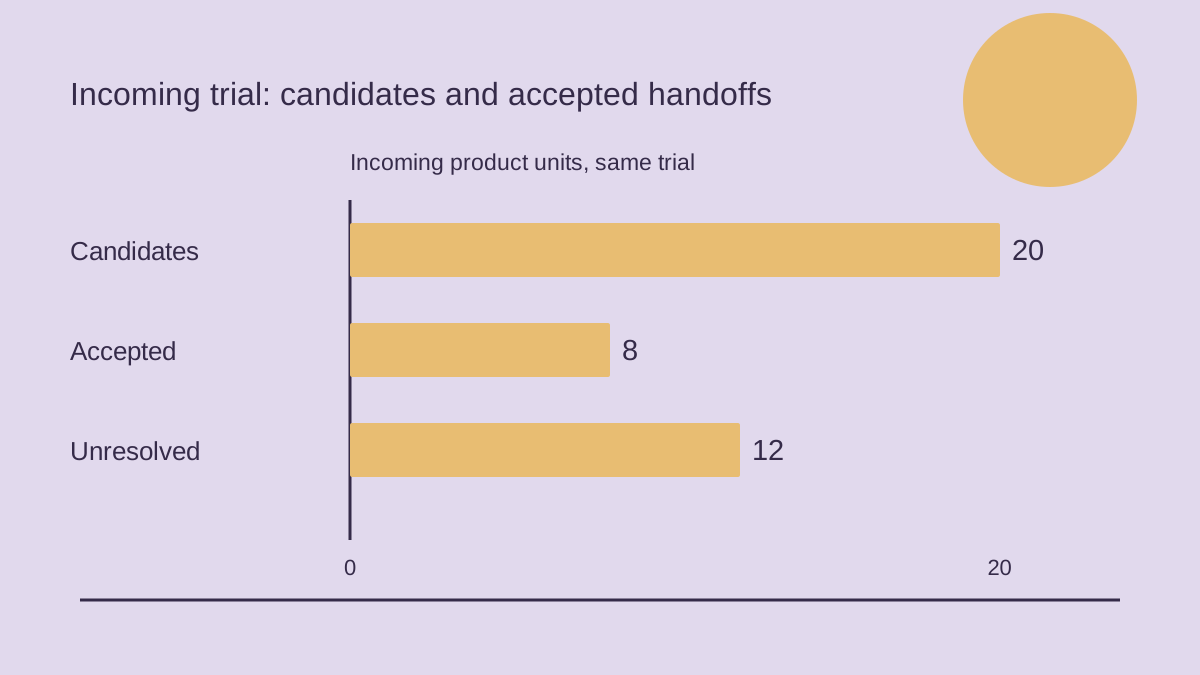
If the fictional plant later changes its customer assignment, the earlier reservation should remain visible as an earlier state. A revised commitment could make a different number relevant, but it would not retroactively change what the previous account showed. The value of the example lies in the boundary between physical presence, accepted condition and a named commercial obligation. It supplies no forecast of the actual conversion and no estimate of the inventory buffer the real business would require.
A calendar needs dependencies rather than one confident finish date
A conversion schedule can name the stopping date for an old activity and the intended starting date for a new one. Those dates leave an interval in which several different conditions may matter. Old orders need a supply path, the space needs to become available for the new arrangement, and the incoming product needs its own evidence of readiness. A single finish date can conceal the dependencies that determine whether those paths remain connected.
An informative historical account would preserve the original expectation alongside any later observation. If a trial moves, the changed date should be attached to the affected activity rather than quietly replacing every other date. Some obligations may remain covered while another milestone changes. Others may need a revised commitment. Keeping a versioned schedule allows the reader to see what was expected at the time and what subsequently became known, without treating either the old plan or the newest headline as the whole record.
A date can also carry a different meaning for different participants. The outgoing schedule may describe its last planned manufacturing activity, while a customer schedule describes the final delivery still expected. The incoming schedule may refer to a first trial, while a supplier is preparing for a later repeat order. Those dates can all be accurate without being interchangeable. Their labels should preserve the activity and participant concerned, allowing a future account to explain the interval between them rather than treating any difference as an automatic contradiction.
The cost boundary includes continuing obligations
Investment in a new line is not itself a measure of the transition's complete economic effect. A proposed comparison could include the new operation, the resources used during conversion and the outgoing obligations that remain active. An apparent improvement at the new line might coexist with additional work elsewhere in the network. Whether that work matters to the comparison depends on its boundary, not on whether it happens inside the repurposed building.
This is a framing principle rather than a calculation of costs or savings. No economic result follows without actual quantities, a period and an appropriate comparator. A reader would need to know whether the account describes the building, the product family, the customer supply arrangement or a wider network. A narrower measure can be useful if it is labelled accurately. Problems arise when a building-level observation is promoted into a company-wide benefit while the continuing obligations disappear from view.
A continuity ledger can keep the claims readable
The following fields form an analytical outline, not a description of the company's procedures. They identify what a future continuity claim would need to connect. The aim is to make an obligation traceable through a changing arrangement, with an unresolved state available whenever the necessary evidence has not yet arrived. A blank outcome should remain a blank outcome until it has an observation attached.
- The outgoing product and the customer commitment that remains open.
- The stock or alternative supply assigned to that commitment, including its accepted condition.
- The incoming product version and the production activity actually observed.
- The specific customer handoff that turns a candidate unit into accepted delivery.
- The shared resource, time interval and priority decision where activities overlap.
- The dated revision that changes an earlier product, schedule or customer assignment.
These fields should not be compressed into a single score that makes strong evidence in one area cancel missing evidence in another. A ready new line cannot answer an unresolved old-order question; a covered old order cannot demonstrate repeat output from the new line. Each connection has its own subject. Reading the ledger as a set of linked observations preserves that distinction while still allowing the transition to be understood as one business change.
The eventual result needs both continuity and a defined outcome
A future assessment of the announced conversion would be strongest when it can describe what happened to the outgoing commitments and what the incoming operation actually delivered. It would distinguish plans, physical milestones, accepted deliveries and repeat performance. Those observations could support a narrower conclusion before they support a broader one. The evidence should determine the scope of the claim, rather than an ambitious claim determining which observations are counted.
Employment, customer continuity and economic performance would also retain their own measures. None is automatically demonstrated by the others. A production milestone might be important without resolving every wider outcome; a continuing customer supply arrangement might be valuable without proving the new line's efficiency. The useful perspective is therefore to follow both sides of the conversion and keep their meeting points visible. A building changes its use at a physical boundary, while the business transition extends through the obligations and accepted products that cross it.
Sources: Manufacturing Dive.




Leave a comment