

A plant-derived membrane becomes an industrial component when a customer can qualify it in a defined device and obtain it repeatedly under an agreed specification. The origin of the cellulose matters to the supply chain, but it cannot answer the device question by itself. A separator proposal therefore needs two connected bodies of evidence: how the component performs in its intended cell, and how the proposed producer would supply that same component consistently.
On December 10, 2025, Interfax reported work at Novosibirsk State Technical University in Novosibirsk, Russia, on cellulose membranes made from miscanthus for supercapacitor separators. The report described planned laboratory cell checks and further process optimisation in 2026. It did not announce qualified commercial production.
The development should consequently be assessed as a research route with a defined next test, rather than a finished substitute for every existing separator. The following analysis proposes a qualification and supply framework. It contains no additional measured cell performance, verified factory costs or claim that the planned tests have already succeeded.
Let the cell application define the purchase
The first commercial question is what a prospective customer would buy. Cellulose as an intermediate, a membrane sheet and a separator cut for a particular cell are different products. Each passes a different responsibility to the buyer. A quotation for one should not be read as the cost of another simply because all three belong to the same research route.
A purchasing specification should identify the delivered form, usable dimensions, accepted condition and remaining operations. If the customer must cut the membrane, the calculation should include material that cannot become accepted pieces. If the supplier delivers finished pieces, the quotation should explain whether inspection and packaging are included. This would make proposed prices comparable before anyone concludes that a new feedstock has produced a cheaper component.
The application should remain equally specific. A positive result in one agreed supercapacitor configuration would be useful evidence for that configuration. It would not automatically establish suitability for another electrolyte, another cell assembly or an unrelated energy-storage product. A focused first application can create a practical route to procurement without requiring an unsupported claim of universal compatibility.
Turn the planned trial into a decision document
A laboratory trial is most useful commercially when its result will change a decision. Before starting, the development team and prospective buyer should identify what outcome would justify a further trial, what would permit a repeat supply and what would stop work on the chosen application. Otherwise measurements can accumulate without resolving the purchasing question.
The record should describe the specimen, the cell configuration, the comparison material and the interpretation of the results. Acceptance limits should be agreed in advance where possible. If an exploratory test has no fixed acceptance limits, its result can still inform development, but it should be presented as exploration rather than a passed purchasing specification.
It is also important to retain the relationship between the separator batch and the tested cell. A later batch needs a reason to inherit the earlier result. That reason might be a demonstrated manufacturing specification and agreed release checks; it cannot be the shared word cellulose alone. The trial record should therefore become the beginning of a product evidence chain.
Compare against an explicit baseline
A proposed replacement needs a baseline that represents what the buyer actually requires. The comparison should use the same relevant cell conditions and should explain any differences in preparation or assembly. If the new separator receives a different treatment before testing, that treatment belongs in both the interpretation and the proposed cost account.
A baseline need not be chosen to make either material appear superior. Its purpose is to reveal the consequence of changing the component in the chosen application. Where the experiment also changes another element, the team should not attribute the entire result to the separator without a basis for doing so. A more limited conclusion would often be more useful to an engineer deciding the next trial.
Commercial discussion should preserve this comparison boundary. An improvement on one selected endpoint may support further development while leaving other acceptance conditions unresolved. Conversely, a similar result could still matter if a complete supply proposal offered a verified advantage elsewhere. Neither conclusion follows solely from the agricultural origin of the feedstock.
Ask whether a result belongs to the material or the assembly
The cell result is produced by a complete test arrangement. A qualification programme should identify which conditions are held constant and which may vary. This would help the team distinguish a membrane question from an assembly question when a result changes between trials. It is a proposed method of interpreting evidence, not an assertion about a defect in the reported research.
For a purchasing decision, the buyer needs to know the range of conditions represented by the accepted result. A record that omits the relevant preparation or handling step may be difficult to transfer to a production trial. The supplier and buyer should therefore agree how the tested configuration connects to the configuration that would actually be delivered and assembled.
If that connection cannot yet be made, the sensible next step is a targeted comparison. It should ask a specific question about the proposed change rather than repeat a favourable demonstration for publicity. Such a comparison can preserve the value of the original laboratory work while explaining what remains necessary for a customer to use it.
Define the service claim before a resource test
A resource test needs a stated endpoint and an interpretation. The parties should define what counts as an unacceptable change, when observations are taken and what reaching the chosen endpoint would establish. The term long-lasting is too open to become a supply guarantee without these details.
The tested duty should correspond to the application being proposed. A completed test would support that duty and its stated limits. It should not be converted into an unlimited lifetime or extended to a different operating pattern without checking whether the comparison remains valid. This distinction would keep a promising result from becoming a warranty that the evidence does not support.
Development qualification and routine batch release should also remain separate. A long trial may establish the basis for a product, while a shorter agreed check may help determine whether later deliveries remain within that basis. The relationship between the two needs evidence. A short check should not be advertised as a complete repetition of the qualification simply because it is easier to schedule.
Qualify the delivered membrane condition
Material delivered to a buyer should be described in the condition in which it will be used or prepared for use. The supplier and buyer should specify the agreed storage, packaging and handling boundary. Without that boundary, they may compare a carefully prepared laboratory specimen with a commercial delivery whose preparation is still unresolved.
This question does not require assuming that the membrane is unusually difficult to handle. It requires recording the conditions supporting the claim. If the buyer performs a conditioning step, its time, material use and acceptance consequence belong in the complete route. If the supplier performs it, the delivery specification should state what the buyer receives and what further work remains.
A retained reference specimen could assist a dispute only if its storage and interpretation are also defined. It would not automatically recreate a cell trial. Its useful role would be to connect a delivery with a recorded material condition and to help identify which additional check is needed when the customer and supplier obtain different results.
Follow feedstock quality through to accepted components
An industrial proposal would need an incoming-feedstock specification linked to the output specification. A supply agreement for plant biomass is not yet a supply agreement for accepted separators. The development programme should determine which incoming records matter to its chosen route and how deviations would be handled before they reach a customer's component.
A useful traceability chain would connect an incoming lot, the cellulose intermediate, the membrane batch and the tested or delivered pieces. It would allow the producer to investigate a deviation without treating every batch as an unrelated experiment. It could also help determine whether a proposed change in feedstock supplier requires new qualification or a narrower comparison.
The account should use consistent quantity bases. An incoming material figure and an accepted membrane figure cannot establish conversion efficiency unless their measurement conditions are compatible. Any development calculation should state what is being measured and exclude unusable output from the customer denominator. This is a request for evidence, not a yield number supplied by the Interfax report.
Give the agricultural supply plan an operating schedule
A production proposal should explain how contracted incoming material would arrive when processing requires it. Its assumptions should cover supplier commitments, storage and the effect of delayed or rejected deliveries. The plan should rely on verified arrangements for the proposed operation rather than on a general expectation that a plant feedstock will be available.
Growing area, purchased biomass and usable process input are distinct planning quantities. The developer would need a documented connection between them before making a capacity commitment. A broad agricultural potential can justify investigation while leaving the proposed factory's actual supply unresolved. Keeping that distinction visible would help avoid an expansion based on material that has not been contracted.
The cash plan should also identify when the producer pays for incoming material relative to releasing accepted membranes. Inventory may be needed to support continuity, but it uses storage and financing. Those costs should be assessed alongside the benefit that the inventory is intended to provide, rather than omitted because the final component is small.
Evaluate solvent reuse as a complete operating loop
A reuse proposition needs a boundary. The proposed producer should identify the solvent entering the route, the amount returned to an agreed usable condition, the replacement required and the treatment of material that is not returned. Describing a solvent as reusable does not provide these operating quantities.
The qualification question is also whether a membrane made with the proposed recovered input still meets the same product specification. A recovery loop and a membrane process should therefore be assessed together. If recovery changes a condition relevant to output, the cost of bringing that condition back within the agreed limit belongs in the route rather than outside its accounts.
The environmental question requires the same discipline. A plant feedstock or a reusable solvent may motivate investigation, but neither establishes the environmental performance of the completed supply chain. A comparison would need consistent product output, defined boundaries and verified operating data. No carbon-saving or waste-reduction percentage can be calculated from the brief research announcement alone.
Put finishing and inspection into the output denominator
For component economics, the relevant output is what the buyer accepts. Membrane formed in a development run may still require cutting, inspection and release. A proposed producer should record the usable area or accepted piece count after those operations, using the same product definition as the purchasing specification.
Consider a completely hypothetical example in abstract accounting units. A run costs 90 cost units and yields 100 membrane units before final release. If 75 units are accepted, the cost per accepted unit is 1.2. If 50 are accepted at the same total cost, it is 1.8. These are not measured yields, physical dimensions or prices from the project.
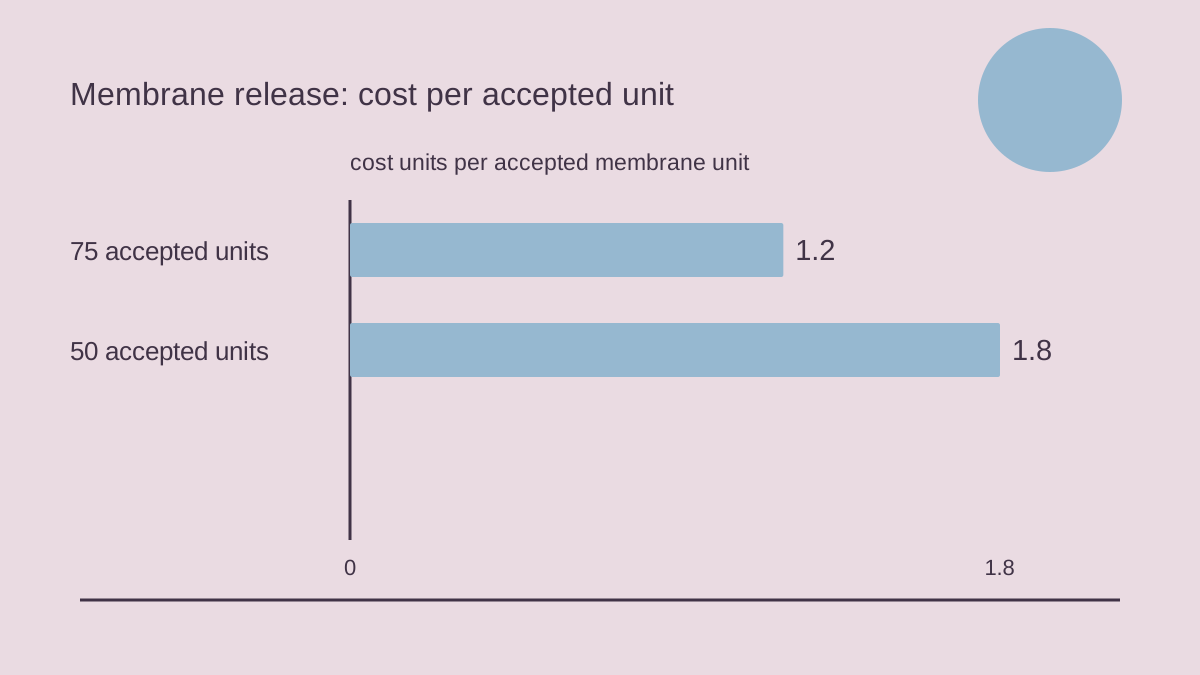
The example shows why dividing by every formed unit would answer the wrong purchasing question. A proposed saving from feedstock cost could be offset by a different acceptance rate or additional finishing work. A complete comparison would reveal that relationship before the supplier committed to a price for a product that the pilot had not yet shown it could supply.
Assign responsibility for rejected output
A supply contract should identify who decides whether a batch is accepted, how a disputed result is reviewed and what happens to rejected material. It should distinguish a manufacturing deviation from a change in the buyer's agreed application. Without that distinction, every rejection risks becoming an argument about a moving target.
Any proposed rework should have an acceptance route of its own. Reprocessing does not automatically restore a component to the original evidence base. The producer would need to show that the released output still meets the agreed specification and to include the cost and delay of obtaining that result. The buyer should know whether reworked material is permitted under its purchase conditions.
The disposition of rejected material also belongs in the financial and environmental account. A potential use elsewhere is not the same as an actual sale or an available recovery credit. Such a credit should be included only with a supported route, defined ownership and realistic timing. Otherwise the model would fund production with an unresolved assumption.
Find the limiting step before adding capacity
A proposed capacity figure should cover the complete route to accepted delivery. It should include preparation of the intermediate, membrane manufacture, finishing, inspection and release, together with whatever recovery operation the chosen route requires. Quoting one isolated operation as the capacity of the full chain would leave the other stages untested.
The development team should identify the step that limits accepted output under the proposed product specification. More equipment at another step may increase work in progress without increasing delivery. That would affect both cash and storage. A staged expansion should therefore be justified by the observed or verified relationship between the limiting step and the customer order.
The plan should also state how a change in product mix affects its assumptions. A larger membrane sheet, a different cut pattern or a new acceptance requirement may change the relevant denominator. Capacity for one defined product should not be advertised as capacity for every separator that could theoretically be made from the same intermediate.
Treat the 2026 work as a plan with checkpoints
The source places further optimisation in the following year. As of the article's December 2025 date, that remains a plan. A commercial assessment can ask what the planned work should establish, but it should not describe future trials as completed evidence or attach production results that the report does not contain.
- Record the intended cell and a comparison baseline.
- Set the acceptance rule and retain batch-to-cell traceability.
- Check repeat production against the same deliverable.
- Account for incoming supply, recovery, finishing and rejected output.
- Define what permits a repeat customer delivery and later expansion.
These checkpoints would connect optimisation to a decision instead of leaving it as a general promise of improvement. They would also allow the project to stop or revise an application if the evidence did not support the original target. A revised target could still be useful, provided the change remained visible in both the technical record and the commercial account.
Make the release record usable across organisations
The evidence chain should have a practical owner at each handover. A supplier's batch identifier needs to remain connected to the customer's receipt and to the cell trial record. If the customer renames the incoming material internally, the correspondence should be preserved. This administrative detail would allow a later question to be traced to the actual delivered batch rather than to a general product name.
The parties should also agree which document takes precedence when a purchase order, a research report and a delivery certificate describe different conditions. A certificate cannot silently expand the qualification described in the research record. An updated purchase requirement should trigger an explicit review of whether the existing evidence still supports it. Resolving these relationships before an order would make the eventual acceptance decision clearer and reduce the risk of treating a paperwork difference as a material failure.
Keep other storage applications as separate qualifications
A research route may create possibilities beyond its first intended cell. Those possibilities should be treated as additional projects with their own material condition, device specification and evidence. The shared feedstock does not make the acceptance conditions of different storage technologies interchangeable.
A developer can preserve a broader research agenda while choosing one focused commercial trial. The wider agenda should not be used to enlarge the implied addressable demand before customer evaluation supports it. For a proposed production investment, the most useful demand evidence would concern the exact product the route is being designed to deliver.
The practical next milestone is therefore a linked chain: a recorded cell result, an agreed separator specification, repeatable accepted batches and a complete supply account. If those elements can be connected, miscanthus-derived cellulose would have a clearer manufacturing proposition. Until then, it remains a research candidate whose device and supply questions should be tested together.
Sources: Интерфакс Россия.



Leave a comment