
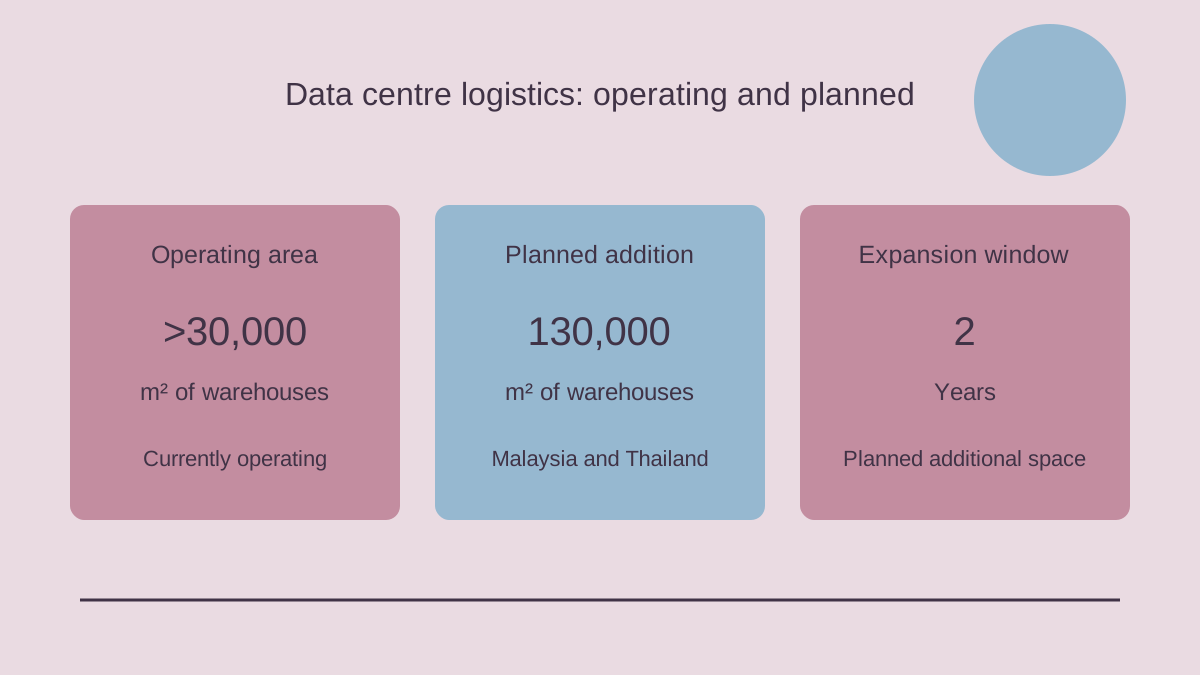
Bernama reported on June 9, 2026, that DHL Supply Chain's data-centre logistics expansion combined more than 30,000 square metres of operating warehouse capacity with another 130,000 square metres planned in Malaysia and Thailand over the following two years. The figures describe logistics infrastructure. A customer's practical question is different: can the right identified equipment pass through the service and reach an accepted installation handoff when the receiving project needs it?
Warehouse area and installation readiness measure different things
Space can support a service without establishing its completed outcome. A warehouse-area figure describes an infrastructure boundary; an accepted installation handoff describes a customer boundary. Comparing the two as though they were interchangeable would obscure the work between them. An evaluation of the proposed expansion should therefore retain both the capacity being offered and the task that capacity is intended to support. This article does not claim that any particular data-centre equipment has already been installed or commissioned through the announced additional space.
The receiving task should be named before the service is judged. It could concern an identified equipment package accepted at an agreed handoff point, rather than the customer's complete operating facility. That narrower endpoint could still be valuable. Its value would come from a clear connection to the receiving project's requirement, not from an implied claim about computing output. A logistics record should show what the provider has demonstrated and where responsibility passes onwards, leaving subsequent installation and commissioning conclusions to their own supporting evidence.
An equipment package needs a service identity
A movement count would become more useful when it can be connected to the equipment package the customer expects. The service assessment should identify the units assigned to the package and the record used to follow them. If the receiving project needs a particular combination, unrelated available units would not automatically fulfil that need. This is a proposed evaluation question, not a description of a proprietary DHL process. Its purpose is to keep the customer requirement attached to the physical items being moved through the assessed service.
Identity should also survive a change in location or handling responsibility. A future record could connect warehouse receipt, release and the accepted handoff without treating each entry as a new unrelated movement. If that connection is incomplete, the uncertainty should be retained. A large total of recorded actions could otherwise create an impression of completeness while leaving the status of one required unit unclear. The practical service question would remain whether the identified package has a reconciled history and an accepted destination outcome.
The receiving project has its own readiness boundary
An available shipment and a ready recipient are separate conditions. A receiving project could have an agreed requirement while the intended handoff remains unassessed. The logistics proposition should identify the receiving condition relevant to the selected service and the point at which that condition is confirmed. The article does not prescribe site preparations or installation procedures. It asks whether the claimed delivery service covers the receiving arrangement actually proposed, rather than assuming that the ability to dispatch equipment establishes the ability to hand it over successfully.
A comparison could therefore retain the scheduled handoff, the recipient's observed readiness and the eventual accepted event as separate entries. An incomplete receiving decision would not be recorded as a failed delivery automatically, but it should not disappear from the service account. It might explain why dispatch performance and accepted handoff performance differ. The distinction would make the assessment fairer to both parties while helping the customer identify the next unresolved decision affecting the project, instead of assigning every delay to an unexplained general logistics category.
The sequence should follow the agreed package
A customer might require a package in a particular agreed sequence. If so, the service assessment should measure that sequence rather than only its total quantity. An arrival can be timely on a general calendar yet remain unsuitable for the receiving task if the required preceding package is unavailable. This is a conditional planning example, not a claim about a specific installation dependency. The evaluator would need to establish the actual receiving requirement before treating sequence as an acceptance criterion for the assessed service.
The record should also show when the receiving requirement changes. A revised sequence would create a revised service commitment, and the comparison should preserve both versions. Judging performance against a requirement adopted after the event could misrepresent what was agreed. Conversely, ignoring an agreed revision could conceal a real mismatch. A documented sequence history would allow the assessment to follow the customer decision without rewriting earlier observations. The service could then be evaluated against the commitment applicable to each identified package at the relevant time.
Dispatch and accepted handoff need separate observations
A dispatch record would show that an identified package left an assessed stage. An accepted handoff record would show that the selected recipient accepted it against the agreed service requirement. Both observations could matter, but they answer different questions. A report about completed handoffs should not rely solely on departure data. A report about warehouse release could legitimately stop at release if it names that boundary accurately. The important distinction is between a measured stage outcome and an assumed continuation beyond the observation.
A future service comparison should apply the same endpoints to the reference arrangement. One provider assessed at dispatch and another assessed at recipient acceptance would produce an uneven ranking. The record could retain intermediate and final observations for both, with explanations for any unresolved interval. That would help identify where a difference arises without presuming its cause. It would also prevent a favourable measurement at one stage from becoming a claim of better installation readiness across the complete customer project without the necessary connecting evidence.
The interface needs an accountable decision
A physical transfer and an accepted transfer are not necessarily the same observation. A future evaluation should identify who receives responsibility at the selected handoff and how the acceptance decision is recorded. The purpose is not to invent a provider's operating procedure. It is to ensure that a service claim has an identifiable decision boundary. If the parties' records describe different statuses for the same package, that mismatch should remain visible until it is reconciled rather than be resolved by selecting the more favourable record.
Reconciliation could connect the physical event, package identity and receiver decision. An evaluator would then be able to distinguish an incomplete record from a confirmed rejection or an accepted event. Those categories call for different follow-up questions. Keeping them separate would help a project assess the service without either concealing an exception or attributing a failure before its explanation is established. The claimed handoff would rest on connected observations, while any wider claims about the customer's installed equipment would remain outside that boundary until separately demonstrated.
A fictional kit separates storage from readiness
Consider an explicitly invented assessment involving ten units divided between two customer kits. This is not a DHL performance record or a description of a real data centre. Suppose all ten units are present in the warehouse, but only one kit has its complete required identity record and a confirmed receiving handoff. The other kit awaits a decision about one assigned unit. The storage count is complete, while the readiness account contains one accepted proposition and one unresolved proposition. The two accounts describe different states.
Now suppose, still only within this fictional example, that the unresolved kit occupies less space than the accepted kit. Ranking the stored units by area would not resolve the missing handoff decision. Nor would dispatching an unrelated unit automatically complete the agreed package. The next useful action would depend on the unresolved identity or recipient requirement. The example explains why expanding a warehouse-area total does not itself establish accepted installation support. The service assessment needs a connection from available space to the particular package and decision the customer actually requires.
A staged expansion should preserve its operating scope
Existing operating infrastructure and committed future infrastructure should have different states in an evaluation. The announcement contains both. A service proposition should identify which locations and periods its observations cover rather than apply current evidence automatically to additional space that remains planned. A successful operation at one assessed location could justify further investigation of another, but would not complete that investigation. Keeping the expansion stages distinct would allow the project to show growth without treating a commitment to build as a demonstrated operating service.
The assessment should also retain a changed scope if customers move between stages. An earlier result would apply to its documented arrangement, while a later arrangement would need an identified transfer decision. Some evidence might remain relevant; some might require extension. The report should explain that relationship instead of assuming complete continuity from a shared brand or service description. This would make the infrastructure programme's practical progress visible through accepted operations, with the proposed next stages still represented accurately as work whose service evidence is developing.
Exceptions should stay attached to the receiving task
A delayed decision, an identity mismatch or a changed customer sequence could affect an assessed handoff in a hypothetical programme. The record should attach the exception to the relevant package and task. Combining all exceptions into an unexplained total would make it difficult to identify which commitment remains unresolved. This article reports no such events in the announced expansion. It proposes an account that could preserve them if observed, allowing the customer to assess the actual service boundary without inferring that every exception has the same explanation.
An exception history should retain the first observation, the decision owner and the eventual outcome. If a revised package is accepted, the result should apply to that revised package, with the earlier status preserved. A corrected record should not silently become evidence that the original proposition was complete. Such a history would help a project learn from a mismatch while keeping the evidence fair. It could distinguish resolution that supports the next commitment from an outstanding question that still limits the scope of the service being offered.
Reverse movements need their own acceptance question
A customer lifecycle could include equipment moving back from a project, as well as equipment moving towards it. If that service is proposed, its endpoint should be defined separately. A returned unit should not automatically be counted as ready for another installation merely because it has reached a warehouse. Its next disposition would need an identified decision and supporting evidence appropriate to that decision. This article provides no equipment-reuse instructions or claim about what happens to actual returned units in the provider's programme.
The identity history would remain useful across the return, but the acceptance question could change. A record might show a completed return handoff while leaving the next use unresolved. Those would be compatible findings. Keeping the states separate would prevent a lifecycle claim from implying that every movement establishes a new accepted deployment. The service could demonstrate value for the stages it actually covers, while subsequent use, disposition or customer commissioning remains a distinct evidence question. The complete lifecycle proposition would grow through those connections rather than through a combined movement count.
A handoff ledger can link infrastructure with service
A concise ledger could organise the observations needed to assess the proposed logistics service. The following fields are an analytical suggestion, not a description of DHL's internal records, a security procedure or evidence of completed customer installations:
- The customer task, agreed package and service acceptance endpoint.
- Unit identities connecting receipt, release and the receiving decision.
- Recipient-readiness observations and the sequence agreed for each package.
- Handoff responsibilities, accepted outcomes and unresolved record mismatches.
- Locations and operating periods covered by the existing evidence.
- Exceptions, revisions and any separate acceptance question for a reverse movement.
The ledger would not establish service performance simply by having a heading for each subject. Its entries would need traceable observations. A missing receiving decision should remain missing, and a planned location should remain planned. This would give the customer a concrete basis for judging the next commitment without treating the infrastructure total as a substitute for the intended installation-support outcome.
The commercial case should follow accepted handoffs
A service comparison would need an identified expenditure boundary and an outcome relevant to the customer. Spending per stored unit would answer a different question from spending per accepted package handoff. A future account should retain the resources committed to unresolved work where they belong inside that boundary. A larger infrastructure commitment would not automatically establish a lower cost or a shorter customer project. This article reports no measured saving, security guarantee or reduction in installation time from the additional planned logistics area.
The strongest future case would connect operating locations, reconciled equipment identities, documented receiving requirements and repeated accepted handoffs. A separate record would establish what those handoffs mean for subsequent installation and commissioning. Until those connections exist, the announced expansion should retain its demonstrated role as an infrastructure proposition, with current operation distinguished from future capacity. That distinction gives the customer a precise way to assess the service: what can be accepted at the selected boundary, which parts remain unresolved, and what evidence would justify expanding the next equipment or delivery commitment.
Sources: Bernama.






Leave a comment