

A factory recovery report is most useful when every milestone has a defined meaning. Access to a building, availability of utilities, movement of finished stock and release of new production describe different parts of a supply route. A buyer needs to know which part has evidence before converting a recovery update into an expected delivery. The commercial task is to connect those stages without letting one stand in for all the others.
On October 9, 2024, Manufacturing Dive carried Elise Reuter's report on Baxter's North Cove factory in Marion, North Carolina, United States, after Hurricane Helene flooding. Baxter reported progress with access and utilities and the movement of unaffected finished goods. Engineering certification and communication of anticipated production plans remained prospective. The update did not establish that the factory had resumed full production.
The following analysis develops an operating and procurement framework for interpreting such an update. It does not add later outcomes, prescribe manufacturing procedures or offer clinical advice. Its proposed checks concern the evidence behind supply commitments: what material is available, what operation has been accepted and what delivery a counterparty can reasonably recognise from the documented status.
Define recovery by the service being restored
The starting point should be the service the factory is expected to deliver. A recovery plan can contain many valuable activities, but their commercial significance depends on the output the customer is waiting for. The plan should name that output and its acceptance boundary rather than use an undifferentiated declaration that the site is returning to normal.
A stated boundary would let the team distinguish restoration of premises from restoration of a particular manufacturing route. If the intended product requires several operations, the plan should show their relationship without assuming that completing one proves readiness of the rest. This is an analytical requirement for the proposed account, not a statement about undisclosed conditions inside Baxter's plant.
The same definition should appear in the customer-facing commitment. If the factory reports readiness for a limited task, the delivery forecast should preserve that limitation. A broader promise would need additional evidence. Clear scope would allow a buyer to use an update without guessing whether the word recovery means access, a trial operation or recurring accepted supply.
Make access an enabling milestone
An access milestone should explain which movement it permits and who has accepted that movement for the stated purpose. Entry for assessment and access for a defined shipping activity are not automatically the same decision. A plan should retain the distinction so that its readers can understand what the completed work enables next.
The record should also identify any conditions attached to the access decision. If a route is available for a particular activity, the schedule needs to recognise that scope. The proposed framework does not infer load limits or engineering findings for the reported site. It asks that whatever conditions actually apply remain visible to the people making the next operational commitment.
Commercial reporting should therefore connect access to a specific subsequent task, not directly to total production capacity. A delivery forecast can explain that a documented movement is now possible while leaving other dependencies open. That narrower account would preserve the value of progress without using it to establish an operating result beyond its evidence.
Distinguish utility availability from accepted operation
A utility-restoration update should identify the service restored and the operational boundary to which the observation applies. Availability can be important, but a manufacturing commitment still needs the decision that the intended operation can use the service under its agreed conditions. The two milestones should remain separate in the recovery record.
The team should state what observation would close the next dependency. It should assign an owner for that decision and retain its basis. This would let a scheduler see whether the production plan relies on an accepted condition, a pending check or an expectation. The framework supplies no technical limits and makes no finding about the reported factory's utility quality.
If a service is restored before other required work is complete, the report can recognise that achievement without describing the complete route as ready. A sequence of narrower decisions would be easier to update when another dependency changes. It would also reduce the risk of several teams interpreting one broad status word as different permissions.
Account for existing finished goods separately
Existing finished goods require their own quantity, location and release status. Moving them may support a delivery without demonstrating new production at the affected factory. The inventory account should preserve that origin so that the shipment can be understood as use of an existing stock rather than evidence of a restarted manufacturing route.
The quantity physically present and the quantity available for the proposed delivery should be separately defined. A warehouse count does not itself establish every permission required for a sale or shipment. The project should use the actual applicable acceptance process and identify its decision, without this analysis inventing a product-release protocol or asserting an undisclosed inventory condition.
A forecast should then show which commitments rely on the released stock. That would help the team avoid assigning the same available quantity to several customers or several periods. A recovered stock can be commercially significant while remaining finite; its movement should not become an unexplained recurring source in a longer-term production plan.
Keep new output on a different evidence path
New output needs an account linked to the restored operation. The plan should define the milestone permitting that operation, the quantity produced and the decision accepting the quantity for its intended next stage. An earlier shipment from stock cannot close those milestones because it represents a different source of supply.
The account should preserve the period represented by an operating observation. A result for a defined run can support a statement about that run. It cannot independently establish output for every later period or every product configuration. The team needs to explain the scope of its observation before using it in a recurring supply forecast.
The point is not to undervalue the first accepted output. It can be an important recovery milestone. The purpose is to keep its meaning intact and identify what additional evidence would support the next commercial commitment. A sequence from accepted operation to accepted output and then recurring delivery would be more informative than one combined reopening date.
Reconcile stocks, production and deliveries
A recovery ledger should distinguish the sources contributing to supply. Beginning released stock, newly released production, incoming transfers and deliveries each need a defined quantity and period. The combined account should make it possible to return from a delivery total to the source supporting it, rather than leave the reader to infer production from dispatch activity.
Consider a purely hypothetical illustration in abstract units. A period begins with 80 available units, receives no newly released production and ships 30 units. The remaining stock is 50, subject to the definitions of the illustration. The 30 shipped units show a delivery activity, not 30 units of restarted production. These are not Baxter inventory or shipment figures.
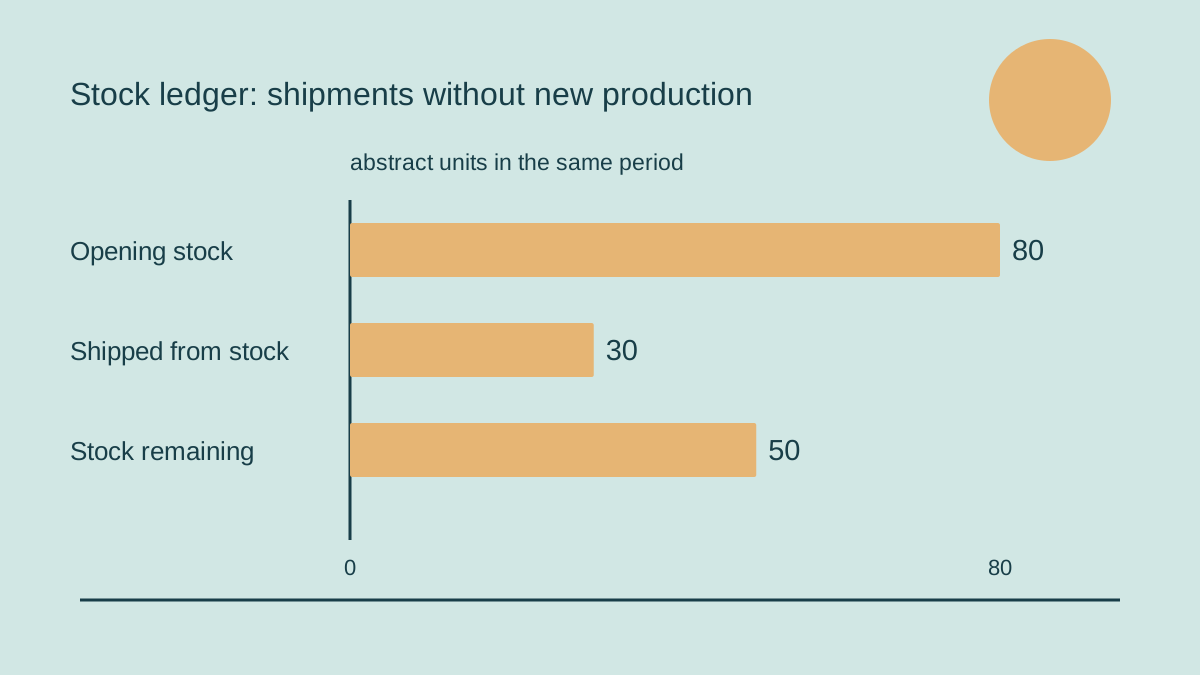
The example does not estimate how long actual stocks would last. It shows why the reconciliation matters. A real forecast would need documented quantities, commitments and applicable release decisions. Keeping those elements visible would allow a purchaser to understand which deliveries have a stock basis and which depend on an unfinished recovery stage.
Give alternative-site supply its own scope
If a recovery plan includes output from another facility, that source should have its own account. The model should identify the product, quantity, period and acceptance boundary supporting the proposed transfer or delivery. An alternative location is a source to be examined, rather than an automatic substitute for every commitment of the affected factory.
The plan should distinguish a proposed allocation from a confirmed commitment. A possible quantity can be useful in a scenario, but it should remain conditional until its basis changes. This framework makes no claim about the actual capacity, qualification or delivery performance of Baxter's other sites. Those conclusions would require the corresponding evidence.
The combined schedule should also preserve responsibility for the handoff. A quantity available at another location is not identical to a quantity accepted at the customer's delivery point. Naming the intervening obligations would allow the model to compare equivalent outcomes and would prevent a source substitution from concealing a new unfinished part of the supply route.
Describe allocations without converting them into clinical rules
A commercial allocation should identify the quantity, customer group and period represented by the commitment. The buyer needs to know whether the number describes a confirmed delivery, a planning ceiling or a provisional expectation. Those meanings should not be merged, because they support different procurement decisions and different interpretations of an order acknowledgement.
The supply account should also distinguish the customer's request from the seller's accepted obligation. If the two differ, the difference belongs in the record. This is a commercial reconciliation, not a recommendation about how a healthcare provider should use a product or distribute it among patients. Those decisions are outside the scope of this analysis.
An updated allocation should show its effective period and the commitments it replaces. That would help both parties avoid treating an older quantity and a newer quantity as additional supply. A documented change can be useful even when it reduces an expectation, because it lets the buyer revise a procurement plan against the current acknowledged commitment.
Record readiness decisions with their limits
Each readiness decision should have an owner, a stated scope and an evidence reference. A completed assessment can support the decision assigned to it, while another required assessment remains pending. The project should be able to explain that separation without asking a general statement of progress to act as every required permission.
If an acceptance has conditions, the schedule should carry them forward. A conditional decision may allow a limited next activity and still leave other work open. Removing the condition from a status summary would change the meaning of the decision. The record should retain both the accepted task and the obligations that have not yet been discharged.
The customer-facing update need not reproduce every internal document. It should, however, use a description consistent with those documents. A concise update can identify what has been accepted, what remains prospective and which delivery implication follows. That makes brevity compatible with precision rather than leaving a buyer to reconstruct the evidence chain from broad assurances.
Use dates as scoped forecasts
A recovery date should name its milestone. A date for an assessment, a proposed trial and an expected shipment do not describe the same event. The schedule should state which one is being forecast and which dependencies remain. A single date labelled return to operation would otherwise conceal the separate assumptions behind the commercial promise.
The forecast should also preserve the date on which it was made. A later revision can be legitimate when new evidence changes the plan, but the record should explain what changed. Retaining the earlier version would allow the team to examine whether the revision came from better information, a different scope or a new decision about priorities.
A historical report should retain the knowledge available at publication. Future plans in that report must remain future plans unless a separate later source is introduced. This analysis does not use subsequent outcomes to make the October 2024 update appear more conclusive than it was. Its commercial framework begins with the limits of that dated evidence.
Keep people and responsibilities visible
A recovery plan should identify the parties responsible for each proposed activity and acceptance. An equipment or premises milestone alone does not establish that the necessary operating responsibilities have been assigned. The schedule should show who can authorise the next task and who will maintain the record connecting that task to the supply commitment.
The plan should also distinguish an assumed availability from a confirmed arrangement. This is a question for project governance, not an assertion about the reported workforce's condition. The framework does not infer employee availability from a building update or introduce personal information. It asks that the operating plan use evidence appropriate to the responsibilities it relies on.
A handover between teams should preserve unfinished obligations. If the recovery team passes a task to the operating team, the record should explain what is complete and what remains to be verified. This would keep a change of organisational owner from being mistaken for completion of the operational requirement itself.
Separate recovery expenditure from supply performance
The recovery account should identify the work and costs within its stated boundary. Spending can demonstrate that resources have been committed, but it does not independently establish accepted output. A business review should retain separate evidence for the expenditure, the milestone achieved and the supply result attributed to that milestone.
Where a temporary arrangement supports a delivery, its cost and period should be visible. If another budget carries the expense, the complete account should still identify it. Moving a cost between teams does not explain whether the proposed supply route is commercially repeatable, and a one-period arrangement should not silently become an indefinite operating assumption.
The review should avoid converting every restoration cost into an investment benefit. Some work may restore the original service; another proposed change may have a different purpose. The account needs to identify those purposes and the evidence for any claimed improvement. This framework does not calculate actual recovery costs, margins or financial returns for the reported event.
Use a release sequence that supports revision
A useful sequence should make it possible to revise a commitment when a dependency is not met. The project can preserve completed work while explaining why a later stage remains open. That is more informative than requiring every recovery update to support the same broad conclusion, regardless of which part of the route has changed.
- Define the intended product and delivery boundary.
- Record the access and utility decisions enabling the next task.
- Separate released finished stock from new production.
- Keep alternative-site commitments within their own evidence.
- Reconcile available quantities with acknowledged deliveries.
- Carry pending conditions into dates and customer updates.
The sequence would allow a buyer to recognise genuine progress and retain the uncertainty attached to unfinished work. A limitation does not erase a completed milestone. It identifies the question the next observation must answer before the supplier and customer can expand their commercial commitment.
The meaningful endpoint is accepted supply
The reported recovery progress provides a reason to examine how a factory's physical restoration connects to its customer obligations. It does not settle the full-production outcome. A defensible account would preserve the path from an enabling condition to an accepted operation, a released quantity and a delivery supported by that quantity.
If later evidence closes those stages, it would support a more specific recovery statement. Until then, the historical update should retain its limits. The buyer's central question is which supply commitment the documented status supports now, and which additional decisions are still needed before a broader commitment can be made.
Sources: Manufacturing Dive.






Leave a comment