

A manufacturing network's capacity total becomes commercially useful only when the unit, product scope and delivery boundary are defined. Adding equipment can expand a proposed route, but a customer buys a particular accepted supply rather than an abstract network number. The investment question is how the stated capacity connects to that supply, and which assumptions must hold for the connection to remain valid.
On February 27, 2024, Manufacturing Dive reported National Resilience's expansion plans for Cincinnati, Ohio, and Durham, North Carolina, United States. The company targeted more than 200 million units across its network by 2025 and planned at least $225 million for Cincinnati. These were forward-looking plans. The reported unit total did not establish a number of patients, doses or accepted deliveries from one site.
The following analysis examines the accounting and scheduling questions behind such an expansion. It does not estimate the company's achieved output, prescribe pharmaceutical manufacturing procedures or assess a medicine's clinical performance. Its focus is the commercial definition of capacity: what is counted, where it becomes available, which operation the count represents and what evidence would support a customer's supply commitment.
Write the capacity unit before writing the total
A proposed capacity account should begin with a unit dictionary. It should name the physical or commercial item represented by each count and the stage at which it is counted. A unit at filling, a unit entering assembly and a unit accepted for delivery may be related, but the account should explain that relationship instead of assuming the labels mean the same thing.
The dictionary should also identify whether a count describes an individual item or a grouping. If the product definition changes, the model must preserve the version associated with the capacity figure. Otherwise a later report could retain the number while changing what each counted unit represents, making an apparent comparison answer a different question from the original investment case.
The same discipline applies to public communication. A network total can remain informative within its stated scope. It should not become a patient count or a treatment quantity without the separate evidence required for that conversion. This analysis makes no such conversion; its question is how a manufacturing count would be connected to an agreed product and transaction.
Separate an operation's capacity from a complete route
The factory model should identify the operations required to reach the customer boundary. Filling, assembly and packaging should each have a defined role within the proposed route. A capacity addition at one operation can be important while leaving the route's final deliverable dependent on other operations. The investment account should show those dependencies rather than describe every installed addition as an equal increase in final supply.
The route should also state where an operation occurs. If work moves between facilities, its transfer and acceptance responsibilities belong in the account. A network label does not remove the need to explain the handoff. The customer needs to understand which completed result supports the next stage and which party is responsible for making that result available.
This proposed mapping does not assert an undisclosed bottleneck at Resilience's sites. It establishes the information needed to test a capacity claim. Once the route is defined, a reviewer can ask whether each proposed output is supported by the tasks it depends on, without inventing an operational problem or assuming that no problem could exist.
Give product mix an explicit place in the schedule
A capacity model should identify the product mix assumed for its total. If several configurations share a proposed resource, their quantities need a scheduling basis. The account should not assume that each product can independently use the entire resource during the same period. A common schedule would make the combined proposal assessable against the time and responsibilities available.
The model should preserve the distinction between an illustrative mix and a committed mix. An illustration can explain how the route might operate, but it does not establish the customer's actual order pattern. The investment review should identify which assumptions are supported by commitments and which remain scenarios awaiting confirmation or a revised planning decision.
If the mix changes, the reviewer needs to know which conclusions must be reconsidered. A capacity figure may remain meaningful under the original assumptions while no longer describing the revised schedule. Keeping the original and revised versions would allow the project to explain the change without treating one total as a universal promise for every possible product combination.
Use a common period for linked operations
Linked operations should be compared within a defined period. A proposed annual quantity and a shorter-period observation cannot be treated as equivalent without explaining the relationship. The account should name its operating calendar, the availability assumed within that calendar and the scope of any adjustment. These are modelling definitions, not a forecast of the company's actual utilisation.
Consider a completely hypothetical route in abstract accepted units per defined period. Filling can support 90 units, assembly 70 and packaging 80, under matching definitions. If every delivered unit requires each operation, the proposed complete route cannot claim 240 finished units by adding the three counts. Within the illustration, assembly sets a ceiling of 70 before other dependencies are considered.
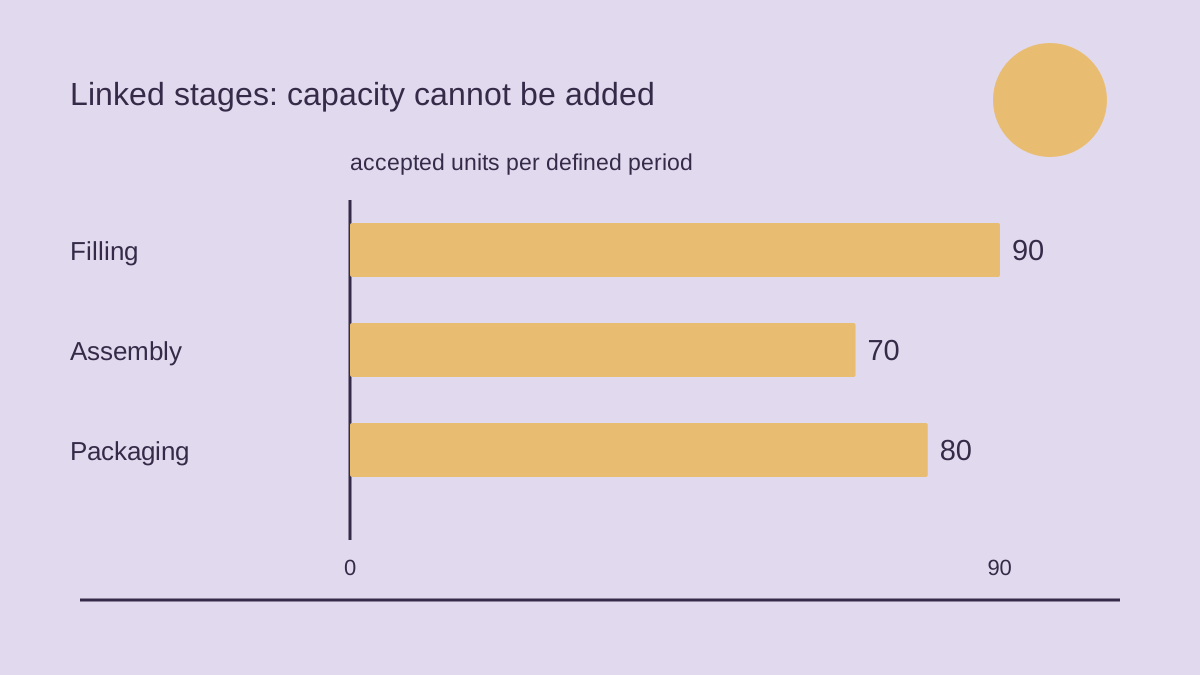
These figures are not Resilience measurements and do not locate a real bottleneck. They show why linked-stage counts should not be added as though they were separate finished products. A real capacity account would need its own documented stage definitions, schedule and acceptance decisions before drawing a conclusion about delivered quantity.
Keep acceptance inside the definition of output
The model should identify the decision that makes a quantity available for the next task or for delivery. Produced quantity and accepted quantity should remain reconcilable. If the commercial proposal uses an accepted-output figure, the review needs the boundary supporting that figure rather than a general equipment specification or an unqualified production count.
The acceptance scope should remain linked to the product version and operating conditions represented. An observation for one defined task cannot independently establish every later configuration. The account can use that observation for its actual purpose while naming the further evidence needed to support a broader commitment. This analysis does not prescribe a release protocol or claim a regulatory approval.
Where a decision remains pending, the schedule should show the dependency. A prospective quantity may be useful in planning, but it should not silently become available inventory. Preserving that status would help the commercial team distinguish a proposed expansion result from a quantity that has already passed the decisions required for the acknowledged supply transaction.
Distinguish equipment installation from recurring delivery
An expansion schedule should assign a specific meaning to each milestone. Installation, an accepted operating task, an accepted output and a recurring delivery commitment describe different results. The project should identify the evidence closing each one. Completing an earlier milestone can be valuable without establishing that every later dependency has also been completed.
A plan should state which milestone its date forecasts. If a line is expected to be completed by a future year, the historical account should preserve that expectation rather than use it as proof of current output. A later operating conclusion would require later evidence. The February 2024 report should therefore be read within the plans and information available at that date.
The commercial benefit of this separation is a schedule that can be revised precisely. If one dependency changes, the team can show the affected commitments without rewriting all progress as either a complete success or a complete failure. A scoped milestone record would keep useful achievements visible while preserving uncertainty where work remains unfinished.
Allocate network capacity without double counting it
A network proposal should explain how capacity is assigned across products, sites and partners. The same available quantity should not support several incompatible commitments in the same period. A commercial account needs to distinguish the resource available from the claims already placed on it, with a common definition of quantity and timing.
An internal transfer should also have a clear meaning. A quantity counted when it leaves one site and again when it enters another is not automatically two finished deliveries. The network account should retain both movements where useful, while reconciling them to the unique output supporting the external transaction. This would prevent activity counts from becoming an inflated supply total.
Where an allocation remains conditional, the model should carry the condition. A possible network assignment can support a scenario, but it should not be described as firm partner supply until the relevant commitment is established. The account should explain the decision that changes the status, rather than rely on the size of the announced network target.
Define the customer's reservation separately
A partner agreement should identify the product, period and scope of the reserved service. A reservation of time, an expected production quantity and an accepted-delivery obligation may represent different transactions. The customer needs to understand which one it is buying and which remaining conditions govern the conversion from a reservation to actual supplied product.
The agreement should also state which changes require reconsideration. If the customer changes its requested product or schedule, the parties need a defined way to assess the effect on the original reservation. This is a proposed commercial question, not a statement about Resilience's actual partner contracts or their undisclosed conditions.
A confirmed reservation should be kept separate from broader market expectations. Interest in a product category does not by itself establish a particular customer's obligation. The model can describe expected demand as an assumption, while keeping signed commitments, proposals and possible future orders in distinguishable categories. That would make the investment case reviewable without converting all demand scenarios into revenue.
Include inputs and handoffs in the availability claim
The route's proposed availability should identify the inputs and decisions it assumes. An installed operation needs more than an equipment count to support a delivery schedule. The model should name the responsibility for making the agreed inputs available, accepting them at the required boundary and handing the result to the next operation.
If another party supplies an input or service, that obligation should remain visible. The account should distinguish a confirmed arrangement from an assumed one and state the consequence of a change. This analysis does not introduce specific material requirements or manufacturing instructions; it asks that the actual chosen route's dependencies be included in its commercial description.
The schedule should also show the status of material between operations. A quantity waiting for a decision is different from a quantity available for the next task. Preserving those statuses would allow a reviewer to see whether the capacity proposal is supported by a complete route or by several unconnected observations of local activity.
Compare costs against the same service
The expansion account should define what its expenditure purchases. A capital total can describe resources committed, but it does not independently establish a unit cost or financial return. Those conclusions need the complete expenditure boundary, the output definition and the period represented. The project should keep these elements connected rather than infer operating economics from the investment amount alone.
Where several operations share an expense, the allocation rule should be stated. The reviewer needs to know whether the rule represents an observation or a management choice. A useful allocation can support planning when its limitations are clear; it should not be presented as a separately measured cost that the available records never actually identified.
Comparison with an alternative should purchase the same service. A proposal including assembly and delivery cannot be compared directly with a price for filling alone as though the scopes were equivalent. Identifying the remaining obligations would make the commercial comparison more informative and would prevent a missing task from looking like a genuine cost advantage.
Keep clinical and manufacturing conclusions separate
A manufacturing expansion does not establish a medicine's clinical result. A capacity unit also does not identify a treated person without the additional definitions and evidence required for that statement. The commercial analysis should retain its own scope: accepted product, operation, quantity and delivery, rather than use a larger manufacturing count as a claim about patient outcomes.
The same boundary applies to approval claims. A planned production addition should not be described as authorising a medicine or demonstrating every applicable permission. Such a conclusion would need its own authoritative evidence. This analysis makes no finding about a particular therapy's approval status, effectiveness, dosing or suitability for an individual.
Maintaining the boundary does not make the supply question unimportant. It makes the question precise enough to assess. A customer can examine whether a supplier has a documented route to the agreed product while leaving clinical decisions to their appropriate evidence and responsibilities. The expansion narrative should not merge those different decisions into one unsupported conclusion.
Make the capacity register useful after the announcement
A continuing register should preserve the original target and the observations later used to assess it. It should name the site, product definition, period and status associated with each figure. If the target is revised, the record should explain why, allowing the reviewer to distinguish a changed definition from changed operating performance.
The register should also identify which figures can be combined. Quantities representing different stages or incompatible products may require separate presentation. A total is useful when its composition is understandable, not merely because it is large. The reader should be able to trace the headline back to the site-level accounts and their acceptance boundaries.
This record would let the investment review remain a live decision process. A result below an assumed range could identify work requiring revision, while a supported result could justify a more specific commitment. In either case, the register should retain the evidence rather than select only observations that make the original announcement appear complete.
Use a decision sequence rather than an equipment tally
The next useful milestone would connect the unit definition to the complete route and the partner transaction. A reviewer should be able to identify the evidence for each connection and the remaining condition that would change the decision. This would turn an expansion plan into a testable commercial proposition.
- Define the counted item and its acceptance stage.
- Map the linked operations and their shared period.
- State the product mix assumed in the schedule.
- Reconcile site movements with unique external output.
- Separate partner reservations from confirmed deliveries.
- Keep future milestones and unsupported conversions outside realised results.
The reported plans provide a reason to examine this sequence, but they do not complete it. A credible capacity statement would preserve its unit and boundary from the first target through later operating evidence. The central commercial question is which accepted supply the network can support for a defined partner and period, rather than how many unlike activities can be collected into one total.
Sources: Manufacturing Dive.





Leave a comment