

An extra protective layer can improve a manufacturing route only if its contribution survives the complete journey to an accepted product. A promising intermediate structure is a reason to investigate, but purchasing decisions need a comparison of usable output, additional work and uncertainty. For diffractive optics, the central commercial question is therefore not whether a more elaborate process looks impressive. It is whether that process produces the required optical element more dependably at an acceptable total cost.
On August 23, 2024, Interfax reported research in Novosibirsk, Russia, on laser writing with silicon-coated metal films. It attributed the announcement to Nauka v Sibiri. The report described a promising chromium route with a more resistant mask, although processing required two etchants. Further experiments to establish error limits and applications remained planned.
This article proposes an original framework for assessing such a process change. The checks below are conditional requirements for a future manufacturing evaluation, not reported test results or a description of an existing factory. No yield improvement, customer qualification, commercial launch or environmental benefit is assumed. A defensible decision would connect the extra operations to evidence about finished optics, while preserving the distinction between a useful research result and a production commitment.
Start with the optical task, not the coating
A proposed evaluation should begin with the function the finished element must perform. The purchaser and developer would need a common definition of the intended optical task, operating conditions and acceptance method. Without that definition, an attractive surface pattern could become the object of the trial even though the customer needs a particular optical response. The product requirement should determine what is measured, rather than allowing the easiest measurement to define the product.
The specification would also need a declared revision. If the intended use changes during development, the team should recognise that the evidence may no longer answer the same question. A successful result against one drawing should not silently qualify another design. Maintaining this distinction allows research to continue without converting every experimental improvement into a claim of manufacturing readiness.
Separate the layer's role from the whole route
The extra layer should have a clearly stated purpose in the proposed process. The evaluation would ask which failure mechanism it is intended to address, where that mechanism appears and which observation would show that the intervention is useful. A precise hypothesis is easier to test than a general promise of better quality. It also makes an unfavourable finding useful: the team could discover that the identified problem contributes little to the final rejection rate.
The route should nevertheless be assessed as a connected sequence. Depositing an additional layer might alter handling, cleaning, waiting time or later inspection requirements. These are possibilities to examine, not facts about the reported experiments. The trial should record such changes explicitly so that an apparent improvement at one operation is not accepted while a new source of loss elsewhere remains outside the comparison.
Choose a baseline that answers the business question
A credible comparison would specify the existing or alternative route before collecting results. That baseline should produce a comparable optical function and face the same acceptance criteria. Comparing the new process with an intentionally weak reference would tell the purchaser little about a realistic choice. Conversely, comparing unrelated products could punish the new route for differences that arise from design rather than processing.
The team would need to document any deliberate difference in materials, equipment condition or operator preparation. Perfect identity may be impractical, but unexplained differences would make interpretation difficult. If the baseline is itself being improved, the evaluation should track its revision rather than treating an earlier version as a permanent competitor. The commercial question concerns the best relevant alternatives available to the decision, not simply the first reference chosen.
Count accepted elements at a declared boundary
The word yield is incomplete without a denominator and an acceptance boundary. A proposed trial should distinguish started substrates, completed structures, inspected elements and products accepted for the intended task. Reporting a high proportion at an intermediate stage could conceal later rejection. Equally, rejecting a part for a requirement added after the trial would distort the comparison unless the changed boundary is disclosed.
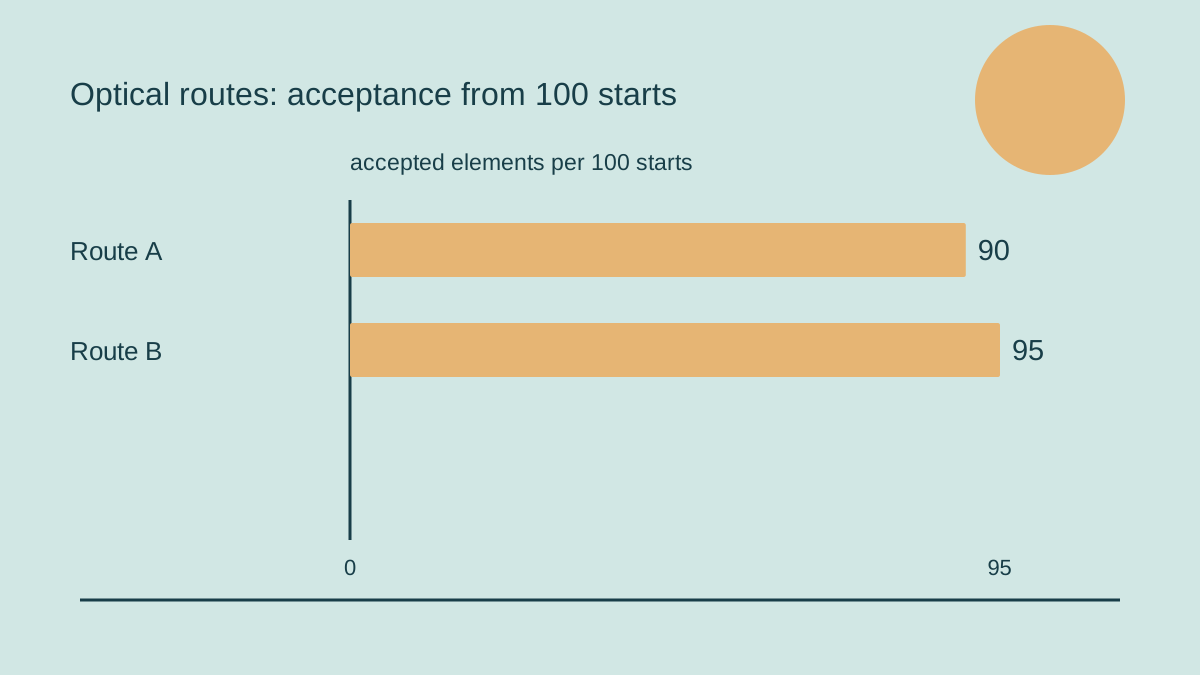
A simple, explicitly hypothetical illustration shows the issue. Suppose one route accepts ninety elements from one hundred starts, while another accepts ninety-five. The second route has a higher acceptance fraction in this invented example, but that alone does not establish lower cost. Its extra operations may consume more resources. These numbers are not measurements from Novosibirsk; they demonstrate why the acceptance count and resource account must be evaluated together.
Build a cost account around usable output
The relevant economic comparison would include the resources needed to obtain an accepted element. A project could record materials, equipment occupation, labour, inspection and rejected work at a consistent boundary. The accounting method should be shared before the trial, because a favourable result can otherwise arise from assigning an inconvenient expense to another department. The purpose is to understand a real manufacturing choice, not to make one stage appear inexpensive.
Development effort and routine production should be identified separately. An experimental run may need unusually intensive measurement, while a future routine route might require a different inspection scheme. Neither assumption should be hidden. The decision should show which costs were observed, which were estimated and what evidence would support reducing them. A forecast of eventual savings remains a forecast until the proposed operating conditions have been demonstrated.
Make repeatability a separate acceptance question
A successful specimen would establish that a result was obtained under its recorded conditions. A purchaser seeking regular supply would also need evidence about consistency across repeated work. The proposed qualification should therefore define what counts as a repeat and which variation matters to the optical task. It should avoid interpreting numerous measurements of one element as proof that independent production runs behave similarly.
The trial design could consider different batches, preparation dates or operators where those differences are relevant. It would need a rationale for the chosen scope and a record of exceptions. If results vary, the useful response is to investigate the pattern rather than remove inconvenient runs without explanation. A stable route is one whose limits can be described and managed, not one whose uncertainty disappears from the presentation.
Control the meaning of measurement
Measurement would need its own acceptance logic. The team should identify what each instrument observes, how that observation relates to the finished optical requirement and what uncertainty accompanies the result. A dimensional record and an optical performance test may answer different questions. Agreement with one should not be allowed to substitute for the other without a demonstrated relationship that the customer accepts.
If alternative measurement methods disagree, the evaluation should preserve the disagreement and examine its cause. Selecting the more flattering reading would not resolve the underlying uncertainty. The qualification record could state which method governs acceptance and why, while keeping supporting observations available. This would let another reviewer distinguish a process limitation from an instrument limitation and understand the evidence behind the decision.
Include the time between operations
A process map should include waiting and storage as well as active work. A future manufacturing route might leave prepared material between operations longer than a laboratory demonstration does. The evaluation would need to decide whether those intervals could affect the product and, if so, what conditions should be recorded. The article does not assume any particular ageing mechanism or storage lifetime for the reported technology.
Scheduling belongs in the same inquiry. An additional operation might be manageable on an otherwise available tool, or it might create a bottleneck when demand grows. These alternatives require evidence about the intended route. A production forecast should identify the assumed equipment availability, allowed waiting conditions and response to an interrupted sequence. A continuous laboratory demonstration would not automatically validate an intermittent factory schedule.
Assess rejected work without disguising it as recovery
The trial should distinguish first-pass acceptance from any permitted rework. If a rejected element can be recovered, the recovery operation would need a defined method and renewed acceptance. Counting every attempted recovery as usable output would inflate the result. Counting recovered products together with first-pass products without showing the additional effort would conceal a potentially important economic difference between routes.
Rejection categories should support decisions rather than serve as decorative statistics. A useful record would show whether losses are associated with preparation, processing, handling, inspection or an unresolved cause. The categories are proposed bookkeeping choices, not findings about this project. Their value lies in identifying where another experiment could reduce uncertainty and whether the extra layer addresses the losses that matter most.
Review chemical and waste requirements on their own evidence
A more complex processing sequence would require an appropriate assessment by qualified specialists before implementation. The evaluation should identify the proposed substances, equipment and handling conditions rather than infer safety from the small scale of an optical component. This article does not provide chemical operating instructions. The commercial plan would need the documented approvals and responsibilities applicable to the intended installation.
Resource or environmental claims would also need a stated comparison boundary. Fewer rejected elements might reduce some material losses, while extra operations might introduce other demands. Without an account of both sides, neither a sustainability advantage nor a disadvantage is established. The prudent evaluation would disclose which flows were measured, which remain unknown and which claim the available evidence can actually support.
Define responsibilities before a customer trial
A customer trial should make clear who supplies the design, who prepares the elements and who decides whether the optical task has been met. These responsibilities would prevent a useful experimental delivery from becoming an ambiguous promise of routine supply. The parties should agree how an unexpected result will be documented and which questions require another run rather than an immediate commercial conclusion.
The record should also explain how design information and process evidence can be reviewed without assuming unrestricted disclosure of confidential work. A purchaser may need sufficient evidence to judge repeatability while the developer retains protected knowledge. The parties would have to settle that balance explicitly. An undisclosed mechanism is not automatically a defect, but a claim that cannot be assessed needs a narrower commercial commitment.
Use decision gates instead of a single launch declaration
A staged decision could preserve useful progress without pretending that all uncertainties have disappeared. Each gate would answer a defined question and specify the evidence needed to proceed. The following sequence is a suggested evaluation structure, not a programme announced by the researchers or an account of milestones already completed.
- Agree the optical task, product revision and acceptance method.
- Compare a documented baseline with the proposed route.
- Review accepted output, uncertainty and additional process effort together.
- Test relevant repetition, waiting conditions and exception handling.
- Approve only the commercial scope supported by the resulting evidence.
A gate may produce a limited approval rather than an unrestricted one. For example, evidence for a particular design would support a decision about that design within its tested conditions. Extending the claim would require an explained basis. This approach gives development a practical destination while allowing unresolved questions to remain visible.
Write the supply claim at the same scale as the evidence
A proposed offer should say what can be supplied, under which accepted conditions and with which documentation. Terms such as production-ready or high yield are insufficient if they omit the product revision and trial boundary. A buyer would need to understand whether the offer concerns experimental elements, a limited qualified batch or a repeatable manufacturing service. Those are different commitments even when they involve similar-looking components.
The developer should preserve the date and scope of the underlying evidence. A later change in equipment, design or materials could require a review before the earlier qualification is reused. This does not mean every change necessarily invalidates the route. It means the decision should explain why the evidence still applies. Commercial clarity comes from that traceable explanation, not from repeating a broad success label.
Keep an unfavourable comparison useful
A trial could conclude that the additional layer does not justify its full cost for the selected application. That would be a valuable result if the baseline, accounting and acceptance criteria were sound. The analysis might show that the targeted loss is uncommon, that another operation dominates expenditure or that the optical task can be met more simply. None of these possibilities is a reported outcome of the Novosibirsk work.
The team could then decide whether another application deserves investigation or whether the development should remain outside the current purchasing plan. It should not turn a disappointing comparison into an untested claim about a different market. A disciplined account preserves what was learned, names the unresolved question and defines the next experiment only where a plausible decision depends on its answer.
Connect a research opportunity to a reviewable decision
The value of an additional protective layer would ultimately lie in the accepted optical function it helps deliver. A manufacturing evaluation should connect that function to the complete route, repeated evidence and an honest cost account. The reported research provides a reason to ask those questions; it does not supply the answers for an unspecified factory or customer.
A reviewable decision would therefore contain a bounded product claim, a declared comparison, the relevant observations and the remaining uncertainty. If the extra operations earn their place through better usable output or another documented benefit, that case can be assessed on its merits. If they do not, the evidence still improves the choice. Either outcome is more useful to a purchaser than a production promise detached from the conditions under which the optics were actually evaluated.
Sources: Interfax Russia.




Leave a comment