

A battery material that performs well in a cold laboratory test opens a development opportunity. It does not yet answer how a complete battery would serve an outdoor machine, a stationary installation or another customer application. The useful bridge is a defined operating duty: what the equipment must do, at which conditions, and with what evidence. Without that bridge, a promising capacity result can acquire a commercial meaning that the experiment never tested.
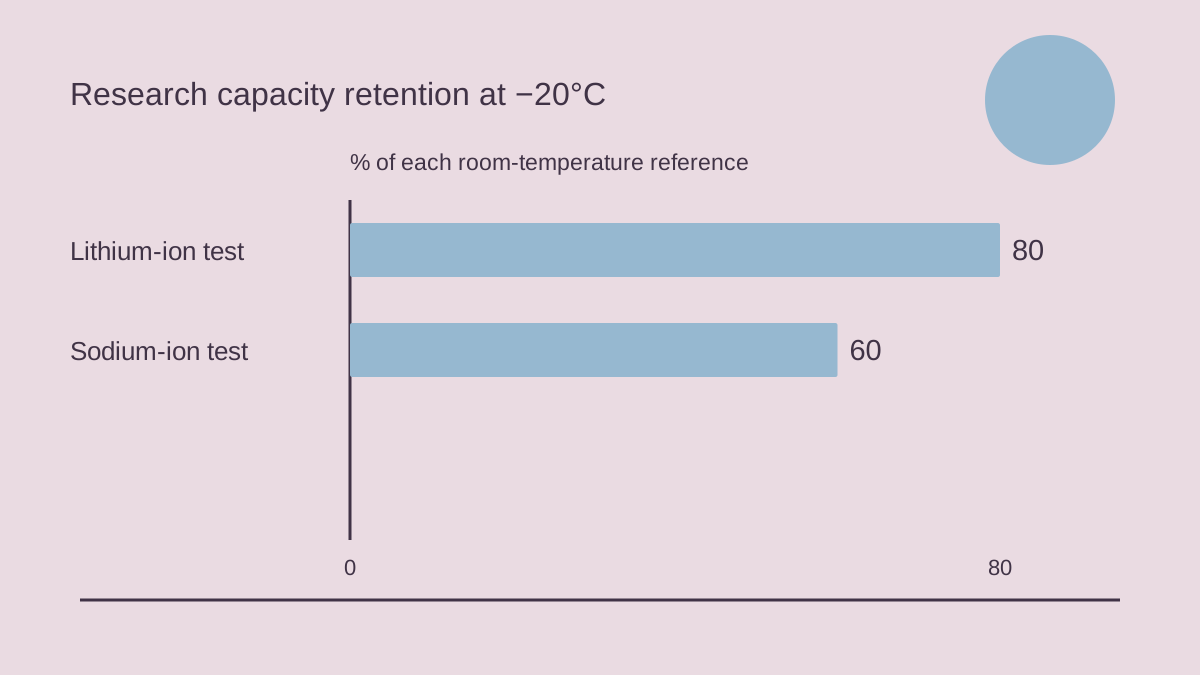
On October 29, 2024, Interfax reported electrode-material research in Novosibirsk, Russia, attributing the announcement to Nauka v Sibiri. After electrolyte changes, researchers reported capacity retention from room temperature to minus twenty degrees Celsius of eighty percent for lithium-ion and sixty percent for sodium-ion tests. Trials at still lower temperatures remained planned. These were research findings, not qualification of a finished commercial battery.
The following analysis develops an original, conditional framework for translating material research into purchasing questions. It does not add undisclosed experimental methods, certify a battery or recommend charging procedures. Its aim is to distinguish the questions answered by a cold-capacity measurement from the questions a customer would need answered before relying on a complete product in a specified duty.
Define winter performance through the intended service
The evaluation should begin with the equipment's task rather than a general promise of winter operation. An installation that must provide a short burst of output presents a different purchasing question from one expected to support a long unattended duty. The buyer should state the required service, its duration and the consequence of an interruption. The battery proposal can then be assessed against that task instead of against an attractive but undefined adjective.
Operating conditions should have a clear boundary. The team would need to identify which temperature relates to the surroundings, which relates to the tested object and how the proposed use changes over time. These are requirements for a future comparison, not details supplied by the historical report. A useful specification would also identify situations that remain outside the claim rather than implying that one cold test covers every winter environment.
Ask what the capacity percentage actually compares
A retention percentage requires a declared reference. The customer would need to know the baseline result, the measured quantity and the conditions under which both readings were obtained. Two percentages with different reference conditions may answer different questions even if their labels look identical. The proposed evaluation should preserve that information alongside the headline value, so that a reviewer can understand the relationship rather than treat the percentage as an independent property.
A purely hypothetical example illustrates the limitation. If an experimental reference delivers ten arbitrary units and its cold reading delivers eight, retention is eighty percent. Another reference that delivers five and retains four also gives eighty percent. Neither invented result tells us that the products offer equal useful service. The example is not research data; it shows why the absolute reference and the customer's required output must accompany a relative measure.
Keep material, cell and assembled product distinct
A material evaluation concerns the object and configuration actually examined. A purchasing decision about a cell or an assembled battery requires evidence at the corresponding product boundary. The developer should make that boundary explicit and explain which aspects of the future product the experiment addresses. Naming the distinction would prevent a result about a candidate component from becoming an unsupported statement about a complete commercial system.
The evidence could still be valuable before product qualification. It might support choosing a development route, defining another experiment or identifying a condition worth investigating. Those decisions should not be dismissed simply because they are narrower than a launch claim. The appropriate commercial response is to assign the finding to the decision it supports and describe the remaining steps, rather than promote it to a broader level or ignore it entirely.
Specify the demanded output as well as stored capacity
A customer task would need an account of the output required over time. The evaluation should ask whether the available evidence describes that demand or a different laboratory exercise. A capacity result alone should not be used to promise performance for an unspecified load. The proposed task could include distinct operating intervals, and the test plan should explain which observations would establish the battery's ability to serve them.
Unexpected interruptions would also need an agreed definition. The customer and developer should distinguish a failure to meet the required output from a planned protective limitation or an excluded condition. This is not a claim that a particular protective mechanism was present in the reported work. It is a requirement for interpreting a future product trial, so that successful completion and limitation are recorded consistently rather than decided after the results are known.
Treat charging as a separate scope of evidence
A proposal about delivery of stored energy should state whether charging has also been evaluated for the intended conditions. The purchaser should not infer a cold-charging capability from a result describing another part of the operating cycle. The development record would need to identify the applicable scope and the qualified product instructions. This article supplies no charging limits, currents or procedures and does not suggest testing a commercial battery outside its approved use.
If the intended service depends on replenishing energy between duties, the schedule becomes part of the purchasing question. The parties would need evidence that the proposed product can complete that service under its accepted conditions. Where such evidence is absent, the offer should preserve the uncertainty. A cold-capacity result may motivate the inquiry, but it should not silently answer the separate question of when the installation will be ready for its next duty.
Make preparation and starting state visible
A future trial should explain how the tested object reached its starting state. The relevant record would identify the preparation boundary and the conditions that the claim assumes. A purchaser cannot assess a cold-start promise if the evidence leaves unclear what happened before the observed interval. The purpose is not to prescribe an experimental method here, but to require a transparent connection between preparation and the meaning of the result.
The same principle applies to a return from storage or an interrupted duty. The evaluation should decide which situations belong in the claim and which require further evidence. If the intended installation begins work from a different state than the research object did, the developer should explain why the comparison remains useful. Where that explanation is unavailable, the supported conclusion should remain limited to the examined configuration and its recorded conditions.
Account for any supporting thermal service
If a proposed product relies on a supporting thermal service, the customer would need to understand that service's role in the complete operating account. The evaluation should state whether additional equipment, energy or preparation time is assumed and where those resources are counted. This is a conditional purchasing question, not a statement that the Novosibirsk experiments used a heater or that their findings depend on an undisclosed thermal arrangement.
The buyer's interest concerns the useful service delivered by the whole installation. An assessment that excludes required support could make a component look more advantageous than the complete product. Conversely, including unrelated site expenditure could obscure a genuine benefit. The parties should agree a relevant boundary before comparison and show the contribution of supporting functions separately, allowing the customer to examine both the component result and the net service.
Compare alternatives against the same task
A fair choice between candidate technologies requires a shared duty and acceptance boundary. The comparison should identify what the buyer is trying to obtain rather than rank materials by one favourable measure. A candidate with a weaker headline retention value might still deserve investigation for another relevant property, while a higher value might not justify the entire product proposal. These are possibilities for evaluation, not conclusions about lithium-ion or sodium-ion products in general.
The record should separate observed differences from assumptions about future manufacturing or supply. A research result does not by itself establish purchase price, delivery availability or the cost of replacement in a customer installation. Such matters require their own evidence. Keeping the accounts distinct would allow the purchaser to recognise an interesting material finding without treating it as a complete commercial comparison between finished technologies.
Distinguish an initial result from repeated duty
A single demonstrated interval would not automatically answer a question about repeated service over an intended period. The qualification plan should state which repetition matters to the customer and what evidence would support that claim. Numerous readings during one experiment are not necessarily equivalent to independent repetitions under different relevant conditions. The report should show the structure of the evidence so that quantity of observations is not confused with breadth of coverage.
If a proposed application combines cold operation with repeated use, the evaluation would need to address that combined task within an agreed scope. It should avoid adding separate favourable findings as though they prove every combination. Where the evidence remains incomplete, the team can identify the missing trial rather than speculate about the outcome. This preserves a useful development path while keeping a future service promise proportionate to what has actually been examined.
Keep variability and exceptions in the record
The trial should describe how candidate samples were selected and how variation will be reviewed. A purchasing decision would need to know whether the observed result is associated with a narrowly prepared example or a reproducible product route. The proposed record could identify relevant batches and configurations without assuming any particular manufacturing problem. Its purpose is to make the scope assessable and prevent a selected success from representing all future supply.
Exceptions should have an agreed treatment. If a reading is excluded, the reason should remain visible, together with the implication for the claim. Removing an inconvenient observation without explanation would weaken the comparison. A useful report would distinguish an identified measurement problem, an examined product limitation and an unresolved anomaly. Those categories help determine the next action instead of compressing every difficulty into a vague statement that more testing is needed.
Consider production and procurement without inventing readiness
A material-development opportunity may raise questions about future sourcing and manufacture. A purchaser could ask what form of supply is being proposed, which preparation steps remain experimental and what evidence would support repeatable delivery. The historical research report should not be treated as an answer to those questions. It describes an investigation; it does not establish an industrial supply route or a delivery commitment for a finished battery.
A sensible enquiry would separate research samples from a qualified component and from a complete product offer. Each boundary would have different documentation and acceptance needs. If the developer is ready to offer only experimental material, that limited proposal can still be useful to an appropriate research partner. The buyer should understand its purpose and avoid placing a routine operating obligation on a product whose evidence supports only exploratory work.
Give safety and environmental claims their own review
A cold-temperature capacity finding should not be converted into a broad safety assurance. A complete product would need the assessments, instructions and approvals appropriate to its intended installation, reviewed by qualified specialists. This article does not provide a battery safety procedure or infer any approval from the reported research. The purchasing record should identify which claims have supporting documentation and which remain outside the offered scope.
The same discipline applies to environmental or resource advantages. The availability of a candidate ingredient does not alone establish a smaller impact for a finished product throughout the customer's duty. A comparison would need a stated boundary and evidence about the relevant inputs, service and end-of-use arrangements. Without that account, the claim remains unproved. The analysis can identify the question without assigning either an advantage or a disadvantage to the materials under investigation.
Turn the evaluation into explicit decision gates
The developer and purchaser could organise the work around successive decisions, each with a named question. The following sequence is a proposed framework, not a programme announced by the researchers. It would help connect a promising material finding to a bounded product offer while allowing development to continue when some questions remain unanswered.
- Define the customer duty and the object whose performance is being claimed.
- Record the reference behind each relative capacity measure.
- Establish the evidence for demanded output and any separately claimed charging service.
- Review preparation, supporting functions, repetition and relevant variation.
- Approve only the product and supply scope supported by that evidence.
A gate could permit another research trial rather than routine procurement. That would be a meaningful decision if it states the unresolved issue and how the trial will address it. The framework should preserve these intermediate outcomes rather than force every development result into the language of a product launch.
Describe limits in the customer-facing offer
An offer should identify the qualified configuration, relevant conditions and supporting record. A general winter-performance label would be insufficient if it leaves the customer to infer an untested task. The supplier should state what has been established and how changes to the intended use will be reviewed. That explanation makes the scope commercially understandable without requiring the buyer to reconstruct it from a research announcement.
The historical date also matters. The proposed evaluation should not add later results to the October 2024 announcement without separately verifying them. Planned trials at lower temperatures remain plans within that account. If another result later becomes available, it should carry its own date, configuration and acceptance boundary. Combining different stages into one timeless claim would obscure both progress and the uncertainty that a purchasing decision still needs to recognise.
Use the material finding to improve the next decision
Cold-electrode research can be valuable without already establishing a finished battery's winter service. Its commercial contribution is strongest when it changes a defined development or purchasing decision. A transparent account would connect the reported material result to the intended task, identify missing product evidence and explain what another trial could resolve. It would preserve the opportunity while refusing to turn an unknown into an assumed advantage.
The resulting decision might favour further investigation, a narrowly bounded prototype trial or a different route for the present application. None of those outcomes is implied by the historical report. What matters is that the choice can be reviewed against its evidence. A capacity percentage then becomes one useful part of an informed evaluation, rather than a substitute for the complete battery duty the customer actually needs.
Sources: Interfax Russia.





Leave a comment