

Converting a former industrial building into a pet-food factory creates a useful distinction between inherited space and a new operating purpose. The building can provide a physical starting point, but the manufacturing and supply route must be understood on its own terms. A customer needs evidence about the product's journey from incoming material to accepted dispatch. The most useful operating map therefore follows that journey rather than treating the previous use of the premises as proof of the new service.
On April 8, 2024, Manufacturing Dive reported Purina's opening of a pet-food factory and distribution centre in a repurposed brewery in Eden, North Carolina, United States. Kate Magill's report described automated warehousing and freezer systems. Purina's March 26 announcement confirms the former brewery's reuse. The opening is a reported event; it does not alone establish every customer's supply conditions or measured benefit from the conversion.
The analysis below proposes an original, conditional framework for examining a converted site's operating account. It does not describe undisclosed conditions at Eden or prescribe food-manufacturing procedures. Its concern is how a purchaser or project reviewer could connect space, material identity, operational handovers and dispatch evidence without assuming that a ceremony or a building's history answers all of those questions.
Distinguish the reused structure from the new service
A project review should identify what has been retained and what the new operation is expected to deliver. The distinction is broader than a list of building components. A reused structure may be part of the investment account, while the customer-facing service depends on a new combination of equipment, people, records and product acceptance. The review should avoid allowing the physical continuity of a site to substitute for evidence about that combination.
The inherited property could be advantageous under some project conditions and restrictive under others. That is a question to examine, not an outcome established by the Eden announcement. A clear record would explain the design assumptions, name the operating boundary and identify which retained features are relevant. The decision can then assess reuse as a documented project choice rather than assume that it guarantees either savings or difficulty.
Draw the material route before interpreting floor area
Large premises do not by themselves describe an effective manufacturing route. The proposed map should show the intended progression of incoming material, work in progress, completed product and dispatch. It would also need to identify where a handover changes responsibility or product status. A floor-area figure can help describe a site, but a customer cannot infer an accepted supply service from square footage without the operating relationships that give the space a purpose.
The map should separate physical movement from approval to proceed. A load may reach a location while still awaiting a decision about its next use. Treating arrival as permission would erase an important distinction in the record. This is a proposed evaluation principle, not a finding about Purina's systems. It would help a reviewer ask whether each movement is accompanied by the information and authority required for the intended route.
Define inventory identity at each handover
A converted site's operating account would need to preserve the identity of the material and product moving through it. The review should ask which record identifies a unit of work, how changes are registered and which party can confirm its current status. The relevant boundary depends on the product and the accepted system; this article does not prescribe a specific traceability format or claim that a particular scheme is used at Eden.
Identity should remain understandable when physical units are divided, combined or moved. The proposed review could ask how the record relates earlier inputs to later output and how uncertainty is handled if that relation cannot be established. A simple location label would not necessarily answer the question. The objective is a reviewable account of the intended product route, so that available inventory and accepted inventory do not become interchangeable terms.
Give automated movement an explicit operating meaning
An automated storage or movement system should be assessed through the task it performs. The evaluation would ask what instruction initiates movement, what confirmation records completion and what happens when the expected response is absent. The presence of automated equipment does not alone establish the quality of those relationships. A reviewer should seek evidence that the proposed service works at the relevant boundary rather than assume that automation is a complete explanation of performance.
The system's operating account should also name the responsibility for an exception. If a movement is interrupted, the record would need to distinguish the physical state from the information state and explain the next authorised action. These are conditional questions, not descriptions of failures at the reported factory. They would let the project assess the usefulness of automation without converting the technology label into an unsupported claim of error-free operation.
Review controlled storage against the intended requirement
Where the proposed product route requires controlled storage conditions, the review should identify the applicable requirement and its evidence. A reference to a freezer or another controlled area would not itself define the acceptance boundary. The relevant specialists would need to establish the operating conditions, monitoring and response appropriate to the proposed use. This article offers no temperature limits, storage duration or instructions for pet-food production.
The purchaser's question concerns whether the product offered for dispatch has the required documented status. The operating map should therefore connect relevant storage evidence to the inventory record and any decision to release the product. It should not ask the customer to infer those relationships from an equipment description. A bounded account would show what is confirmed and which conditions remain outside the claim, without inventing undisclosed performance results.
Separate product acceptance from simple completion
A completed operation is not automatically an accepted product. The project record would need to define which decisions establish suitability for the intended supply and who has authority to make them. The distinction would prevent a progress report about completed work from becoming a broader statement about product availability. The proposed review is concerned with the evidence behind that statement, not with specifying the technical acceptance procedures that qualified personnel should determine.
The site should be represented through its declared status boundary. If a customer commitment concerns released product, the underlying account should not count material that has merely reached the end of an earlier operation. Equally, if a report concerns experimental or limited output, the wording should preserve that scope. Consistent terms allow a purchaser to connect an operating milestone to a specific offer without guessing how much of the supply route it covers.
Count usable capacity at the relevant constraint
An operating map should distinguish the capacity of an individual area from the usable capacity of the complete service. The review would ask which stage constrains the intended flow and whether other stages can support the same task. This is an analytical question, not an estimate of Eden's output. A favourable figure for one operation would need an explained relationship to the accepted dispatch volume before it could support a customer promise.
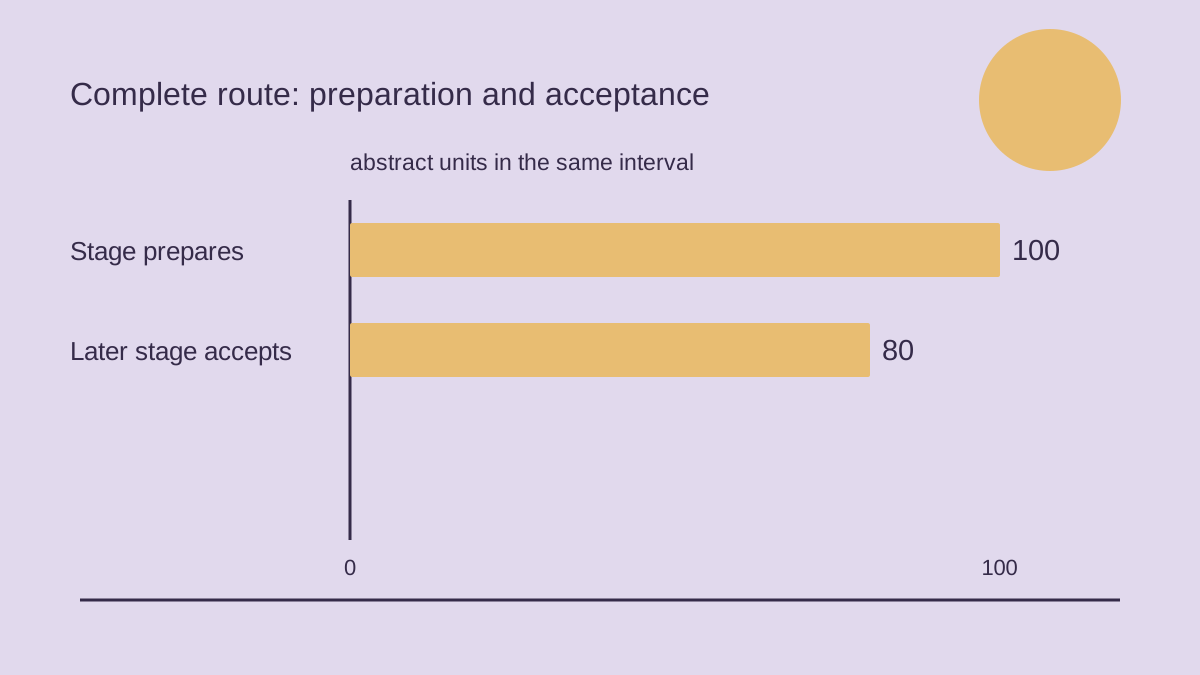
A hypothetical illustration makes the distinction concrete. Suppose one stage can prepare one hundred units of work in an invented interval, while a later stage can accept eighty. The complete route cannot be represented by the first number alone. Neither figure is a measurement from Purina. The example simply shows why a project should identify the relevant constraint and its acceptance boundary instead of selecting the largest available capacity figure.
Include changes of product and interrupted schedules
If the intended service involves several product configurations, the operating evaluation would need to recognise changes between them. The team should identify which evidence supports the proposed sequence and what additional work the sequence assumes. This article does not claim any particular changeover practice or product mix at the reported site. It asks that the commercial offer preserve the difference between demonstrated work and an untested combination of activities.
Interrupted schedules should receive the same attention. A plan that assumes uninterrupted movement may not answer the question of how a real delivery calendar will be served. The review could identify what happens when a required stage becomes unavailable and how the revised status reaches planning and dispatch. The resulting account would be more useful than an undifferentiated statement that the factory is open, because it connects the facility to the offered service.
Map maintenance to the promised supply boundary
The operating account should identify the relationship between maintenance responsibilities and the intended supply. A reviewer would need to understand which equipment or supporting function is relevant to a commitment and how its unavailable status is represented. This is not a suggestion that the converted brewery has a maintenance problem. It is a requirement for evaluating a future service promise that depends on the continued availability of a connected route.
Where an alternative route is proposed, the project should explain which acceptance evidence supports it. A backup label would be insufficient if the customer cannot tell whether the alternative serves the same product task. The review should also distinguish a planned intervention from an unexpected interruption. Preserving that distinction helps the parties discuss delivery contingencies without assuming either perfect availability or an undisclosed level of unreliability.
Connect roles and training to actual decisions
A new operating purpose requires an understandable allocation of decisions. The evaluation should ask who can change a product's status, authorise movement, investigate an exception and confirm dispatch. A staffing figure alone would not establish those responsibilities. The review would need an account of the roles relevant to the intended route, without inferring the competence of individuals from the announcement of jobs or the existence of a training activity.
The same principle applies to automation support. If a worker is expected to interpret an exception, the operating plan should show the scope of that role and how unresolved issues are escalated. These are proposed governance questions, not claims about Purina's personnel. They help connect the physical system to a reviewable authority structure so that a product's accepted status is supported by an identifiable decision rather than by an ambiguous expectation.
Keep conversion economics at a declared boundary
A project might reasonably investigate whether reusing premises changes the investment or operating account. The comparison should state the alternative, the included work and the period being assessed. Without those boundaries, a claim of savings could reflect an omitted conversion cost or an unrelated expenditure. The historic opening report does not establish the economic result of an unspecified comparison, and this analysis does not assign a saving to the Eden project.
The record should distinguish observed spending from forecasts and from benefits that have not been measured. Retained space, new equipment, changed layout and ongoing operation may affect different parts of the account. Showing them separately would let a reviewer understand the proposed rationale. A reuse decision could be sound for several documented reasons, but those reasons should be named rather than compressed into a general assumption that an existing building is always cheaper.
Assess environmental claims with their own evidence
Repurposing a building can prompt environmental questions, but the label alone does not resolve them. A comparison would need a defined scope and evidence about the relevant construction, operation and service. The assessment should identify which matters are measured and which remain uncertain. This article does not calculate emissions, resource savings or waste performance, and it does not convert corporate aims into demonstrated results for the reported facility.
A purchaser could still ask a supplier to explain a particular claim in a reviewable form. The useful response would identify its date, boundary and supporting record, rather than rely on the appeal of industrial reuse. Where evidence supports only a narrow statement, the claim should remain narrow. That discipline allows environmental information to inform the choice without allowing it to substitute for product acceptance or the evidence behind a delivery commitment.
Use commissioning questions to bound the offer
A project reviewer could organise the operating account around questions that connect the converted premises to a specific supply service. The following list is an original proposed structure, not a description of Purina's commissioning programme. It would let the team distinguish a facility announcement from the evidence relevant to an individual purchaser's requirements.
- What product and delivery boundary does the offer cover?
- How does material identity remain visible through the intended route?
- Which decisions authorise movement, acceptance and dispatch?
- How are automated-system exceptions and unavailable stages recorded?
- Which capacity and cost claims have evidence at the complete-service boundary?
The answers may support a limited scope before a broader one. That is a useful result if the customer understands the limit and the next unresolved question. A review should preserve such boundaries rather than demand that every facility milestone be described as unrestricted readiness.
Translate the operating map into a delivery statement
A customer-facing offer should identify the available product, accepted status, proposed dispatch and assumptions behind the timing. The map would make those terms traceable to the route, rather than leaving them detached from the operating account. A factory opening may establish an important milestone, but a specific purchaser still needs to know what the offered service covers. The historic report should not be asked to answer an undisclosed contract question.
If the scope changes, the supplier should explain which earlier evidence remains relevant and which requires review. The change might concern a product configuration, a movement route or an intended schedule. It does not necessarily invalidate the service, but it should not disappear from the reasoning. A clear delivery statement gains credibility when it shows why its evidence applies to the offer currently being made.
Make industrial reuse part of an assessable supply case
The Eden opening illustrates a setting in which inherited industrial space receives a new purpose. The useful analytical response is to examine the new purpose through a connected operating map: material movement, product identity, decisions and dispatch. None of those relationships should be inferred merely from the former use of the building or the presence of automated equipment. They need an account proportionate to the claim being made.
A reviewable supply case would identify its product boundary, preserve the relevant evidence and state the uncertainty that remains. It could then assess the benefits of the conversion without inventing results that the announcement did not provide. Industrial reuse becomes commercially informative when it is connected to that account, allowing the purchaser to recognise a significant opening while judging the particular service on the evidence that actually supports it.
Sources: Manufacturing Dive; Nestlé Purina PetCare.




Leave a comment