

A regional tyre factory announcement can change a buyer's view of future supply without yet changing what can be ordered. The useful question is how the proposal will acquire a dated, product-specific route to delivery. A declared manufacturing ambition and an accepted purchasing option describe different stages. Keeping them separate allows a customer to investigate a development opportunity while retaining an evidence-based account of the supply that is currently available.
On January 11, 2024, Manufacturing Dive reported Sailun Tire's plan for a manufacturing plant in Mexico. Sara Samora's article described proposed annual capacity of six million semi-steel radial tyres and a possible additional all-steel radial capacity. The report said the location and dates for construction or production had not been disclosed. This was a factory plan, not a report of completed production.
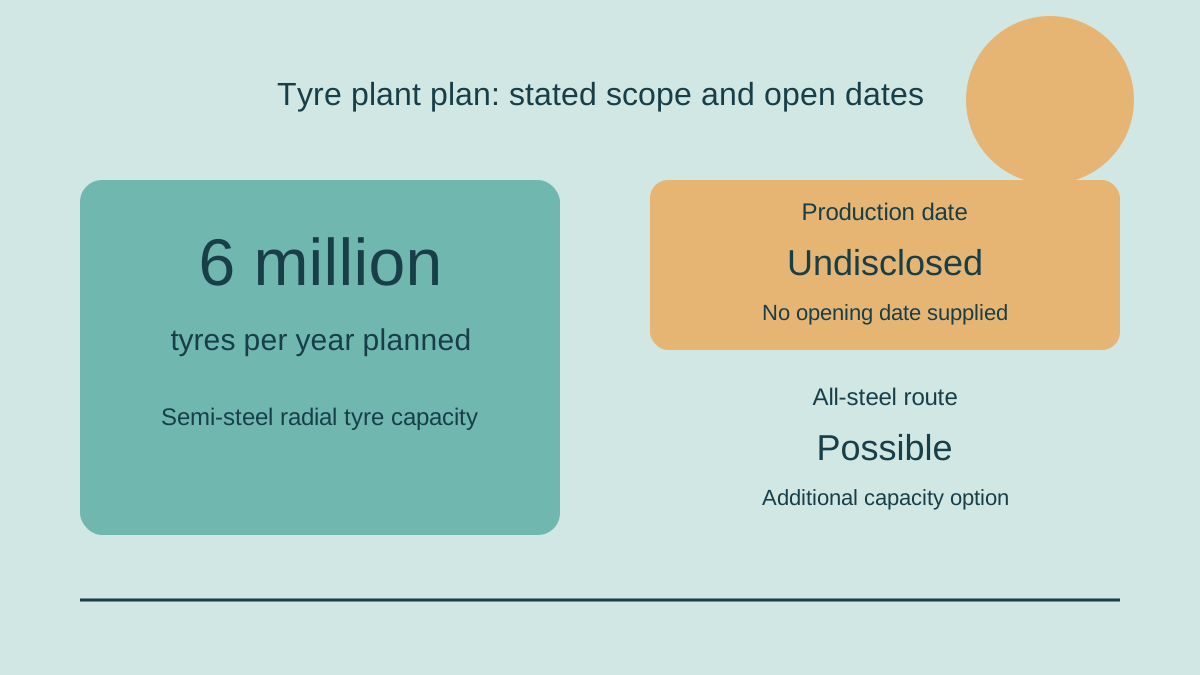
The following original analysis considers how a purchaser could review such a plan. Its proposed gates are conditional questions rather than milestones announced or completed by Sailun. It does not add a location, opening date, investment outcome or tyre-performance finding. The focus is the evidence needed to connect a regional manufacturing proposal to a bounded supply commitment.
Record what is known and what is still open
A useful project record would begin with separate entries for confirmed information, a company's stated intention and unresolved matters. The distinction should remain visible when the record is shared with purchasing or planning teams. An announced proposal can support discussion, but an undisclosed date cannot be treated as an implicit schedule. The buyer needs to know which parts of the account have evidence before making a decision that depends on their timing.
An unanswered question should also have a defined consequence. If a delivery plan depends on the site's location, the evaluation should say that the decision remains conditional until suitable information is available. This does not establish that the project is delayed or unable to proceed. It simply connects the uncertainty to the purchaser's requirement, preventing the absence of a fact from being replaced with a convenient assumption about readiness.
Define the tyre offer more narrowly than the factory label
A factory plan describes a manufacturing setting; a purchaser needs a specified product offer. The enquiry should therefore identify which tyre configuration, intended application and acceptance boundary matter to the customer. An annual total for a broad category does not establish the availability of every product within it. The buyer should avoid interpreting category-level capacity as a commitment to a particular size, specification or delivery arrangement that the source never described.
The proposed record would need to distinguish a currently offered product from one intended for future development. Neither status is inherently unhelpful, but each supports a different decision. A development discussion might justify further review, while a routine order requires an accepted offer. The manufacturer and buyer should preserve that difference in their language so that a regional factory announcement does not silently enlarge the product scope already available to the market.
Separate initial plans from possible expansion
A proposal may contain an initial manufacturing scope and a possible later extension. The review should retain that structure rather than add both together as though they describe one completed facility. A potential extension would need its own decision, timing and evidence before it could support a supply promise. The article's mention of possible additional capacity should not be used to infer that the extra product route has already been approved or installed.
The purchaser could ask which part of the proposal is relevant to the intended order and what would change if the later option did not proceed. This is a conditional planning question, not a forecast about Sailun's implementation. It would help the buyer avoid relying on an optional stage for a commitment that must be fulfilled earlier. Each decision should point to the scope that actually supports it, preserving the limits of both initial and prospective activity.
Use a dated route instead of an inferred opening
The path from proposal to supply would need a schedule with named boundaries. Construction, equipment readiness, product evaluation and accepted dispatch answer different questions. The purchaser should not collapse them into one opening date unless the corresponding meaning is explained. A useful enquiry would ask which event supports the offer and which events remain prerequisites, without assuming that an announcement about one stage establishes completion of the rest.
Dates should be tied to evidence and revised transparently. If a company provides a target, the record should identify it as a target and preserve the date of the statement. Later information may update the assessment, but it should not rewrite the historical announcement as if the outcome were known at the time. This discipline lets a buyer recognise progress while distinguishing the original proposal, a subsequent commitment and an observed result.
Treat site information as a logistics input
A proposed regional facility does not define the customer's delivery route until the relevant site information and service boundary are known. The review would need to identify the offered dispatch point, responsibility for onward movement and any assumptions about the intended destination. This article does not infer a city or industrial park from the country announcement. A purchaser should seek the information needed for the actual route rather than substitute a familiar manufacturing location.
The delivery account should separate proximity from demonstrated service. Being in a broad region may be relevant to a strategic discussion, but it does not alone establish lead time, available transport or the total cost of a shipment. Those claims require their own records. Keeping the questions distinct would allow the buyer to consider the project's regional significance without treating geography as an automatic answer to the practical conditions of an order.
Identify the party that can make the commitment
A joint manufacturing proposal can involve several parties with different responsibilities. The purchasing enquiry would need to establish who offers the product, who provides the relevant evidence and who can authorise a delivery commitment. The existence of a project agreement does not by itself answer the customer's contract question. This analysis does not assign undisclosed obligations to Sailun or another participant; it asks that a future offer make its responsibility structure assessable.
The buyer should also distinguish a project contact from an accepted supplier for the intended transaction. A party may be able to explain the development without being the entity that undertakes product supply. Clear roles would prevent correspondence about a factory plan from becoming an ambiguous purchasing assurance. Where a responsibility remains unresolved, the evaluation should name that issue and limit the decision accordingly, rather than assume that every participant can speak for the whole route.
Require evidence for the product claim
A proposed tyre offer would need the product evidence and approvals appropriate to its intended use, reviewed through the relevant qualified process. A factory announcement is not a substitute for that assessment. The purchaser should identify the documentation required by its task and ask which configuration the evidence covers. This article supplies no tyre-testing protocol, performance rating, fitting advice or assurance about the safety of an unspecified product.
The record should preserve the distinction between a product developed elsewhere and a product supplied through the proposed route. Earlier evidence may be relevant, but its applicability would need an explained basis. A buyer should not assume either that all previous approval automatically transfers or that none can apply. The useful question is what relationship has been demonstrated and what further review is required before the current offer can be accepted.
Translate annual capacity into an allocation question
An annual capacity figure describes a proposed scale, not the quantity available to an individual customer at a particular time. The review would need to understand the product scope, accepted output and allocation relevant to the offer. This is not an estimate of Sailun's orders or future utilisation. It is a purchasing principle that prevents a plant-wide number from being treated as a reserved customer quantity without an explicit commitment.
A purely hypothetical example illustrates the distinction. Imagine a route able to provide one hundred accepted units in an invented period, while a buyer seeks ten. The capacity figure alone does not establish that those ten are allocated, ready or scheduled for the buyer. Neither number is project data. The example shows why available capacity, a customer's allocation and a dated shipment need separate evidence even when the proposed scale appears ample.
Review the route's dependencies without predicting failure
A prospective supply route would need an account of the inputs and services on which it depends. The purchaser could ask which dependencies are relevant to the intended commitment and how their status is represented. This does not mean that a particular input is unavailable or that the plan will encounter difficulty. The point is to make the evidence behind the proposed delivery understandable rather than infer readiness from the existence of a factory investment.
Where the offer relies on an alternative or a contingency, the record should explain its scope. A backup label does not establish that the alternative serves the same product and timing requirements. The buyer would need to know which conditions are accepted and which remain assumptions. Such an account can recognise a practical response to uncertainty without inventing an uninterrupted supply guarantee or turning every unresolved matter into a claim of project failure.
Compare costs at the customer's delivery boundary
A regional manufacturing plan may prompt expectations about a different delivery cost, but the comparison would need a declared boundary. The buyer should identify which product, quantity and service are being compared, and which costs belong in the account. A broad investment figure cannot answer that question. The project announcement does not establish a cheaper offer for an unspecified customer, and this analysis does not calculate savings from the proposed location.
Observed offers and forecasts should be shown separately. If a projected advantage depends on a future route, the record should state the assumption and identify what evidence would confirm it. The customer can then evaluate the possibility without recording the forecast as a current price. A useful comparison also preserves differences in accepted service, because a lower headline amount may not represent the same delivery or product scope as the alternative.
Give origin and environmental claims separate treatment
A proposal to manufacture regionally may raise questions about origin, documentation or trade treatment. Those matters require the applicable qualified review and product-specific records; geography alone should not be used to provide a legal conclusion. This article does not state tariff eligibility, a local-content rule or a guaranteed customs outcome. The purchaser should identify the claim that matters to its transaction and seek evidence appropriate to that claim.
Environmental assertions would need an equally clear boundary. A shorter imagined route or a new factory label does not alone establish an overall benefit. The relevant comparison would need evidence about the proposed service and the factors included in the assessment. Without that record, the claim remains unresolved. It can be considered as a separate question without substituting for product readiness or assuming a measured advantage that the historical announcement did not provide.
Make readiness gates support specific decisions
A purchaser could organise the review around successive questions rather than wait for one broad declaration of readiness. The following sequence is an original proposed framework, not a schedule announced by the company. Its value would lie in connecting each decision to the scope and evidence that support it while keeping the remaining uncertainty visible.
- Identify the product offer and the party authorised to supply it.
- Record disclosed site information and unresolved timing questions.
- Review the evidence covering the intended product and manufacturing route.
- Establish the customer's allocation, delivery boundary and accepted schedule.
- Approve only the purchasing commitment supported by those records.
An intermediate gate might support another enquiry or a limited evaluation rather than a routine order. That can be a useful outcome if it names the unresolved issue. The framework should preserve those outcomes instead of presenting every announcement as though it already answered the final supply question.
Keep the offer current without erasing its history
A developing project's information will need a reviewable update process. The record should show what changed, when it changed and which decision the change affects. A later location disclosure, schedule or product offer may legitimately broaden the assessment, but it should retain its own evidence. The January 2024 account remains a historical proposal with the limits stated at that time; it should not acquire later facts through unmarked revision.
The customer-facing commitment should point to the current accepted scope. If a change affects the route or product configuration, the supplier should explain why the supporting evidence still applies or what review remains necessary. That explanation does not assume that every change invalidates the offer. It gives the buyer an assessable relationship between the present commitment and the records on which the commitment depends.
Let the proposal inform the right purchasing decision
A regional tyre project can be strategically significant before it becomes a source for a specific order. The useful analytical response is to preserve that significance while asking what would connect the plan to accepted supply. Product scope, location, timing, responsibility and allocation belong in that connection. None should be inferred merely because the announced annual capacity is large or the region appears attractive.
A reviewable purchasing decision would identify the opportunity, state the unanswered questions and limit its commitment to the evidence available. It might justify continued monitoring, further product evaluation or an accepted offer when the necessary records become available. The historical report does not establish which outcome will follow. It supplies a reason to investigate, while a dated and bounded supply case supplies the basis for deciding what the customer can actually rely on.
Sources: Manufacturing Dive.





Leave a comment