

A simulation can finish successfully and still leave the next researcher with an unanswered question: why was this particular calculation performed? The result file records what the computer produced. It may say much less about the decision that led to the calculation, the alternatives that were rejected or the conditions under which the answer remains useful. Connecting scientific programs therefore creates an information problem as well as a software problem.
On 18 November 2025, Interfax reported that Novosibirsk State University in Russia had registered a prototype platform for atomistic materials modelling. A recommendation module was under development, intended to help users select methods and calculation parameters. The university's official channel also confirmed the prototype and identified support from the National Technology Initiative Fund. These announcements concern a developing research tool, not a demonstration that every material can already be predicted reliably.
The broader opportunity is to make a calculation understandable as a chain of decisions. A common interface is useful, but the more valuable handover may be the explanation linking a scientific question to a model, that model to a run, and the run to a limited conclusion. The following analysis sets out what such a handover could contain. Its examples are hypothetical design problems, not a description of functions already delivered by the NSU team.
Begin with the question that a result must answer
Imagine a researcher comparing two candidate surfaces for a device. The request “calculate their properties” is too open to define a useful workflow. A property relevant to selecting a candidate may differ from the property needed to understand why it behaves that way. Before choosing a program, the team needs to decide what comparison would change its next action. Is it trying to narrow a long list, explain a known observation or prepare a particular experiment?
Those purposes create different stopping points. A preliminary screen might only need to identify candidates that deserve closer attention. A mechanistic investigation must retain information that distinguishes competing explanations. A calculation used to prepare an experiment needs to match the conditions that the experiment can actually reproduce. Treating all three as the same task makes a convenient interface look more decisive than the underlying question allows.
A useful project record would therefore start with a sentence such as: “Compare candidates A and B under the stated conditions to decide which should receive the next laboratory test.” That sentence does not guarantee a correct model. It makes the purpose available for criticism. Another researcher can challenge whether the proposed output answers the question before a large amount of computing time has been spent.
Make the recommendation an argument that can be inspected
A recommendation system could rank available methods, but a ranked list alone leaves the user dependent on an unexplained preference. The first-ranked option might be fastest, easiest to configure or best supported by available input data. Those are different reasons. If the interface compresses them into a single score, a user may interpret a convenience recommendation as a scientific endorsement.
The more useful design would expose the reason beside the recommendation. For example, a proposed workflow might say that a simpler calculation is suitable for an initial comparison but does not answer a separate question about behaviour outside the model's stated scope. It could identify the missing information that would justify moving to another method. That is a conditional recommendation: its value comes from showing when it should stop being followed.
Expert overrides should carry the same burden of explanation. An experienced user may have a good reason to choose a different approach, but the reason is part of the research record. Recording it need not require a long essay. A brief note explaining a known limitation, an available reference case or a particular constraint can prevent a later colleague from treating the choice as arbitrary.
Keep the method and its particular inputs together
Naming a method is not enough to identify a calculation. Two projects can use the same general approach while selecting different input structures, parameter sets and processing steps. A handover that preserves only the name of the solver leaves the recipient to reconstruct those choices. That reconstruction is precisely where apparently similar runs can become difficult to compare.
The unit of preservation should be a defined run package. It would connect the question, the selected model, the exact inputs and the resulting outputs. A changed input should create a new identifiable revision rather than silently replacing an old file. The point is not to preserve every temporary file forever. It is to retain enough information to explain which version produced the result being discussed.
A compact record could answer five questions:
- What decision was this calculation intended to inform?
- Which model and input versions were selected, and why?
- What transformations occurred before the solver received the data?
- Which output and analysis procedure support the reported finding?
- What limitation prevents the finding from being applied more widely?
These questions give different specialists a common place to meet. The person preparing an atomic structure may not be the person analysing the output. The person deciding which candidate to test may not run the software at all. A shared record allows each of them to see the part of the chain that affects their responsibility.
Units are part of the scientific meaning
A concrete example comes from the separate simulation package LAMMPS. Its July 2025 documentation specifies that unit styles govern inputs and outputs. The “real” style uses femtoseconds for time, while “metal” uses picoseconds; their energy units also differ. These are examples from LAMMPS documentation, not evidence that the NSU prototype uses that software.
Consider two hypothetical exported tables that both contain a column labelled “time”. If the numerical values are copied into a common chart without their unit definitions, the chart can look perfectly orderly while comparing different durations. The error has occurred in the handover, not necessarily in either solver. A platform that successfully launches both programs has not, by that fact alone, established a meaningful comparison between their results.
The practical implication is to carry meaning with the value. A table should make its units visible, and a transformation should record what changed. If a receiving tool expects another convention, the conversion belongs in the recorded workflow rather than in an undocumented spreadsheet edit. A reviewer should be able to follow the conversion without relying on the original researcher's memory.
This also changes what an interface should regard as a successful import. Reading every row without a parsing error proves that the file was readable. It does not prove that the receiving program interpreted those rows as intended. A small, deliberately understandable test case can help the team inspect the interpretation before applying the same connection to a much larger project.
Separate restarting a run from explaining a result
Saving a running calculation and preserving a research claim serve different purposes. LAMMPS documentation illustrates the distinction: binary restart files are intended for the same executable and platform, and some commands must be supplied again. A restart file is therefore not automatically a complete, portable account of the work. The precise details depend on the software and version involved.
For a research platform, this suggests two complementary forms of continuity. Operational continuity asks whether interrupted computing work can resume. Scientific continuity asks whether another person can reconstruct the reasoning and evaluate the reported answer. A project can achieve the first while failing the second. A preserved machine state may be useful to the original operator but opaque to a collaborator reading the final report.
The handover should therefore identify the role of each retained item. A restart file supports continuation; an input package explains the setup; an analysis script explains how outputs became a figure; a short interpretation states what the figure is being used to claim. These roles can be connected without pretending that one file performs all of them.
Compare like questions before comparing speed
Speed is an attractive headline for a modelling platform, but a faster answer matters only when the answer serves the intended purpose. Suppose one hypothetical workflow completes in an hour and another takes a day. That comparison alone cannot establish that the first is preferable. It may be answering a narrower question, using a different input or stopping at a different stage of the investigation.
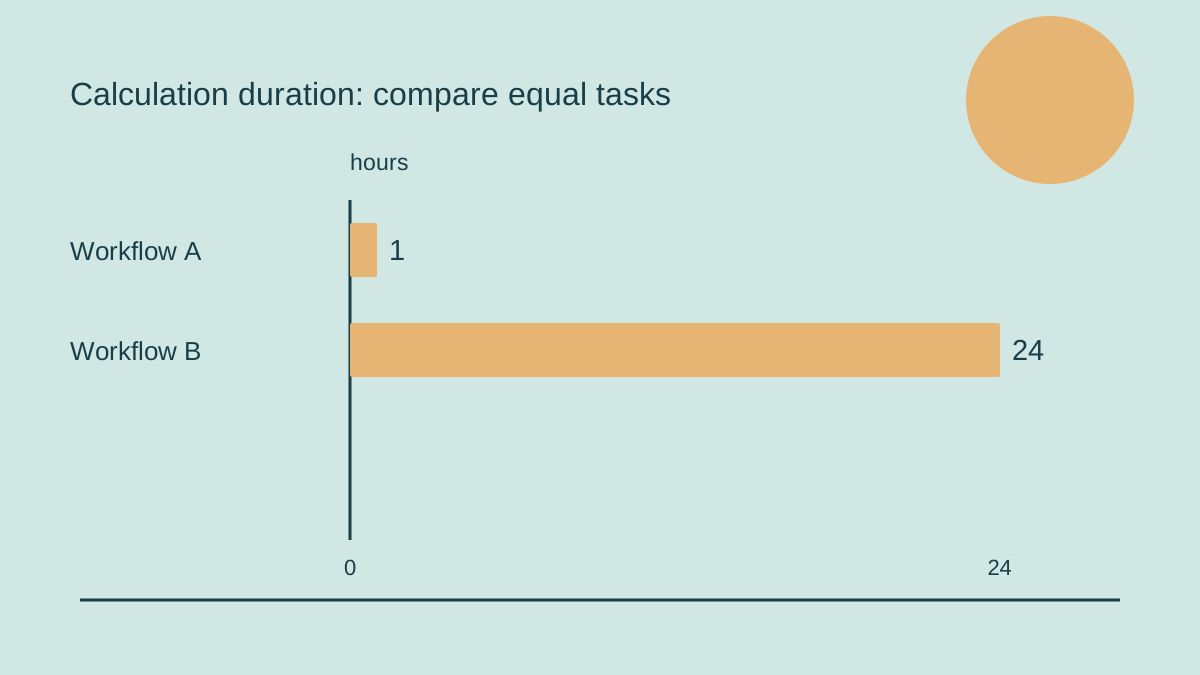
A fair evaluation would first define a common task and the evidence required to consider it finished. Only then should the team compare preparation time, waiting time, computation and interpretation. These are separate costs. A platform might reduce the work required to prepare a run without making the underlying solver faster. That could still be valuable, particularly when repeated setup occupies skilled staff.
Counting only successful runs would also conceal an important part of the work. A tool that helps users reject an unsuitable setup before launching it can save effort even if it produces fewer completed calculations. Conversely, a tool that makes launching easy but interpreting failures difficult can create an expanding queue of results nobody trusts. Evaluation should describe the whole research task, not simply the number of jobs submitted.
Design the next experiment into the handover
A simulated comparison is most useful when it leads to a clearer next step. Return to candidates A and B. If the result favours A only under one carefully specified condition, the next experiment can focus on that condition. If the comparison changes when an assumption changes, the next task may be to investigate the assumption rather than to manufacture either candidate immediately.
This is where the platform's record can become a working document between computational and experimental teams. It should identify the observation that would support the proposed interpretation and the observation that would challenge it. Neither statement requires a promise that the calculation is correct. Both make it easier to learn from a disagreement instead of treating an unexpected laboratory result as an unexplained failure.
The original inputs remain important after that disagreement. If the experimental team discovers that the tested specimen differs from the simulated one in a relevant way, the teams need to locate the difference. A clear handover gives them something specific to revise. Without it, they may repeat the entire workflow or argue about a conclusion whose assumptions are no longer visible.
Make failure informative without turning it into a result
A platform should distinguish a job that did not complete from a completed calculation that does not support the desired conclusion. The first may require operational repair. The second may be scientifically useful. Combining both under a generic failure label encourages the team to discard evidence merely because it is inconvenient or to rerun a task until it produces an attractive output.
For a hypothetical candidate screen, a useful summary would retain the candidate identifier, the stage reached and the reason that no comparison was reported. A missing result should remain missing. It should not silently become a zero in a ranking table. That simple reporting choice prevents a downstream reader from confusing “not evaluated” with “evaluated and poor”.
The same principle applies to recommendations that cannot be made. If required information is absent, the interface should name the gap. Asking for a missing condition can be more productive than selecting a default that appears to complete the form. The user then knows which part of the scientific problem still needs attention.
Give revisions an owner and a visible consequence
A further test of the handover comes when the project changes direction. Suppose the team discovers a mistake in an input structure after several colleagues have already used the resulting comparison. Replacing the input file is only part of the repair. The team also needs to identify which conclusions depended on that version and who needs to know that the comparison has changed.
A practical platform could link a corrected run to the earlier run without deleting the earlier decision trail. A short correction would state the changed input, the reason for the revision and whether the interpretation remains the same. This would let a reader distinguish a correction from an additional experiment. Both produce new files, but they have different consequences for work already underway.
Ownership matters because a warning without a responsible person can remain unresolved. One colleague may prepare the corrected inputs, another rerun the analysis and a third decide whether the laboratory plan should change. Making those responsibilities visible does not require turning research into a rigid approval process. It simply prevents each participant from assuming that somebody else has completed the part that connects the new calculation to the shared decision.
The useful final state is a current interpretation with a traceable history, rather than an ever-growing folder whose latest filename must be guessed.
The platform's lasting value is a transferable decision trail
The NSU announcement gives a reason to examine the work between modelling tools rather than only their individual capabilities. A recommendation module can make that work easier, but its usefulness depends on how well it exposes choices and preserves context. The strongest promise is not that researchers will never need to make difficult decisions. It is that those decisions can become easier to review, repeat and improve.
A successful handover would let a colleague understand the question, identify the exact run, inspect the transformations and see the limits of the conclusion. It would also show what should happen next. That is a more demanding objective than placing several programs behind one screen, yet it is directly connected to the daily work of a research team. The calculation becomes a usable part of an investigation when its reasoning can travel with its result.
Sources: Интерфакс; Novosibirsk State University, official channel; LAMMPS project, July 2025 documentation; LAMMPS project, July 2025 documentation.





Leave a comment