

Seeing inside a sealed container can change the information available to a waste operator. It does not, by itself, turn an image into a complete acceptance decision. Interfax reported on 1 July 2025 that Tomsk Polytechnic University had developed a betatron-based system for examining containers of radioactive waste without opening them. The work was commissioned by TVEL. For the waste-management industry in Russia, the relevant question is how such an inspection could strengthen the evidence attached to a particular package.
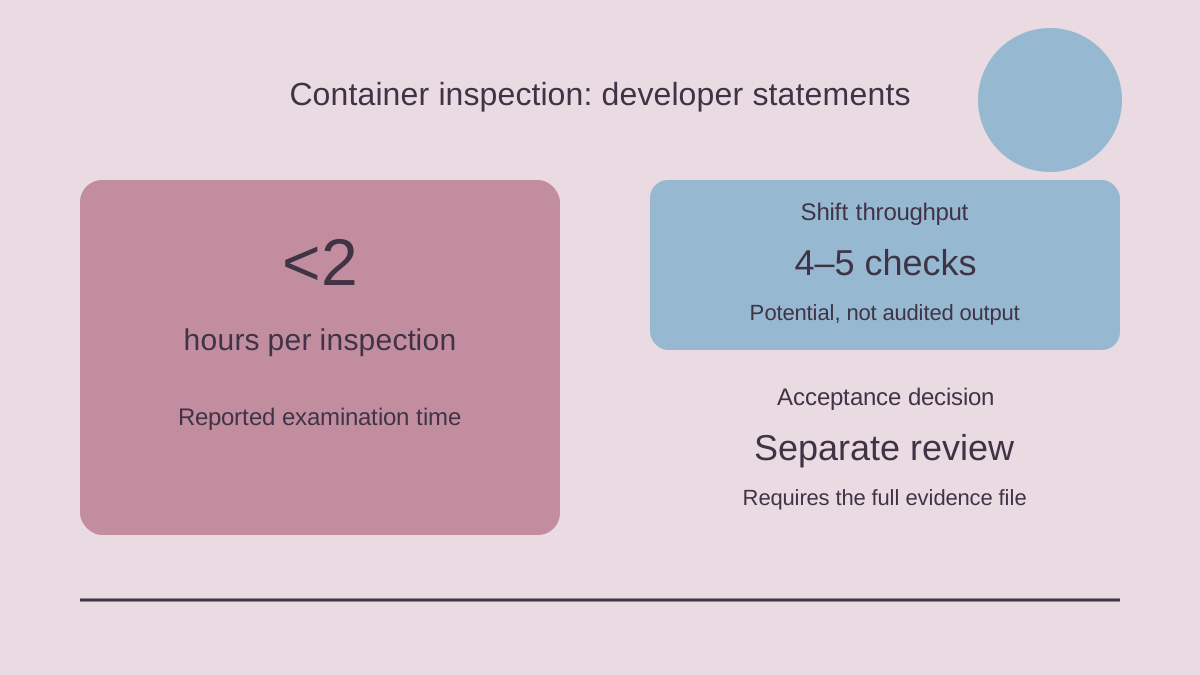
The university describes X-ray imaging, remote operation and software for distinguishing the physical character of container contents. It reports an inspection time below two hours and a potential four to five checks per shift. Those are developer statements, not an independent audit of routine site performance. The analysis below considers the organizational and commercial implications of adding this kind of information to a controlled acceptance workflow.
An image answers a particular question
A useful starting point is to distinguish three records: an image of physical contents, an inventory describing the waste and a decision about the package. They may inform each other, but they are not interchangeable. A picture showing the arrangement of material does not automatically establish every characteristic required to describe radioactive waste.
The university's announcement concerns morphological inspection. A purchaser should therefore define the questions that this inspection is expected to answer and the questions that remain with other evidence. That would prevent the instrument's scope from expanding through an attractive display or a broad interpretation of the word identification.
For example, a reviewer might seek information about the distribution of material or an apparent mismatch with a package description. This is a possible use of imaging evidence, not a claim that the announced system detects every mismatch. The acceptance procedure would have to specify what constitutes a meaningful observation and how it affects the next action.
The container identity connects every record
An inspection becomes useful only if the result can be reliably linked to the package examined. The record should identify the container, the examination and the associated documentation. Without that connection, a technically good image could be attached to the wrong case or separated from the description it was supposed to test.
The practical issue is not simply whether a file has a name. The organization needs a consistent way to preserve identity as a container moves between receipt, examination, review and its next permitted destination. If identification changes, the record should show the connection rather than silently replace the earlier reference.
A review should also distinguish the original observations from later interpretation. Retaining the underlying result alongside the reviewer’s conclusion would allow another authorized reviewer to understand how the decision was reached. A short label without supporting evidence may be easy to store but difficult to revisit when a question arises months later.
Information can reduce one kind of uncertainty
Inspection can narrow uncertainty about the physical contents of a package while leaving other uncertainties unresolved. This is normal for a measurement method. The business value depends on whether the reduced uncertainty matters to the operator's decisions and whether the method can do so consistently under the conditions it encounters.
A purchaser would therefore want an explicit description of the method's applicable range. Different package types and content arrangements could require different evaluation conditions. This article does not claim that any particular arrangement is beyond the announced system; it identifies the need to state where the evidence is considered reliable.
An inconclusive result should have a defined meaning. It might call for review of the available documentation, another appropriate assessment or an exception procedure established by the operator. Treating every inconclusive observation as either acceptance or rejection would hide the uncertainty instead of managing it.
Validation needs reference cases
Before a site relies on a new form of evidence, it needs a basis for interpreting that evidence. A validation programme could compare observations with reference cases whose relevant physical characteristics are known. The objective would be to establish how consistently the method answers the specified inspection questions.
The reference programme should be connected to the intended use. A demonstration that produces a clear picture in one configuration may answer a research question without covering all package configurations proposed for routine work. A site acceptance plan should identify the cases it covers and record the boundaries of the conclusion.
Changes should also be visible. If software, a component or the interpretation method changes, the operator needs to understand whether earlier validation remains applicable. This is a management question about evidence continuity. It does not prescribe instrument settings or replace the specialist procedures required for operating radiation equipment.
Inspection time is not the whole service time
The reported duration below two hours refers to checking a container. A site workflow may also involve scheduling, identification, preparation of the record, movement, interpretation and authorization of the next step. These activities can affect throughput even when the examination itself is quick.
Consider a hypothetical batch of five containers. Suppose the instrument can examine all five during a planned period, but only three review files are completed by the end of it. The site has five examination results and three completed reviews. Counting them as five completed acceptance decisions would mix different stages. These figures illustrate a workflow distinction and are not reported operating data.
The distinction matters when planning staff and equipment. Improving the examination rate would not necessarily remove a review bottleneck. Conversely, preparing complete records before the examination might reduce administrative waiting without changing the instrument. A useful operating report would show the stage at which packages are waiting.
Remote operation changes the work arrangement
The developer describes remote inspection as a way to obtain information without opening the package. This could change the arrangement of tasks, but the effect should be assessed through the site's full workflow. It would be premature to translate a remote-control capability into an unmeasured numerical safety improvement.
The organization needs to define the responsibilities of those receiving packages, operating the approved examination process, reviewing results and authorizing subsequent actions. These roles may be held by different people. A clear division can help prevent an ambiguous observation from becoming an informal decision made simply because a package needs to move.
An exception path is particularly important. The inspection process should be able to record that a case requires further consideration without pressure to assign a conclusive label. The operating organization, using its applicable procedures, would determine the appropriate next step. The research announcement does not establish that procedure for every site.
Software output needs a documented interpretation
A visual classification can be easy to understand at first glance. Its practical use nevertheless depends on what the labels mean, which observations support them and how uncertainty is represented. A purchaser should request documentation that connects the displayed result to the questions defined in its inspection specification.
The record should identify the software version used for the examination or interpretation. If a later version changes the representation of the same data, an authorized reviewer should be able to distinguish a new observation from a new interpretation. Otherwise a change in presentation could appear to be a change in the container.
Human review also has a place in the information chain. The organization should specify which conclusions may be taken directly from a result and which require a qualified reviewer. This is a suggested governance distinction, not a claim about how the university's current software is configured.
The economic comparison follows avoided work
The potential economic value of an additional inspection method depends on the work it changes. Avoiding a package opening in an applicable case could remove certain tasks, while imaging adds its own equipment, staffing and review expenses. An assessment needs to identify both sides for the actual process being considered.
A comparison should use the same inspection objective and case type. Comparing the price of one scan with the total cost of a wider characterization service would not show whether the new method can replace that service. Some tasks may remain necessary, and some may change only for particular packages.
Utilization matters as well. Equipment-related expenses spread over many applicable examinations will give a different unit estimate from the same expenses spread over a small number. A purchaser needs a realistic account of expected cases, downtime and review capacity. The announcement supplies no basis for inventing an installation price or a guaranteed payback period.
Maintenance is part of the evidence chain
A service interruption affects more than a schedule. The operator needs to know whether the equipment returns to a condition covered by its applicable checks and whether any change affects interpretation. A maintenance record should therefore connect the work performed with the instrument's authorized return to service.
The commercial agreement should identify support responsibilities, access to necessary documentation and the process for obtaining replacement components. It should also explain how software support is handled. These terms determine whether the site can maintain the inspection capability over the period for which it intends to rely on it.
Training must be sustainable beyond the initial installation. Staff changes can create a gap between the system's documented capabilities and the skills available on a particular shift. An operator would benefit from a defined training and authorization arrangement, using its own requirements and specialist procedures rather than relying on an informal transfer of knowledge.
The useful metric is a supported decision
Counting scans shows equipment activity. Counting reviewed cases shows a later stage. Counting decisions supported by the defined evidence shows another outcome. A site can report all three without pretending that one number describes the entire service.
It would also be useful to record the proportion of cases requiring clarification and the reason for it. Missing documentation, an uncertain image and a mismatch between records call for different responses. Combining them into a single category of unsuccessful inspections would make the process harder to improve.
A consistent record could show whether the additional evidence reduces rework or changes the time needed to resolve a case. Those are possible performance questions, not demonstrated effects of the announced system. The distinction keeps a trial focused on a measurable benefit while avoiding a claim that equipment activity alone proves better acceptance.
Information must survive a later question
The usefulness of a result may extend beyond the day of examination. A later reviewer might need to establish which container was examined, which documentation was available and which conclusion was authorized. The evidence package should therefore remain intelligible after the original operator or reviewer has changed role.
Preserving the record involves more than storing a screenshot. The organization needs to identify the essential data, associated interpretation and approved decision, then retain the connection between them. If files are moved or formats change, the package identity and the history of interpretation should remain traceable.
Access also needs a defined owner. Authorized reviewers should be able to obtain the relevant evidence, while changes to a concluded record should be controlled and visible. This is a general information-management requirement for the proposed workflow; the article does not claim that any particular archive or access system is already in use.
A purchaser can define a narrower first deployment
An initial site application does not need to cover every container type to be useful. A defined subset of packages and a precise inspection question can provide a clearer basis for acceptance than a broad promise of universal identification. The limits should be written into the proposed use rather than discovered through ambiguous cases after installation.
A trial could then establish whether the evidence is repeatable, understandable to reviewers and compatible with the site's records. It should also test the exception process. A workflow that performs well only when every result is straightforward would give little information about the cases in which the additional inspection is most needed.
The result of that first deployment would support a decision about extension. Expanding to another package type should be treated as a new scope question with appropriate evidence. A successful narrow use does not automatically prove a universal service, but it can provide a credible foundation for broader evaluation.
Questions that belong in the acceptance file
A procurement discussion becomes more concrete when the instrument's proposed role is expressed as a set of deliverables. The file should show the inspection question, applicable package types, validation basis, records produced and responsibilities for interpretation. It should also make clear which characteristics remain outside the agreed evidence.
- What physical question is the examination intended to answer?
- How are results connected to the container and its supporting documents?
- Which reference cases support the proposed scope of use?
- How are inconclusive results recorded and referred for review?
- Which activities are included in throughput and cost estimates?
- How are maintenance, software changes and staff authorization documented?
- Which evidence is retained with the final authorized decision?
Answering these questions would allow a buyer to assess the proposed service without turning a developer's announcement into a regulatory conclusion. The equipment can contribute to an acceptance process; the process still has to define how it uses that contribution.
A discrepancy needs an accountable resolution
If an observation appears inconsistent with the package description, the record should preserve both the observation and the description under review. Replacing the original description immediately would erase the reason the case required attention. A controlled clarification should show who reviewed the difference, what additional evidence was considered and which conclusion was authorized.
The important distinction is between a possible discrepancy and an established explanation. An apparent difference might arise from the interpretation, the record or the package itself. The workflow needs a way to investigate rather than assign a cause from the display alone. This article does not identify a fault in any examined container; it describes a possible review requirement.
A queue of such cases should also have ownership. If a package waits for clarification, someone needs to know what information is missing and who can supply it. Recording only that the case is pending may leave a container in the queue without a practical next action. A documented resolution route can therefore improve the usefulness of imaging even without increasing the number of examinations per hour.
Evidence must cross the organizational boundary
A package may arrive with information prepared by one organization and be examined by another. The receiving team needs to know which record belongs to which package and what each document was intended to establish. Agreeing a handover format would help prevent the new image from becoming an isolated attachment that a later reviewer cannot relate to the supplier's description.
The format could identify the package reference, the source of each document, the examination date and the status of the review. If a supplier provides a revised description, the receiving organization should be able to see what changed and which earlier version was considered during inspection. This is a suggested way to preserve the history of the evidence, not a statement that the announced system already provides a particular document exchange service.
The organizations should also agree who answers a request for clarification. A technical question about an image may need a different respondent from a question about the package history. A handover that names those responsibilities can reduce the risk that a request circulates without an answer. The value comes from connecting the additional observation to people and records capable of resolving the case.
A clearer view should produce a clearer record
The Tomsk development presents a way to obtain additional information about sealed waste containers. Its possible value lies in connecting that information to decisions that previously faced greater physical uncertainty. The connection requires a reliable package identity, a validated scope and a review procedure that preserves the distinction between observation and authorization.
As of the July 2025 announcement, the appropriate assessment is conditional. Routine performance, economic benefit and the role at a particular site would need their own evidence. A clearer view inside a container becomes commercially useful when it also produces a clearer, traceable record of what was examined and why the next decision was made.
Sources: Интерфакс; Tomsk Polytechnic University.





Leave a comment