

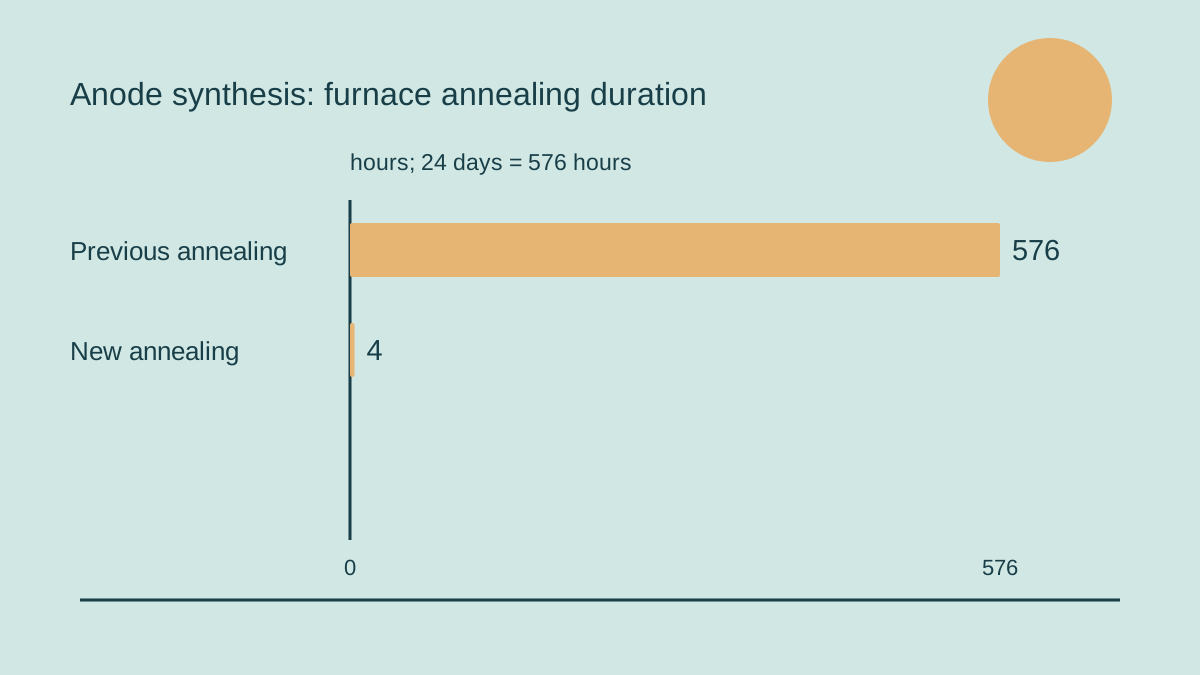
A September 5, 2025 Interfax report describes a niobium-containing anode material developed in Novosibirsk, Russia. Researchers reported a mechanochemical synthesis route that shortened furnace annealing from 24 days to four hours. A complete battery prototype remained a future objective. The industrial question is how a shorter reported operation would translate into a repeatable, accepted material and eventually a qualified cell.
Define the operation before comparing the process
A furnace duration is a measurement attached to one operation. It becomes useful for process planning when the reader knows what enters that operation, what leaves it and which preparation stages occur elsewhere. A comparison of complete manufacturing routes would need the same boundaries on both sides. Otherwise, a reduction in one recorded interval could be mistaken for a reduction in the entire time required to deliver usable material.
The first practical document could therefore be a process map rather than a production forecast. It would distinguish raw-material preparation, mechanical treatment, thermal treatment, cooling, subsequent handling and inspection wherever those operations are relevant to the proposed route. This is a proposed way to investigate the manufacturing question, not a description of an operating production line. The historical report does not establish the duration, equipment demand or outcome of every stage.
Keep the comparison material unchanged
A shorter process is only a meaningful alternative if its output can be compared against the material required for the intended application. That comparison would need an agreed description of composition and the relevant material characteristics. If the output changes while the duration changes, the exercise may be comparing two different products rather than two routes to an equivalent product. Both could be interesting, but the conclusion would need to say which question was answered.
A development team could retain a reference sample and a record of how it was produced. New samples would then be assessed against an identified reference rather than a remembered favourable result. Any change in the reference would require a visible revision. This would help an industrial partner interpret later results without implying that the reported material already has a commercial specification or that a customer has accepted it.
Account for preparation and recovery
Mechanical preparation can raise questions about how material is introduced, removed and recovered. A process study could measure the quantity entering a defined operation and the quantity collected as usable output. It could also identify material retained for inspection, set aside after an interruption or excluded because it does not meet the chosen description. Such records would reveal whether a favourable treatment time accompanies a reliable material balance.
The accounting should avoid treating every collected particle as accepted product. Physical recovery and functional acceptance are separate observations. A sample could be recovered successfully yet fail a later material check; conversely, a small accepted sample could demonstrate a promising property without showing that a large batch can be recovered efficiently. An industrial comparison would need to preserve these distinctions before using the shorter furnace interval in a cost or capacity model.
Measure batches rather than one favourable specimen
A useful next question is whether separately prepared batches would produce comparable material under a defined procedure. Repetition would need independent batch identities and records of relevant conditions. Several measurements of the same favourable specimen answer a different question from measurements of separately prepared batches. Keeping those identities visible would prevent an apparently large body of data from being mistaken for evidence of manufacturing repeatability.
The batch record could identify the input lot, the procedure revision, the equipment used and the samples selected for inspection. It need not claim that every possible variable has been controlled. Its purpose would be to make the tested conditions explicit enough for a partner to reproduce the comparison or understand a deviation. Without that record, a later unsuccessful batch would be difficult to interpret and might lead to changes that obscure the original result.
Choose the accepted-output denominator
A hypothetical accounting example illustrates the importance of the denominator. Suppose a trial begins with 100 units of material and recovers 90 units, of which 70 meet an agreed material description. These invented quantities are not reported results from the Novosibirsk work. They show that recovery and acceptance would yield different ratios, and that a cost stated per recovered unit would differ from a cost stated per accepted unit.
If a second hypothetical route also produces 70 accepted units but requires less furnace time, the comparison would still need information about its other operations. Preparation, inspection and interruption costs could change the answer. A fair account would retain both the reduction in the identified operation and the unresolved questions about the whole route. It would not erase a promising result merely because more evidence is needed, or convert that result into an unsupported production saving.
Separate thermal duration from energy consumption
A recorded treatment duration does not, by itself, provide a complete energy account. A process study could identify the equipment and the period over which energy would be measured, including relevant preparation and recovery stages. The comparison would need compatible boundaries and a stated quantity of accepted material. This is a proposed measurement framework; no unreported energy consumption or emissions reduction is assigned to the research.
The same care applies to equipment occupancy. The time during which equipment is unavailable for another batch may include loading, cooling, inspection or maintenance as well as the named treatment. An industrial partner could distinguish active operation from total occupancy when considering a trial schedule. That would make the shorter reported annealing interval useful within a broader plan while avoiding an unsupported conclusion about the number of batches a factory could complete.
Connect the material to a defined electrode study
An anode material would eventually need to be evaluated in a defined electrode arrangement if the development programme proceeds in that direction. The evaluation record could distinguish the material preparation from the electrode preparation and identify which changes were introduced at each stage. Otherwise, a result observed after several simultaneous changes would not clearly identify the contribution of the synthesis route being considered.
A proposed test programme could first define what evidence is needed from the material and then what evidence is needed from the electrode. The two questions are related, but they are not interchangeable. A material characteristic cannot establish every property of an electrode containing that material. This distinction would help a partner design a limited, interpretable trial instead of using the manufacturing announcement as a substitute for an application-specific evaluation.
Preserve the future status of the complete cell
The historical source places a complete battery prototype among future objectives. A commercial reading should preserve that status. The material result can support a reason to investigate, while the complete-cell arrangement remains a separate development subject. Selecting the other constituents and assembling an evaluation programme would require their own records and decisions. None of those steps is reported here as a completed qualification or a product available for purchase.
For a potential partner, a useful question would be what the proposed prototype is intended to demonstrate. A prototype designed to investigate an interaction does not automatically establish the performance of a production cell. Its configuration, measurement boundaries and unresolved limitations would need to accompany any result. Keeping those details together would reduce the risk of carrying a favourable material comparison into claims about vehicle operation or charging that the report does not establish.
Use explicit gates for the next trial
A staged programme could organise the unresolved questions into decisions that have a defined owner and a defined evidence requirement. A gate would not need to promise commercial success. It would identify the information required before the next resource commitment. This approach would make the project reviewable even if a trial produces a mixed result, because the team would know which question was answered and which remained open.
- Confirm the material description and the reference against which samples will be compared.
- Record complete process boundaries before estimating time, energy or cost.
- Distinguish recovered material from material accepted under the agreed checks.
- Assess independent batches before treating repetition as manufacturing evidence.
- Identify the limited question a proposed electrode or complete-cell trial should answer.
These gates are an original proposal for discussing development evidence. They are not reported company procedures or requirements imposed by a regulator. A research group and an industrial partner could adapt them to the actual programme. Their value would lie in making decisions explicit, rather than adding an appearance of formal approval to an early result.
Make changes traceable during scale-up
A larger trial could involve changes to input quantities, equipment arrangements or handling. Each change would create a question about whether the previous comparison still applies. A record could distinguish the unchanged reference procedure from the revised trial procedure and identify the reason for the revision. If several changes are introduced together, the interpretation should acknowledge that their individual effects may not have been separated.
Traceability would also help when material is shared with a partner. A sample identity could connect the delivered material to its preparation record and the evidence already collected. The partner could then attach its own observations to the same identity. A result from an unidentified sample would be less useful for deciding whether the manufacturing route should proceed, even if the result itself appeared favourable.
Plan interruption and disagreement handling
A development trial can encounter an interruption, an uncertain measurement or disagreement about whether a sample meets the proposed description. The programme could define how such cases would be recorded before they occur. Material affected by an interruption could retain a separate identity, rather than being silently combined with material from an uninterrupted run. This would protect the interpretation of subsequent measurements without assuming that an interruption necessarily makes every sample unusable.
Where two measurements disagree, the record could preserve both observations and the conditions under which they were obtained. A decision to repeat a measurement would then answer an identified question. It should not become a search for a favourable number while unfavourable observations disappear. An industrial partner would need the uncertainty around the comparison as well as its strongest result in order to plan a meaningful next trial.
Discuss supply without assuming a factory
An early material-development discussion could distinguish a research sample, a trial batch and recurring supply. These are different commitments with different evidence requirements. A group able to provide a small research sample may not have established the arrangements for repeated production. An enquiry could state the intended use and the quantity under consideration while leaving the availability and conditions of supply to separate confirmation.
The discussion could also identify who owns the next evaluation and how results would be returned. A sample handover without an agreed question can generate observations that are difficult to compare. A more defined handover could state the material identity, the planned use and the information that would support a subsequent decision. This is a proposed collaboration structure, not a claim that the research group already operates a commercial supply service.
Build an investment case from observed boundaries
A prospective investment case would need to connect the promising synthesis result to a defined production objective. The objective could specify accepted material, a repeatable procedure and the application evidence still required. An estimate based only on furnace duration would leave too much of that connection unresolved. A staged estimate could show which assumptions are supported by observation and which remain conditions to be tested.
The investor or partner could then consider the next commitment as a way to resolve a specific uncertainty. That approach would avoid treating every development expense as evidence of inevitable commercial deployment. It would also avoid discarding an early result simply because a finished product has not yet been demonstrated. The question would be whether the next trial can produce decision-relevant evidence at an appropriate cost, with a clear record of its limitations.
Keep the reported achievement and the open questions together
The shorter reported annealing operation is a concrete reason to examine a complete synthesis comparison. Its significance would grow if the route produced repeatable accepted material and supported a defined application programme. Those later conclusions need evidence beyond the historical announcement. A responsible industrial discussion can therefore retain the reported advance while making the boundaries of the present result visible.
The most useful next record would connect operation time, material identity, batch recovery, acceptance and the intended evaluation. It would let a partner follow the reasoning from a research observation to a proposed trial without assuming a completed battery, an operating factory or a realised economic benefit. The development question remains specific: whether a promising change in one synthesis operation can become a reproducible route to material that meets an identified application requirement.
Sources: Интерфакс Россия.


Leave a comment