

A promising porous material becomes a useful product only when its properties can be repeated and linked to a defined job. On January 27, 2025, Interfax reported chitosan-based cryogel research at Novosibirsk State Technical University in Russia. The university's account described improved absorbing properties and ongoing work on consistency between batches. Water treatment was among the possible applications. Those statements establish a research direction, rather than a qualified water-treatment product.
The commercial question is therefore narrower than whether a material can absorb something in a laboratory. It is whether a defined form of the material can provide a repeatable service under the conditions a customer actually faces. This analysis examines that question as a prospective application. It does not report an installed cryogel treatment plant, prescribe a preparation recipe or claim that the research has demonstrated drinking-water safety.
Start with the service, then define the material
A developer could begin by choosing the water stream and the target substance for a proposed evaluation. Without that definition, a general description of absorption would leave the buyer unable to decide what problem the material is intended to solve. The required evidence should follow the service being proposed, rather than the list of all applications suggested for a material family.
The same material description may be relevant to several different projects, but evidence from one use should not automatically be transferred to another. A test for a selected substance in a prepared solution would answer a different question from an operating trial on an actual water stream. Likewise, a possible agricultural application would not establish suitability for a treatment unit. The project needs to identify which proposition it is evaluating and which conclusions remain outside that boundary.
Batch consistency is a customer requirement
The report explicitly identifies reproducibility as ongoing work. For a prospective buyer, that is not a minor manufacturing detail. A result obtained from one sample cannot by itself establish what a later delivery will do. The supplier would need to connect the performance measured during evaluation with the characteristics of material released for use.
A proposed quality record could identify the production batch, the samples tested, the agreed measurements and the decision to release the material. The choice of measurements would need to be justified by their relationship to the intended service. Recording an easily measured property is useful only if the project understands what it says about performance. These are suggested controls for assessing a future product, not procedures attributed to the university team. Their purpose is to turn an attractive specimen into an accountable delivery.
Choose a measurement basis that survives delivery
A material that contains or takes up water can be described using different quantity bases. A development programme should make its basis explicit when reporting a result or quoting a supply quantity. The purchaser needs to understand what is included in the measured mass and whether the same definition applies during testing, packaging and use.
The analysis does not assign a particular water content to the reported cryogel. It asks for a consistent account. A comparison could otherwise appear to show a change in performance when the quantity basis has changed instead. For example, a price per delivered unit cannot be compared meaningfully with a test result per differently defined unit unless the conversion is established. The record should preserve the material condition and measurement basis alongside the number, rather than leave them to interpretation.
A target-substance result needs an agreed endpoint
For a prospective treatment test, the parties would need to agree what counts as useful performance. The endpoint could concern the concentration remaining in the treated stream under a specified test. Whatever is selected, it should be established before the trial so that a visually impressive observation is not substituted for the result the customer requires.
A statement that some material was taken up would not, on its own, establish how long the proposed service can continue or whether the desired endpoint is met. The evaluation would need to connect the incoming conditions, the amount treated and the resulting measurements. It should also distinguish a research comparison from a product acceptance decision. The former may identify a promising direction even when it does not yet provide the evidence needed to approve an operating purchase.
Actual water conditions belong in the test boundary
The next stage would need to establish whether the selected trial represents the intended water stream. A prepared laboratory solution can be useful for isolating a question. Its usefulness does not make it a complete model of every customer site. The project should state which conditions have been examined and which remain assumptions.
Rather than claim a universal capability, the developer could define a range for evaluation and identify conditions outside it. This would give a customer a clearer basis for judging the result. The point is not to infer a particular failure mechanism for the reported material. It is to prevent a narrow test from supporting a broad operating promise. A test report that identifies its boundaries can be valuable even when additional work is needed before a field application.
The physical form must fit the proposed unit
A useful material still needs to be presented in a form that can be handled by the proposed equipment. A developer might consider how it would be placed, retained, removed and replaced. The suitable arrangement would depend on the intended application; this analysis does not specify a design for a treatment vessel.
These questions matter because the customer buys a service that includes handling, rather than a material property in isolation. A trial should therefore identify whether the form being evaluated is the form intended for delivery. If the project changes the shape, package or supporting arrangement, the relationship between the early result and the final product should be re-examined. A successful specimen test is useful evidence, but it should not be read as proof that every subsequent product format will behave identically.
Operating time is different from a single observation
A prospective user would need to understand what happens over the period for which the material is intended to provide service. The evaluation should therefore distinguish a single measurement from a sequence of measurements. A snapshot may show that a target can be reached at one point without establishing the interval over which it remains achievable.
The appropriate test programme would be chosen for the proposed application. It could track the amount treated and the agreed endpoint over a stated period, with the material and operating conditions recorded. No operating lifetime can be calculated from the January announcement alone. Nor should an intended lifetime be reported as a demonstrated one. A useful next update would show what has been observed repeatedly and where the result still depends on an assumption about future use.
Replacement and reuse are separate propositions
The business case needs to identify what happens when the material no longer provides the required service. Replacement with new material and reuse after an additional operation are different models. A developer should choose the model being evaluated rather than allow an assumed ability to reuse the material to enter the calculation unnoticed.
If reuse is proposed, it would require evidence about the additional operation, the condition of the material afterwards and the performance in subsequent use. Any resulting secondary stream would also belong in the account. This is an evaluation framework, not a regeneration recipe or a claim that the cryogel has passed a reuse test. A lower purchase frequency would not establish lower total cost if the intervening work creates expenses that the model has omitted.
The spent material belongs in the service account
A water-treatment application would need to account for the material after use, together with any substances it has captured. The nature of the original material does not alone determine the appropriate destination of the used product. The evaluation should examine that question for the intended service instead of treating the end of use as the end of responsibility.
This distinction is especially important when a proposal includes a general description of a material as environmentally benign. Such a description should not be transferred automatically to a spent product whose contents and condition are different. The analysis does not identify an actual hazardous waste from the reported research or prescribe a disposal method. It asks that collection, transport and the agreed management route be included when assessing a complete treatment service.
Compare cost per accepted service
A buyer would need a cost measure tied to the service it accepts. Material price alone may be an incomplete comparison if different candidates require different amounts, replacement intervals or handling. The assessment should define the accepted service and the costs included before ranking alternatives.
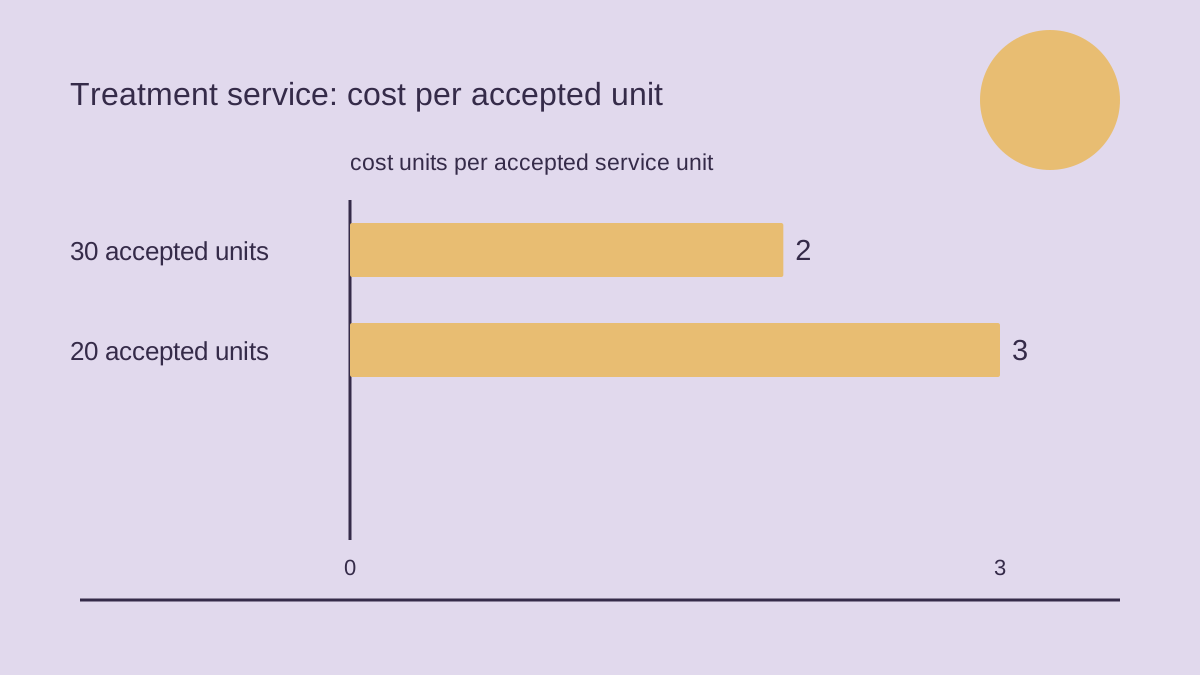
Consider a hypothetical illustration using abstract monetary units and accepted service units. It is not a reconstruction of the university's results. If a campaign costs 60 and provides 30 accepted service units, the cost per unit is two. If the same cost provides only 20 accepted units, the cost rises to three. The example assumes unchanged total cost and no value from unaccepted service. It does not specify an actual treatment volume, pollutant concentration, material capacity or market price. Its purpose is to show why an acceptance definition belongs in the denominator.
A baseline should receive the same scrutiny
A proposed cryogel service would need to be compared with a relevant alternative. The comparison should use the same stream, endpoint and cost boundary wherever possible. Selecting a weak comparison without explaining why it is relevant could make a new material look advantageous without answering the customer's actual decision.
The existing option might already have operating evidence that a new candidate does not yet possess. That difference should remain visible. It is not a reason to reject a new approach automatically, but it affects the evidence required before switching. A development trial can establish a promising result while leaving the purchasing decision open. A fair comparison would distinguish the observed technical difference from the uncertainty associated with qualification, availability and the change in operating arrangements.
Scale-up must preserve the evaluated product
Increasing the amount made is not the same as preserving the material that produced a useful test result. A scale-up programme would need to connect the larger production batch with the agreed quality definition. Otherwise the customer could be asked to accept a product using evidence obtained from a materially different specimen.
The account should identify changes in production scope and show which characteristics have been rechecked. This does not require assuming that a larger process will necessarily perform worse. It requires evidence that the relevant result survives the change. An output target would be more informative if accompanied by the proportion of material meeting the release criteria and the destination of lots that do not. Without that information, gross production could overstate the amount suitable for the proposed service.
Storage and transport connect the laboratory to the user
A material delivered to a customer has passed through handling and storage that may not be part of its original test. The developer would need to identify the delivered condition and the period for which that condition is supported by evidence. This is a qualification question, not a statement that the reported cryogel deteriorates in transit.
The packaging and handling proposal should make its assumptions visible. A customer needs to know which instructions and conditions belong to the evaluated product, while a supplier needs a basis for investigating a disputed delivery. Retained samples or documented checks could help connect the production batch with the delivered lot, if appropriate for the programme. The chosen controls should serve that evidence task rather than add documentation with no relationship to the intended use.
Supply planning needs accepted batches
A project may plan a certain gross manufacturing volume while having less material available for delivery. The commercial model should distinguish material made, material released and material committed to customer evaluation. Those categories affect both availability and the money tied up in the project.
For a prospective buyer, a reliable supply discussion would concern accepted batches at the required time, not merely an annual production intention. For the developer, qualification samples and retained stock may create costs before regular orders begin. A cash timetable should therefore sit alongside the unit-cost model. This does not establish the size of the research team's funding needs. It identifies a question that an operating proposal would have to answer before presenting a low material price as a complete commercial advantage.
Define the evidence needed for the next decision
The early development stage would be easier to assess if each step were connected to a decision. A material characterisation could justify selecting a candidate. A repeatability study could justify a customer trial. An application test could justify discussing an operating pilot. These are possible stages, not achievements reported for the cryogel.
- Choose a specific application and an agreed performance endpoint.
- Define the material condition and batch-release measurements.
- Test repeated lots under a stated application boundary.
- Include replacement, handling and spent-material management.
- Compare the complete cost per accepted service.
- Separate a research result from customer qualification and supply readiness.
This sequence would not guarantee commercial success. It would make an unfavourable result informative by identifying which assumption needs revision before the next commitment. More production is not always the appropriate next step when the unresolved question concerns the service rather than manufacturing volume.
Control changes after an application has been qualified
A successful application test would establish a starting configuration, rather than permission to change every part of the product. A supplier should record which material batch, physical form, storage condition and test procedure produced the accepted result. If the next delivery changes one of these elements, the customer needs a way to decide whether the previous evidence still applies. This is a proposed commercial control, not a claim that such a system already exists for the reported cryogel.
Consider a purely hypothetical change in packaging. The material may retain the same name and nominal formulation, while the customer receives a different arrangement of pieces. Acceptance should then ask whether the arrangement changes handling, the amount placed in the test unit or the service endpoint. A label describing the material as equivalent would not answer those questions. Equally, the customer should not require an entirely new research programme for every administrative change. The parties need agreed categories of change and a proportionate route for checking their consequences.
Retained samples could support this route if their storage and subsequent testing are defined. They would let the parties examine a disputed lot against a recorded reference, but they would not automatically reproduce the conditions of a water-treatment trial. A reference sample is useful only within the limits of what it represents. Its role, permitted storage interval and interpretation should be written down before a quality dispute, when neither party knows which result will favour it.
The same discipline applies to the test method. If a measurement procedure changes, an apparent improvement could reflect the new procedure rather than better material. Before comparing results, the supplier and customer should ask whether the older and newer measurements answer the same question. Where they do not, the sensible response is to establish a new baseline and explain its limits, rather than combine the two series into an unsupported performance trend.
Independent review can also be specified narrowly. An outside laboratory might check a particular endpoint or repeat a defined comparison; that does not make every proposed application validated. The report should identify the sample, procedure and conclusion actually reviewed. Commercial communication should retain that scope. This would make the evidence easier to use for procurement because a buyer could see what had been checked, what remained uncertain and what additional test its own application would require.
Finally, delivery documentation should connect the product to this evidence without burying the buyer in unrelated research. A lot identifier, an agreed acceptance record, declared changes and a contact for resolving deviations would form a practical chain. If that chain breaks, a promising research result cannot establish the quality of the disputed delivery by itself. Maintaining the chain would be part of the future operating cost and should therefore enter the business case from the beginning.
A useful product needs a repeatable promise
The January 2025 account gives a reason to continue investigating a porous chitosan material, while explicitly leaving batch reproducibility as work in progress. A water-treatment proposition would become stronger when it connects a defined material, a relevant test, an accepted endpoint and a complete service account.
The central commercial promise would concern what the buyer receives repeatedly, not the most impressive result from a selected specimen. The next meaningful milestone is therefore evidence that the evaluated performance can be supplied consistently under a stated boundary. Until that link exists, the cryogel should remain a research candidate with potential applications, rather than a treatment product presumed to be qualified from its porous structure alone.
Sources: Интерфакс Россия; Наука.рф (university statement).




Leave a comment