

A new elastomer-compounding line can expand a manufacturer's options without making every intended material grade immediately available to a customer. The purchasing question concerns the grade that a downstream process can accept, the evidence covering it and the supply boundary behind the offer. A line's proposed scale is relevant, but it should not replace that product-specific account. The useful connection runs from formulation and production route to accepted material and the customer's intended component.
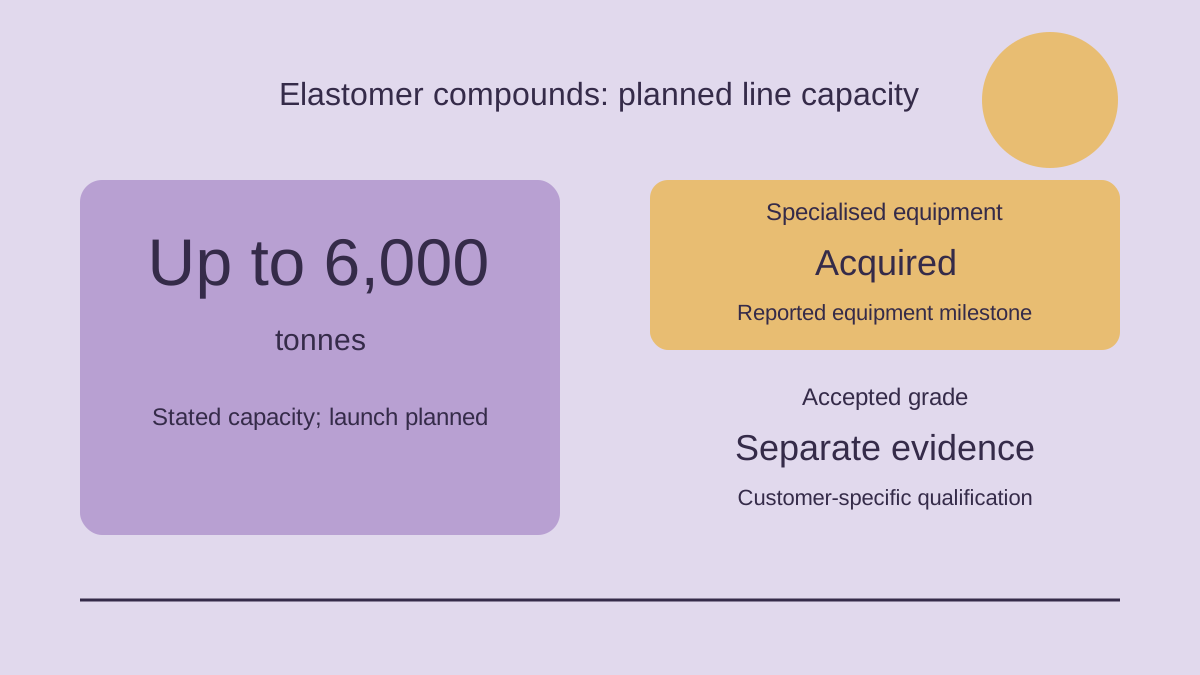
On January 24, 2025, Interfax reported that R&P Polyplastic planned a new thermoplastic elastomer compound line in Engels, Russia, with stated capacity of up to six thousand tonnes. The company's representative described acquired specialised equipment and intended improvements in the material range. Launch remained prospective in that report. It did not establish completed commissioning or accepted supply of every proposed grade.
The following original analysis proposes a conditional way to review such a development. It does not add later launch results, undisclosed formulations or processing instructions. Its focus is the bridge between a manufacturer's proposed compounding capacity and a customer's evidence for accepting a particular material. The proposed checks are an evaluation framework, not a programme announced by Polyplastic.
Start with the component's material task
The downstream customer should define what the material must help the intended component do. A broad elastomer category is insufficient if the component's requirements remain unstated. The enquiry would need a declared application, product revision and acceptance boundary, agreed with the people responsible for the component. This would let the manufacturer assess a relevant grade rather than infer the customer's needs from a general request for a flexible or improved material.
The task should also identify which conditions belong in the evaluation and which remain outside it. A successful observation for one component does not automatically answer another application. The proposed review should preserve that distinction when results are shared across purchasing and development teams. This is a requirement for a future customer decision, not a statement that any particular grade in the Engels project has failed or passed an undisclosed test.
Define the grade more precisely than the polymer family
A material family can describe a development direction, while a grade identifies a specific offered product within an accepted scope. The purchaser would need a clear grade designation, the applicable documentation and a record of what revision is being evaluated. Without that information, separate samples could be discussed under the same broad name even though the comparison no longer concerns the same offer. Product identity should determine what evidence can be reused.
The review should distinguish a research formulation, a trial grade and a routinely offered material. Each can support useful work, but each carries a different purchasing implication. A successful discussion of formulations should not be treated as an accepted catalogue offer. Conversely, a limited trial need not be dismissed as commercially meaningless if it addresses a defined development question. The customer should know which decision the proposed material and its evidence can currently support.
Connect formulation evidence to the intended production route
A promising formulation result and the readiness of a production route answer related but distinct questions. The review would need to identify where the examined material was prepared and how that evidence relates to the route proposed for supply. Earlier observations may remain relevant, but their applicability should have an explained basis. The presence of acquired equipment does not alone demonstrate that all intended grades can be supplied through it under an accepted routine arrangement.
The manufacturer could present a bounded account of the relationship without disclosing protected formulation knowledge. The purchaser needs sufficient evidence to judge the offer, not necessarily unrestricted access to every development detail. Where a relationship has not yet been established, the record should name the unresolved question. This would allow further investigation while preventing an earlier sample result from silently becoming proof of a new line's complete operating capability.
Choose a downstream trial that represents the decision
A customer trial should be selected for the question it needs to answer. The team would need to explain how the trial object and conditions relate to the intended component and production task. An attractive result on a convenient specimen may be useful to development without qualifying the final offer. The review should identify that limited value rather than assume either that every trial is representative or that only a complete product launch can yield useful evidence.
The trial should have acceptance criteria before the result is known. If a requirement changes during the evaluation, the record should show the revision and its consequence for earlier observations. Otherwise, success could be declared by changing the question after the material has been examined. This article does not prescribe processing parameters or component tests; it proposes a clear relationship between the agreed task, the observation and the purchasing conclusion.
Review processing compatibility without inventing a recipe
A proposed grade would need an assessment of its suitability for the customer's intended processing route by the relevant specialists. The enquiry should distinguish documented guidance from a customer's untested assumption. A material offer does not automatically establish compatibility with an unspecified tool, machine or production schedule. The supplier and customer would need to agree which evidence covers the intended route and what further evaluation remains necessary before routine use.
This analysis provides no temperatures, equipment settings or formulation instructions. Its purchasing question is whether the accepted record identifies the relevant product and the boundaries of its use. If the customer changes the component or process, the parties should explain why earlier evidence remains applicable or which review is required. The decision should not assume that a broad material description supplies all the missing details of a particular manufacturing application.
Separate material acceptance from component acceptance
A supplied material may meet its agreed specification while the customer's finished component still requires its own assessment. The operating account should preserve both boundaries. Accepting a batch against a material document should not be represented as approval of every component that might be made from it. Equally, an unfavourable component result should be investigated in relation to the actual trial rather than automatically assigned to an unspecified defect in the supplied grade.
The record should identify who decides at each boundary and how an unresolved result is communicated. Clear roles would let the team distinguish a material discrepancy, a component-design question and a processing issue that still needs investigation. These are proposed evaluation categories, not findings about Polyplastic. Their purpose is to turn an unexpected observation into a defined next action instead of a broad claim that the material or the entire line is unsuitable.
Keep batch identity and revision together
A customer evaluation would need to relate each sample to its grade, revision and relevant batch record. The label should remain understandable when material moves between storage, preparation and trial work. Without that connection, a later favourable result might be attributed to an earlier formulation simply because both were described by the same family name. The review should preserve the relationship between the material actually examined and the claim that the observation supports.
If the formulation or route changes, the record should state how earlier evidence will be reviewed. A change does not necessarily invalidate every observation, but its significance needs an explanation. The manufacturer and customer should agree which changes require another trial and which have an accepted basis for continuity. This would make product development traceable without pretending that a grade's history consists of one fixed version that never needs reassessment.
Assess consistency beyond a selected sample
A favourable sample can demonstrate a result under its recorded conditions. Regular procurement requires an account of consistency across the relevant supply scope. The proposed evaluation should identify which repetitions matter and how the samples represent that scope. Numerous measurements on one object should not be confused with evidence that independent batches behave similarly. The buyer needs the structure of the evidence, not merely a large count of readings.
Variation should be recorded in a way that supports decisions. The report could identify observed differences, explained exceptions and unresolved results without assigning a cause that has not been established. Selecting only the most favourable examples would weaken the account. Where the evidence is incomplete, the useful response is to define a further trial or a narrower supply scope, rather than promise consistency beyond what the material records actually support.
Translate line capacity into accepted grade availability
A proposed line total does not establish the quantity of a particular accepted grade available to a customer. The purchasing review should connect the offer to the relevant product mix, accepted output and allocation. This is not an estimate of the company's utilisation or order book. It is a distinction between equipment scale and a specific supply service, allowing the buyer to ask what quantity is supported by the current offer and under which schedule.
A hypothetical example illustrates the point. Suppose an invented route has room for one hundred units in a period, while a customer's accepted grade receives twenty and the customer seeks ten. The first figure does not establish that the ten are assigned or ready for delivery. These numbers are not Polyplastic data. They show why total capacity, grade-specific availability and a customer commitment require separate records, even when the headline production scale appears sufficient.
Include storage and handling in the proposed supply account
The supply offer should identify the documented conditions applicable to the material between dispatch and intended use. The relevant specialists would need to establish those conditions for the actual grade and packaging. This article gives no storage lifetime, moisture limit or handling procedure. It asks that the purchasing account preserve the relationship between the offered material, its accompanying instructions and the conditions assumed by the customer's evaluation.
If the trial uses a different preparation or storage history from the intended regular supply, the review should explain whether the difference matters. An unexplained difference would make the result harder to apply. The team can investigate that question without inventing a degradation mechanism or assuming a particular sensitivity. The supported claim should remain bounded by the evidence, leaving an unexamined condition visible rather than absorbing it into a general statement of compatibility.
Compare economics through accepted components
A customer may investigate whether a new grade offers a better economic route, but the comparison should include the relevant service and acceptance boundary. A material price alone may not describe the cost of producing an accepted component. The review would need a consistent account of the work included in each alternative and a declared baseline. This analysis does not assign a price advantage, reduced rejection rate or processing saving to the proposed Engels line.
Observed costs and forecasts should remain distinct. If a proposed benefit depends on a future trial or routine supply arrangement, the report should state that condition. The customer can then assess the development opportunity without booking an unproved saving. A fair comparison also preserves differences in product requirements and accepted output, because a lower amount for a different service would not answer the same commercial question as the material route under review.
Give safety and environmental claims their own boundary
A material's proposed use should be assessed through the documentation and qualified review applicable to that use. A manufacturer's line announcement does not establish approval for every application. The purchaser should identify which claims matter to the component and seek evidence at that scope. This article does not infer a food-contact, medical, fire-performance or other specialised approval from the elastomer category or the investment proposal.
Resource or environmental assertions should be examined separately. A changed formulation or a new production route does not alone establish a smaller impact for the customer's accepted component. The comparison would need evidence about the relevant inputs, work and service within a defined boundary. Without that account, neither an advantage nor a disadvantage has been demonstrated. The enquiry can preserve the question without assigning an outcome that the historical report never supplied.
Use grade approval gates to organise the enquiry
The manufacturer and customer could organise evaluation around explicit decisions rather than one broad statement that the line is ready. The following sequence is an original proposed framework, not an announced Polyplastic qualification programme. It would connect development evidence to the particular purchasing question while keeping incomplete work visible.
- Agree the component task and identify the grade revision under evaluation.
- Review the relationship between existing formulation evidence and the proposed supply route.
- Conduct the appropriate downstream trial against declared acceptance criteria.
- Assess relevant batch consistency, documentation and material status.
- Approve only the grade quantity and delivery scope supported by the resulting record.
An intermediate decision may support continued development or a limited trial supply. That remains useful if its boundary is explicit. The framework should not force every result into the language of routine commercial availability before the relevant product and supply questions have been answered.
Keep the commercial offer aligned with the historical evidence
The January 2025 report describes a prospective launch. The analysis should preserve that status rather than insert an assumed later commissioning result. Any subsequent event would need separately verified information with its own date and scope. Keeping the historical boundary intact helps a reviewer distinguish the manufacturer's intention, an evaluation outcome and a current offer instead of combining them into one undated success statement.
A customer-facing proposal should identify the grade, accepted revision, quantity and delivery conditions that are actually offered. If the scope changes, the supplier should explain which earlier evidence still applies and which matters need review. That account can recognise useful continuity without assuming unrestricted transfer of every previous finding. A clear offer gains credibility through the explained relationship between its present commitment and the records supporting it.
Make the new line a useful part of the material decision
A new compounding route can be commercially important without automatically qualifying every intended elastomer grade. Its useful contribution lies in the decisions it enables: further formulation work, a defined component trial or an accepted supply arrangement when the evidence is available. Product identity, route applicability, batch consistency and allocation belong in that connection. The headline capacity should inform the enquiry without replacing those separate questions.
A reviewable decision would preserve the reported opportunity, identify the customer task and state the uncertainty that remains. It could then assess the proposed grade on the evidence relevant to that task rather than on an assumed industrial outcome. The new line becomes meaningful to procurement when its capability is connected to accepted material and a bounded offer, allowing a customer to distinguish development progress from the supply on which its own production can rely.
Sources: Interfax English.





Leave a comment