

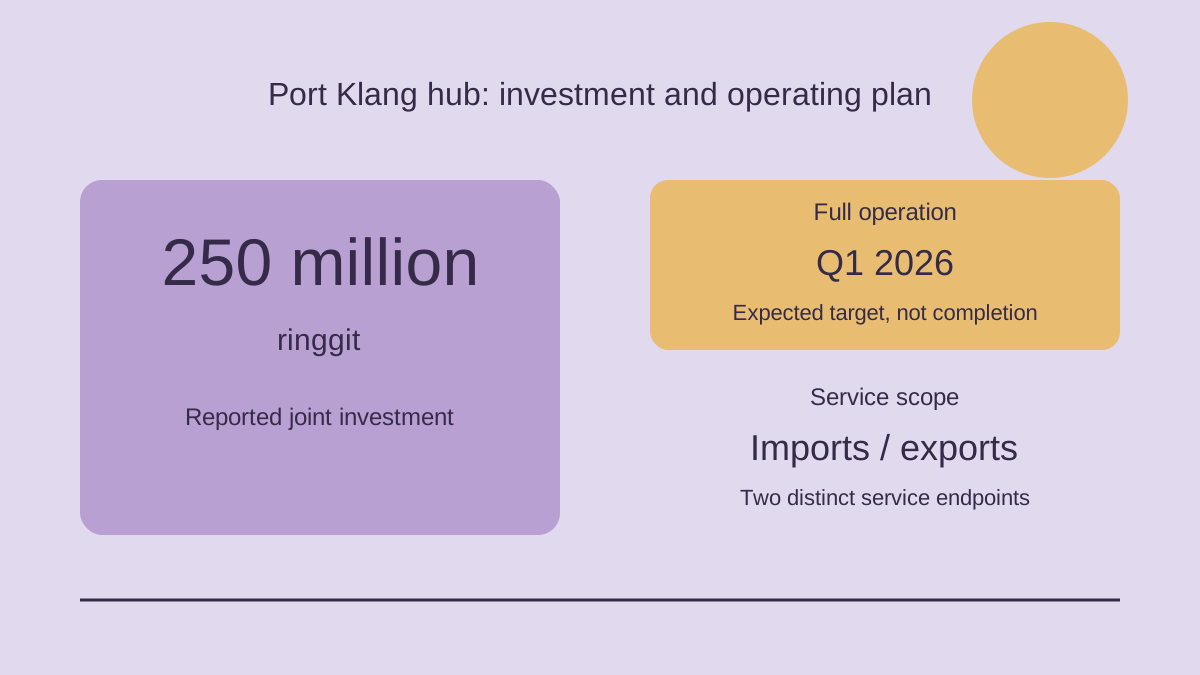
Bernama reported on March 21, 2025, that Nestlé Malaysia and Malconrep Depot (M) Sdn Bhd had jointly invested RM250 million in an integrated logistics hub in Port Klang, Malaysia. The company expected full operation in the first quarter of 2026 and described a role spanning imported raw materials and product exports. The business question is how those two flows would become a dependable service, rather than simply share a new address.
The hub proposition contains two different promises
An import flow would be valuable when the required material becomes available to its intended recipient. An export flow would be valuable when an accepted customer order reaches the agreed delivery point. Those are separate promises, even if the same hub supports both. A meaningful operating assessment would identify their endpoints before combining their performance. Otherwise, a large quantity moving through the building could conceal a mismatch: inbound material accumulating while outbound orders wait, or outbound movement continuing while a particular production requirement remains unresolved.
That distinction suggests a joined-up account with separate service measures. The account would connect an inbound lot with its receiving requirement and an outbound order with its customer requirement, then show how the two depend on intervening production and planning decisions. It would not assume that every inbound lot directly supports the next export order. Where the relationship is indirect, the record should say so. A claim that the hub improves the whole supply chain would need evidence for those relationships, rather than a single total for warehouse throughput.
Building readiness and flow readiness should have separate dates
A construction milestone could be an important project achievement while leaving the service transition incomplete. An operating plan would need to distinguish the availability of physical space from the acceptance of each flow. An inbound route might be ready before an outbound customer arrangement, or the reverse. Recording separate dates would make that sequence visible. The reported first-quarter target was prospective at the date of the article; it should not be turned into a claim that every intended service had already been demonstrated.
For an assessment, readiness should therefore mean a named task can be completed under documented conditions. A future record could identify the first accepted receiving event, the first accepted dispatch and the period over which those events repeat. It could also retain unresolved services alongside accepted ones. This would allow a project to show genuine progress without treating the earliest successful movement as proof of the entire operating proposition. The evidence could grow in stages while each stage retains its own boundary and its actual observation date.
The receiving boundary should follow usable material
An arrival record would not necessarily establish availability for the intended production requirement. A joined-up assessment would identify when the recipient accepts the material and when it can be assigned to the required task. This article does not describe a company procedure or prescribe handling rules. It proposes a decision boundary. Measuring only arrival would answer whether a shipment reached the hub; measuring accepted availability would answer whether the inbound service supplied what the production plan needed, at the relevant point in that plan.
The distinction would also preserve rejected and unresolved lots. A delivered lot awaiting a decision should remain visible as awaiting a decision, rather than counted as usable simply because it occupies space. A receiving account could connect quantity, identity, status and time. Those connections would help explain whether a shortage concerns physical supply, acceptance or allocation. Without them, a planner could see ample aggregate inventory yet remain unable to fulfil a specific requirement. The account would then be tracking presence without adequately describing the service that presence is supposed to support.
Dispatch should be measured against the customer commitment
An outbound movement would need an equally clear endpoint. Departure from the hub and acceptance at the agreed delivery point would be different observations. A service claim should state which one it measures. If the customer commitment concerns delivery, departure performance alone would leave part of that commitment outside the evidence. A future assessment could retain both observations, allowing a reader to see where time is spent and which portion of the delivery chain is covered by the hub's documented operating responsibility.
The order record should also preserve what the customer agreed to receive. Quantity shipped would not automatically equal quantity accepted against the order. A comparison could show accepted, rejected and unresolved outcomes without presuming any rejection occurred in this project. It should apply the same treatment to the reference service used to assess improvement. That would make a claim about better service more precise: a comparison of defined order commitments over defined periods, rather than a count of departures whose relationship to customer acceptance remains unclear.
The yard and warehouse need a visible handoff
The announced combination of warehouse and container-yard functions invites a handoff question. A joined-up record would show when responsibility for an identified movement passes between the assessed stages. It should preserve both the physical event and the associated status information. If a unit moves but its status does not change in the record, the next participant might lack a clear basis for action. Conversely, a recorded status change without the corresponding physical event would leave a different mismatch. These are proposed assessment questions, not reports of faults at the planned hub.
A handoff should consequently have an identified receiving party and a defined acceptance condition. A future trial could examine complete movements across the boundary rather than separate demonstrations on either side. Success within the yard and success within the warehouse would not alone establish a successful interaction between them. The interface would need its own evidence. That evidence would make the integrated proposition meaningful by connecting the two functions, while leaving room to show which part of the interaction still requires investigation before the service is expanded.
A shared resource should be compared at overlapping demand
Combining flows could create opportunities for shared space, people or scheduled movements. The value of sharing would depend on when each flow needs the resource. A comparison should therefore retain the timing of demand instead of considering the flows only as separate daily totals. Two services might each fit the available resource when assessed alone yet require a different arrangement when assessed together. This does not establish that a constraint exists at the project. It identifies why an integrated operating proposition needs a combined demand assessment.
A useful assessment would distinguish average utilisation from the ability to meet simultaneous commitments. It could describe the periods covered, the commitments accepted and any demand not covered by the record. A high average would not automatically demonstrate reliable service during overlap, while a lower average would not automatically establish waste. The interpretation would depend on the service boundary and the requirement the reserve supports. Keeping those details visible would help a project explain its resource choices without turning every occupied area or busy period into a universal efficiency measure.
A worked example separates movement from fulfilment
Consider an explicitly hypothetical hub, unrelated to measured results at Port Klang. During an invented assessment period it records 100 inbound units and 100 outbound units. Of the inbound units, 80 are accepted for the intended receiving requirement and 20 await a decision. Of the outbound units, 90 meet the selected customer commitment and 10 remain unresolved. The movement total is 200 units, but that total does not describe either accepted service. The receiving and delivery accounts have different numerators and different outstanding questions.
Now suppose, only within this invented example, that the reference service receives 90 accepted inbound units and completes 90 accepted outbound units with fewer total movements. Ranking the alternatives by movement would favour the first; ranking the receiving service would favour the reference; ranking the selected delivery outcome would show no difference. There is no contradiction. The rankings answer different questions. The example demonstrates why a headline throughput measure should not stand in for a complete service comparison, and why unresolved units should retain their status rather than acquire an assumed favourable result.
Inventory identity should survive the transition
A transition from an existing arrangement to a new hub would require a record of which lots and orders move between the arrangements. A comparison could be distorted if the new hub receives only convenient orders while difficult ones remain elsewhere, without that selection being disclosed. The assessment should identify the assigned population and the reference period. This is an analytical requirement, not a claim about the company's transition choices. Its purpose is to distinguish an observed service improvement from an unexplained change in the work being assessed.
The transition account should also prevent a lot or order from being counted twice when it crosses the boundary between arrangements. A shared identifier could connect the records while preserving the actual sequence of events. If the identity cannot be reconciled, the result should remain unresolved until the gap is explained. That discipline would help a future report show continuity during the move without claiming that a new digital record automatically establishes continuity. The relevant evidence would be the connection between the record, the material and the accepted service.
Partner coordination should have a decision boundary
A joint project would need to connect the participants' responsibilities for the assessed service. An investment announcement identifies partners but does not specify every future decision arrangement. A practical assessment could therefore ask who accepts a handoff, who resolves a mismatch and who records the resulting decision. These would be questions for the project evidence rather than procedures invented by an outside article. Clarifying the boundary would allow an evaluator to understand whether a delay is associated with one stage, an interface or an unresolved responsibility.
A service record could preserve the initial issue, its assigned owner and its eventual outcome. It should distinguish time spent awaiting a decision from time spent performing the agreed work. Both might affect delivery, but they point to different operating questions. Combining them into one unexplained delay would obscure the next useful assessment. The partners could then examine the decision path as well as the physical path, with the claim of integration supported by connected observations rather than inferred solely from the presence of several functions on one site.
Digital visibility should reconcile the two directions
A system showing inbound lots and outbound orders would become more useful when their statuses can be reconciled with the planning requirement between them. A future evaluation should ask what a user can decide from the record, rather than count the number of displayed fields. If the record cannot explain why a required lot is unavailable or why an accepted order is waiting, visibility may remain incomplete for that decision. The article does not establish what software the planned hub uses or how it performs.
The assessment could examine a complete decision sequence: an identified requirement appears, the relevant record is consulted, an action is assigned and an accepted outcome is recorded. That would test whether information supports the service rather than merely describes activity. An unresolved mismatch would remain part of the evidence, including the effect of a correction. A digitalisation claim could then be bounded by the decisions actually assessed. It should not automatically imply fewer errors, lower environmental impact or better delivery across every flow without the corresponding observations.
A joined-up ledger can keep the claims separate
A concise ledger could connect the hub's physical functions with the service outcomes used to assess them. The following fields describe a proposed evaluation structure, not an existing company record or a completed operating test:
- Inbound lot identity, required recipient and accepted-availability time.
- Outbound order identity, agreed delivery point and acceptance status.
- Yard-to-warehouse handoffs, receiving responsibilities and unresolved mismatches.
- Demand periods for shared resources and commitments covered by those periods.
- Transition identities connecting the existing arrangement with the new one.
- Separate resource and expenditure accounts for receiving, delivery and their interfaces.
The ledger would not prove performance simply by having all its headings filled. Its value would come from traceable observations and clearly marked gaps. A missing observation could define the next assessment; a completed observation could support a bounded claim. Keeping both would allow the project to show how the whole service develops without treating separate successful events as an already demonstrated complete system.
The economic and environmental accounts need their own evidence
A complete expenditure comparison would need a named reference, an assessment period and a service denominator. Spending per movement and spending per accepted order could tell different stories. A future calculation should also retain the resources committed to unresolved work, rather than exclude them because they did not produce an accepted result during the selected period. This article offers no measured saving or profitability forecast. It identifies the account needed to evaluate such a claim without changing the meaning of the service halfway through the comparison.
An environmental proposition would likewise need an identified boundary and observations appropriate to it. A shorter stage, a new building or a digital record would not independently establish a whole-route benefit. Moving an activity between parties would not automatically remove its resource demand from that boundary. The wider case for the Port Klang hub would become stronger when accepted inbound availability, accepted export delivery and the complete intervening account can be reconciled. Until then, the announced investment establishes a project proposition whose operational value remains a question for connected evidence, rather than a conclusion supplied by the size of the commitment.
Sources: Bernama.






Leave a comment