

A March 19, 2025 Interfax report describes research at the Institute of Catalysis in Novosibirsk, Russia, on converting trichloroethylene-based material into carbon nanomaterials. The report identifies possible applications for the carbon product and discusses other process outputs. The industrial question is how a development programme would account for the complete input and output arrangement while separately establishing the suitability of an identified product.
Define the material entering the programme
A development enquiry could begin with the identity of the material being considered and the evidence describing it. A broad waste category does not establish that every material within the category has the same composition or would produce the same observations. The proposed programme could identify its reference material and the scope of any comparison. This would turn a general interest in resource recovery into a defined question that an industrial partner can review.
The input record would need to remain connected to the observations obtained from it. If a later trial uses another input, the change would be visible rather than be described as an unchanged repetition. The historical announcement provides a reason to investigate the research route, but it does not qualify every industrial waste stream for that route. A partner could preserve the reported development while identifying the evidence still needed for its particular material.
Separate disappearance of an input from complete accounting
A claim that an input has been processed would not, by itself, provide a complete account of where its constituents appear afterwards. A proposed programme could identify the boundaries of the observed process and the outputs included in its record. It would also identify unresolved quantities rather than silently treat them as a beneficial product. This is an original accounting framework, not an assertion that a particular unreported output has been observed in the research.
The historical source discusses more than a carbon powder. An industrial reading should therefore avoid treating the powder as the entire output account. The next development record could keep the carbon observation alongside the other identified outputs and the questions still requiring investigation. That would make the research more useful without converting a selected product result into an unsupported conclusion about complete treatment performance, an environmental benefit or an operating site's overall outcome.
Preserve a complete observation boundary
A proposed trial record could state what equipment, inputs and observation period its boundary includes. The purpose would be to make the result interpretable, not to provide an operating method. A comparison using one route's complete arrangement and another route's isolated operation would answer an incomplete question. The programme could keep the limited operation record and the wider arrangement record separately visible, with their intended uses stated.
If the boundary changes during development, the revision would accompany subsequent results. Earlier observations would remain attached to their original boundary. This would let a partner assess which comparisons are still meaningful and which need additional evidence. The historical report does not provide a completed industrial balance for every arrangement, and this analysis assigns none. The useful next question would concern the defined trial and the information needed to review it.
Identify the carbon product before proposing a market
A possible application is not the same as an accepted product specification. A development partner could identify the intended carbon material and the characteristics needed for one selected application. The historical article names several possible uses, but it does not establish that the material has been qualified for every polymer, lubricant or catalyst-support arrangement. The next enquiry could therefore begin with one application question instead of treating a list of uses as confirmed market access.
The product record could connect an identified sample to its preparation and the observations already collected. A receiving partner would then know which material is under evaluation and which conclusion the programme is intended to support. This would preserve the distinction between a research product, an application trial sample and recurring commercial supply. None of those stages should be inferred solely from the existence of a promising carbon-material result.
Use an application-specific acceptance decision
An application programme could state what counts as an accepted result and what that acceptance permits within the programme. Acceptance for another research step would not automatically establish acceptance for recurring production. The decision record could identify the sample, the intended use and the evidence considered. This is a proposed industrial-development structure, not a reported customer policy or a regulatory approval requirement.
If the receiving partner changes the material before evaluating it, the modification would remain part of the record. A favourable observation on the modified sample should not be silently attributed to the original preparation. Keeping that connection visible would help the participants understand whether the result supports the proposed carbon product, the receiving partner's additional development or a combination of the two. The conclusion would remain tied to the arrangement actually evaluated.
Give every output its own status
A complete development account could distinguish collected material, material awaiting assessment and material accepted for a defined use. Those statuses would apply separately to each output being considered. Calling something a potential resource does not establish that a receiving operation can use it. A partner would need the relevant description and a defined acceptance question before a prospective use could become part of a practical integration discussion.
The programme could also preserve the status of material excluded from the intended application. Exclusion would not necessarily describe the whole research route as unsuccessful; it would identify a limitation that matters to the proposed industrial use. This would make the output account more informative than one containing only favourable material quantities. The historical article's discussion of possible integration should remain prospective rather than become a statement that all outputs already enter an accepted production cycle.
A hypothetical accepted-product account
Consider a hypothetical trial that records 100 units entering a defined accounting boundary. Suppose it separately records 30 units in one collected product category, 50 units in another recorded category and 20 units remaining unresolved within the account. These invented quantities are not results from the Novosibirsk research. They illustrate why a useful product observation cannot substitute for a complete output record or justify silently allocating an unresolved quantity to a beneficial use.
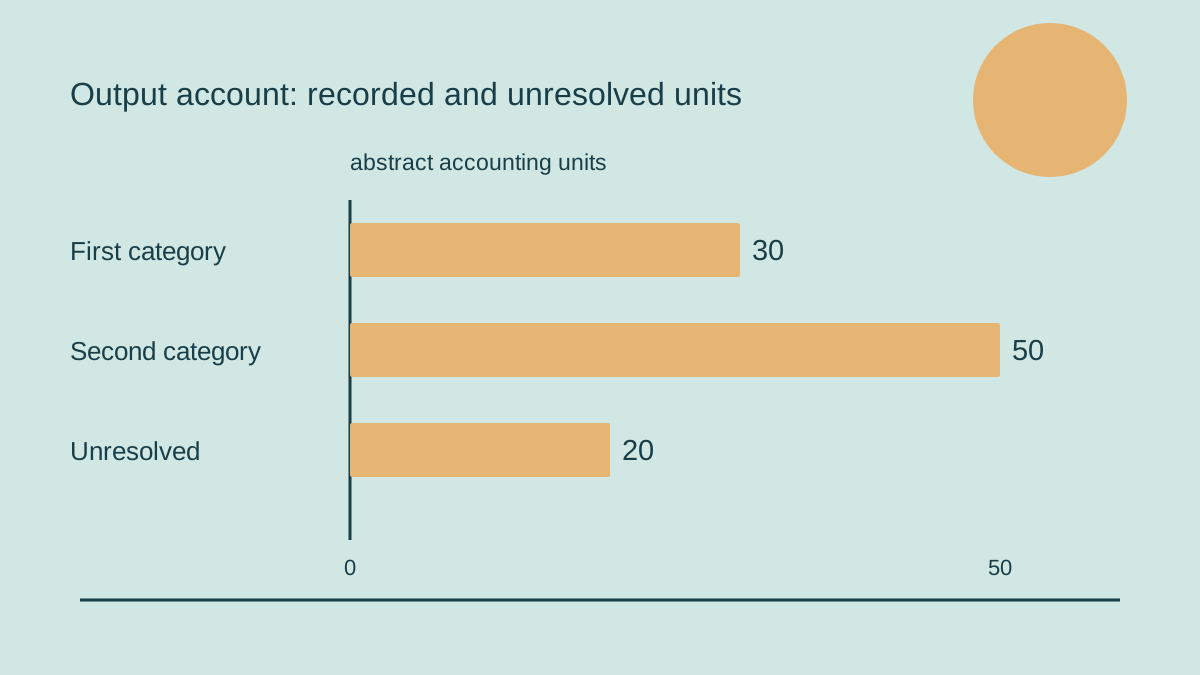
Suppose the same hypothetical programme accepts 20 of the 30 units in its first category for one application trial. The collected-product quantity and the accepted-product quantity would then differ. The example does not calculate a real yield, specify a chemical transformation or predict treatment performance. It shows the importance of stating the counting boundary and the acceptance status before a quantity is used in a discussion of product availability or industrial economics.
Connect repeated trials to their input identities
A proposed programme could distinguish repeated observations of one trial from independently prepared trials. The first can describe an identified observation period; the second can help investigate whether the development arrangement is reproducible. A partner would benefit from knowing which kind of repetition appears in the record. Several readings from one arrangement should not be presented as several independent preparations without making their relationship explicit.
Each trial could retain its input identity, preparation revision and output identities. If inputs or arrangements differ, the differences would remain part of the comparison. This would help a partner investigate whether the route supports a defined development objective while avoiding a claim that every material in a broad waste category will produce the same accepted product. The historical announcement does not supply a completed repeatability programme for all possible industrial inputs.
Keep prospective integration separate from an operating result
The source discusses the possibility of bringing certain outputs into a production cycle. A practical integration programme would need to identify the receiving process and the information it requires. The programme could ask whether an output has an accepted description for that process and how its identity would be preserved during handover. A general statement about potential use does not establish an existing receiving arrangement or an agreed supply commitment.
The receiving operation could also state which questions remain open after a sample assessment. A favourable sample result might justify another trial without establishing recurring acceptance. Keeping the decision scope visible would make the integration proposal more reviewable. It would preserve the value of the research without treating a prospective production link as proof of a completed industrial cycle, a realised substitution or an economic benefit already obtained by a plant.
Set a decision gate before expanding the trial
A staged programme could identify the evidence required before the next material, equipment or collaboration commitment. A gate might concern the input description, a complete output account or an application-specific acceptance result. The purpose would be to answer an identified question rather than promise eventual commercial success. A mixed result could still support a useful decision if the participants know which uncertainty has been reduced and which remains unresolved.
- Identify the input material and preserve its connection to every trial.
- State the complete accounting boundary and retain unresolved quantities.
- Keep each collected output separate from its application acceptance status.
- Define one product application before broadening the market claim.
- Require receiving-process evidence before describing prospective integration as completed.
These gates are original proposals for reviewing development evidence. They are not reported institute procedures, treatment instructions or regulatory rules. Their role is to connect a promising research route to a decision that has an identifiable basis. A research group and an industrial partner could adapt the structure to the actual programme without implying that the historical announcement has already answered every integration question.
Preserve disputed and uncertain observations
A trial record could retain observations that are difficult to interpret or quantities that do not fit the intended account. Removing them without explanation would make the favourable results less useful for an industrial decision. A repeat measurement could address a defined uncertainty instead of becoming a search for a convenient number. If the uncertainty remains, the record could state that limitation and identify the next question to investigate.
A disputed product assessment could retain the sample identity, the observations and the review used to resolve the case. A later acceptance decision would remain connected to that history. This would not imply that a disputed sample establishes a failed research route or that a favourable repetition resolves every output question. The conclusion would remain tied to the material, the accounting boundary and the limited application programme actually evaluated.
Compare economics on accepted outcomes
A prospective economic comparison could identify the accepted outcomes relevant to the proposed industrial arrangement. A collected carbon quantity alone would not necessarily provide the denominator for the whole programme. The account could state which outputs have accepted uses, which require further work and which remain unresolved. This would make the comparison interpretable without inventing a commercial value for every category mentioned in the historical report.
The comparison would also need compatible boundaries for the activities and materials included. A product-value estimate that leaves the rest of the arrangement outside the record would not establish realised economics. This analysis therefore does not assign a price, an operating margin or a cost advantage to the research route. It identifies the evidence a partner would need before assessing whether the proposed integration supports a defined industrial decision.
Do not turn a product finding into a universal environmental claim
A carbon-product observation and a complete environmental assessment are different subjects. The historical source includes expectations about avoiding unwanted compounds, but this analysis does not present those expectations as a universal measured outcome for every industrial input. A broader claim would need evidence gathered for the defined arrangement and its full observation boundary. The product finding can remain significant without being used as a substitute for that evidence.
The same distinction applies to an operating site's overall outcome. A research route does not establish complete deployment, accepted treatment of every stream or absence of every unwanted effect. An industrial programme could identify the particular questions it is intended to resolve and preserve the others as open. That approach would let a partner investigate the proposal without converting a promising development into an unsupported statement about all aspects of an actual plant.
Build the next commitment around a complete record
The reported research creates a specific reason to investigate an industrial development programme. Its practical value would depend on the connection between input identity, complete output accounting and accepted product use. A partner could use that connection to decide whether another trial is justified and what it should answer. The decision would then rest on evidence relevant to the proposed arrangement, rather than on the appeal of describing an unwanted material as a resource.
The most useful next record would follow one defined input through its observed outputs and the acceptance decisions attached to them. Repeating that record under identified conditions would support a clearer development conclusion. It would preserve the promise of the carbon-material result without assuming a completed plant, universal treatment performance or realised economic and environmental benefits. The central question remains whether the route can support a traceable industrial account and an application-specific product conclusion on evidence collected for those purposes.
Sources: Интерфакс Россия.




Leave a comment