

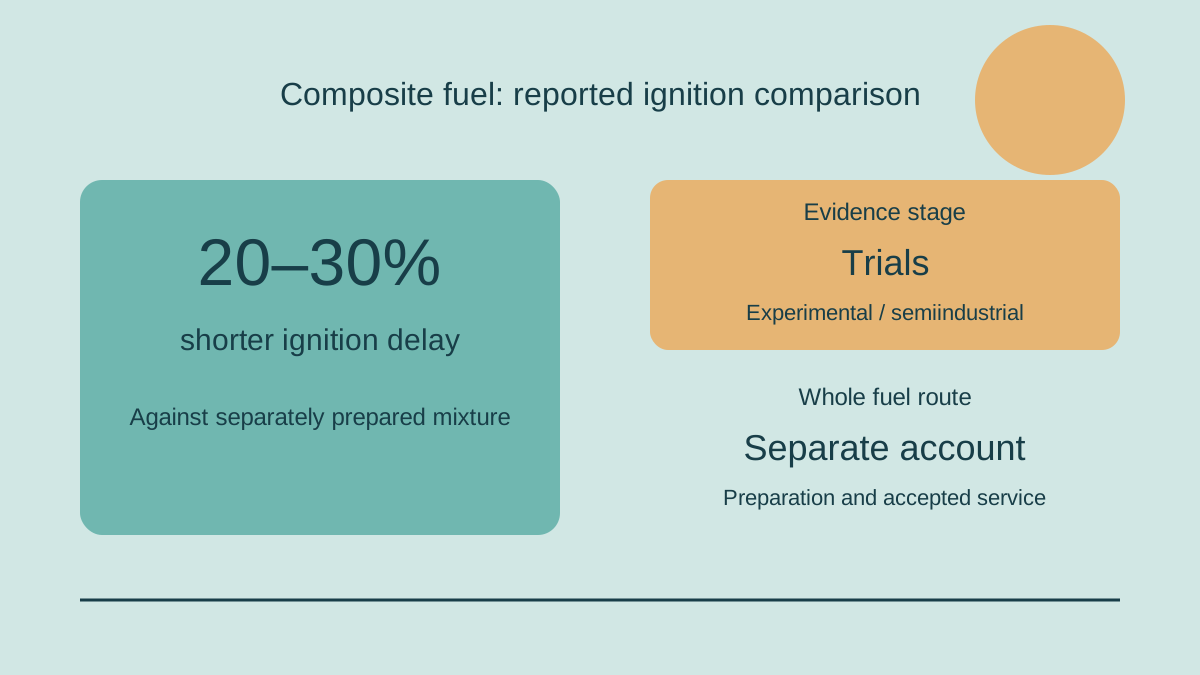
A Novosibirsk research team in Russia has developed a coal-and-sawdust composite. Interfax reported on October 2, 2025, that joint activation shortened ignition delay by 20–30% against a separately prepared mixture. The development remained at experimental and semiindustrial testing stages. That result raises a practical question: what would make the composite a better fuel over a complete operating process?
The comparison should end at useful output
An ignition result and a fuel purchasing decision answer different questions. The first compares a measured response under particular experimental conditions. The second asks whether an alternative delivers an accepted service with a satisfactory total resource commitment. A decision should therefore identify that service before assigning value to a shorter delay. It might concern useful heat delivered during a specified demand period, or another clearly defined output. The article does not establish a plant-wide improvement in either case. Such a finding would require a comparison extending beyond the reported ignition response.
A useful boundary would begin where the competing inputs enter the assessed process and end where usable output is measured. Between those points, preparation, handling, operation and rejected material should remain visible. Excluding an inconvenient stage from only one option would make the comparison asymmetric. The central analytical issue is consequently the denominator: expenditure per accepted unit of service would answer a different question from expenditure per unit of fuel supplied. Keeping both visible could explain why a promising material response does, or does not, become an operational advantage.
A reference mixture needs its own record
The reported comparator is a separately prepared mixture. That distinction should survive in any later assessment. A composite should not quietly be compared against whichever alternative produces the largest apparent benefit. Before a trial, its reference should have an identified composition, preparation history and intended use. These records would make it possible to ask whether an observed difference follows the alternative preparation route or an unrelated change in the supplied material. A label such as conventional fuel would be too broad to resolve that question on its own.
There could also be a legitimate commercial comparison against the fuel a particular operator would otherwise buy. That comparison would need a separate name and separate results. It would not replace the experimental reference retroactively. Keeping the two comparisons distinct would allow an operator to examine both the research proposition and the procurement proposition without treating them as interchangeable. A report could then state exactly which reference supports each conclusion, including any limitations imposed by missing records or differences in the conditions of the comparison.
Fuel identity should follow the batch
A purchasing description alone would not be a sufficient identity for a trial batch. The assessment would need to record which inputs actually reached the preparation stage and which prepared material reached the point of use. That requirement is about traceability rather than prescribing a particular production technique. If a batch is replaced, blended or held back, the trial record should show that change. Otherwise, a difference in results could be attached to a nominal product even though the material being assessed had changed within the comparison.
The same principle would apply to the reference. A detailed composite record alongside a vague reference record would create an uneven evidence base. Both options should carry enough information to connect their observed output with their actual inputs. An identifier would also link accepted batches to rejected or unresolved batches. That matters because commercial reliability concerns the supply stream as a whole. Reporting only successful material would leave the reader unable to judge how representative those successful observations were of the deliveries the operator might eventually receive.
Preparation belongs inside the energy account
An improvement at the point of ignition would not, by itself, demonstrate a reduction in total energy demand. Preparation is part of the alternative being evaluated. A complete comparison would therefore count measured preparation inputs alongside the service produced during use. The reference route would need the same treatment. This does not imply that joint preparation necessarily uses more or less energy. It means the direction and size of any difference should remain an open question until a comparable account has been assembled from actual observations.
The account should state where measurement begins and which activities are excluded. If a supplier performs a stage outside the operator's premises, moving that stage outside the purchase contract would not automatically remove it from a complete process comparison. A separate commercial account could show the operator's own bills, while a resource account could cover the broader boundary. Both could be useful, provided they are named accurately. Treating a transfer of expenditure between parties as a demonstrated reduction in physical resource use would confuse those two accounts.
Demand conditions should be comparable
A trial could produce different observations under different service demands. The comparison should therefore describe what the equipment was expected to deliver during each assessed period. Matching the demanded service would help distinguish a change in fuel performance from a change in the task assigned to the equipment. Where the demand cannot be matched, the difference should be recorded and reflected in the interpretation. An unmatched comparison might still provide useful operational observations, but its headline result should not be presented as if the alternatives had faced identical requirements.
This is also a reason to retain the sequence of observations. A single average could hide an important difference between periods of steady demand and periods when requirements change. The analytical question is not whether every trial must follow a universal schedule. It is whether the evidence covers the conditions relevant to the proposed use. An operator considering one defined duty should be able to find observations for that duty, rather than infer suitability from an aggregate assembled across a different and unspecified pattern of operation.
Accepted output needs a clear definition
The word useful should carry a specific meaning within the trial. Output might be produced yet fail to meet the service requirement chosen for the comparison. A complete account would distinguish gross output from output accepted against that requirement. The distinction should apply equally to the composite and the reference. Without it, a larger reported total might include a larger share of unsuitable service, leaving a purchasing decision based on a quantity that does not represent what the operator actually needs to deliver.
Acceptance criteria should be agreed before the result is known. They should not become easier for one fuel after an unexpected observation. A report could list accepted, rejected and unresolved periods separately, explaining why an observation occupies each category. An unresolved period would remain unresolved rather than being assigned an assumed success. This would preserve the difference between missing evidence and adverse evidence, while preventing either category from disappearing into an attractive average. It would also make later investigation possible without rewriting the original record of the trial.
Storage and movement are separate trial stages
The identity of material at dispatch would not necessarily establish its identity at use. A trial should record the actual handling path and the time between preparation and assessment. Those observations would define what was tested; they would not justify a universal claim about storage behaviour. If future supply would involve a materially different path, that path would need its own evidence. A successful comparison using one carefully tracked delivery cannot alone establish equivalent performance across every proposed transport arrangement or period of storage.
Movement costs should also be attached to the appropriate comparison boundary. A low purchase price might coexist with a different delivery commitment, or the reverse. The assessment should show those commitments rather than folding them into an unexplained total. Records of material not reaching the trial could be particularly relevant to the commercial account. Excluding such material from the delivered quantity while also excluding its cost would produce an artificially clean comparison. The purpose of a complete account is to retain these connections without assuming that any particular loss has occurred.
Equipment fit needs evidence for the proposed installation
A general statement about potential use should not be treated as acceptance for a named installation. The proposed equipment, its required service and the scope of the assessment should be identified together. Compatibility would then become a conclusion supported by that scope rather than a property presumed for every setting. This article provides no operating instructions or settings. Its question is how an operator could tell whether the evidence offered by a supplier actually covers the installation for which a purchasing commitment is being considered.
Any additional equipment or work required by the assessed route would belong in the record. A trial conducted with such support should not subsequently be described as demonstrating the same result without that support. Conversely, a test that did not require a change would support a conclusion only within its documented conditions. Recording what was present would allow the comparison to remain precise. It would also help prevent an early demonstration from being translated into a broad promise of effortless adoption that the available evidence does not establish.
Availability changes the value of an output result
Output measured during successful operation is one part of a service account. Time committed to preparation, inspection, interruption or recovery could also affect the amount of accepted service delivered over an assessment period. A comparison should therefore retain both output during operation and the time over which that output was obtained. Neither measure substitutes for the other. A fuel could appear attractive on an operating-period measure while leaving the whole-period question unanswered. The article reports no evidence establishing either outcome for a commercial installation.
Interruptions should be described carefully. The mere occurrence of an interruption would not prove that the fuel caused it. The record should distinguish a confirmed explanation from an unresolved association and from an unrelated event. That discipline would support a fair comparison without deleting inconvenient observations. Where the cause remains unknown, an evaluator could show the effect of including and excluding the affected period. Such an examination would reveal how strongly the conclusion depends on the unresolved observation, instead of silently choosing the interpretation most favourable to either option.
Repeated batches would test a different proposition
A successful observation could establish that a result is possible under its recorded conditions. Repeated batches would ask whether that result can be reproduced across the supply relevant to a purchasing decision. Those are different propositions. A future assessment should retain each batch result rather than reporting only a combined average. The spread of observations could influence the commitment an operator is willing to make even when the average appears favourable. Without repeated evidence, that spread would remain unknown rather than automatically narrow or commercially acceptable.
Repetition should also distinguish similar conditions from changed conditions. If a later batch is assessed under a different demand pattern, it should not be treated as a simple replication of the first. It could extend the evidence into another part of the proposed operating range, provided the difference is recorded. This approach would allow the assessment to grow without losing its original boundary. The reader could see which conclusions rest on repeated comparable observations and which rest on an initial observation made under newly introduced conditions.
A trial ledger can expose the missing pieces
A compact ledger would connect the material comparison to the service comparison. Its purpose would be to prevent useful information from remaining in separate documents that cannot be reconciled. Each entry should connect an identified batch with its reference, preparation record, assessed period and output decision. The following fields describe a proposed evaluation structure, not a record of completed testing or a claim that the researchers already use such a system:
- Batch and reference identifiers, with a documented comparison boundary.
- Measured preparation and delivery commitments for both alternatives.
- Required service, observed output and the portion accepted against that service.
- Time included in the assessment and explanations for interruptions.
- Rejected or unresolved material and observations, retained alongside accepted results.
- Conditions covered by the evidence and proposed conditions still awaiting assessment.
A ledger assembled this way would make incompleteness visible. It would not turn incomplete evidence into a pass merely because every field has a heading. Entries could explicitly say that a measurement is unavailable or that an explanation remains under review. That would give a decision-maker a concrete reason to request further evidence.
Price and resource efficiency should not collapse into one claim
A commercial comparison would need an identified price basis and an identified service basis. Price per delivered quantity and expenditure per accepted output could move in different directions. Neither should be substituted for the other without showing the intervening account. Similarly, a change in the operator's spending would not automatically establish a change in total resource demand. The relevant conclusion depends on what has been measured and which boundary has been chosen. Keeping those boundaries explicit would help readers assess a proposal without interpreting every favourable cost observation as a wider efficiency claim.
Prospective expenditure should be distinguished from incurred expenditure. If a proposal relies on a future delivery scale or a possible equipment arrangement, its calculation should show that dependence. A sensitivity comparison could ask how the conclusion changes when those assumptions change, but it should remain a conditional calculation. This article offers no price forecast or demonstrated saving. Its analytical point is that a purchasing decision becomes more defensible when it can identify the assumption on which an apparent advantage rests and the evidence needed to replace that assumption.
Environmental conclusions require their own boundary
Using a residual material would not, on its own, establish the environmental result of an entire fuel route. An assessment would need to identify which activities and outputs it includes, what alternative it compares, and where its observations come from. A resource-use argument could be relevant without answering every environmental question. The difference should remain explicit. The reported ignition comparison cannot be converted into a quantified whole-process environmental benefit merely by attaching a general description of the inputs to the result.
Missing measurements should not be replaced with an assumption that every relevant output is favourable. Equally, uncertainty should not be treated as proof of a disadvantage. A report could separate the supported observation, the proposed implication and the outstanding measurement. This would allow a development-stage project to describe a credible research question without presenting a completed environmental assessment. For a prospective operator, the value lies in knowing which part of the claim has evidence and which part still requires investigation under the conditions of the proposed use.
The next commitment should follow the strongest evidence
The reported research provides a reason to examine a composite route further. It does not require a decision-maker to jump directly from an ignition observation to broad commercial adoption. A next commitment could be limited to the unanswered question most relevant to the intended service. If preparation accounting is incomplete, that would define one useful assessment. If the proposed equipment falls outside the documented evidence, a different assessment would be needed. Selecting that question would connect further work to a decision rather than simply repeat a promising headline.
The strongest eventual argument would join traceable fuel identity, a fair reference, measured preparation commitments and accepted service over a documented period. Repeated evidence would then show the extent to which the result carries across the proposed supply and duty. Until those connections are established, the distinction between experimental promise and complete fuel performance should remain visible. That distinction gives the research result a precise place in an industrial evaluation: a starting point for a broader comparison, with the missing evidence clearly named and the size of the next commitment kept consistent with what is actually known.
Sources: Интерфакс Россия.






Leave a comment