

A very thin conducting coating is interesting to a manufacturer only when it can be delivered in a form that a device accepts. Thickness describes one property. It does not establish the usable area, the consistency of successive deliveries or the cost of obtaining an electrode that survives the customer's next processing step. These questions define the commercial significance of a reported laboratory result, even when that result is scientifically promising.
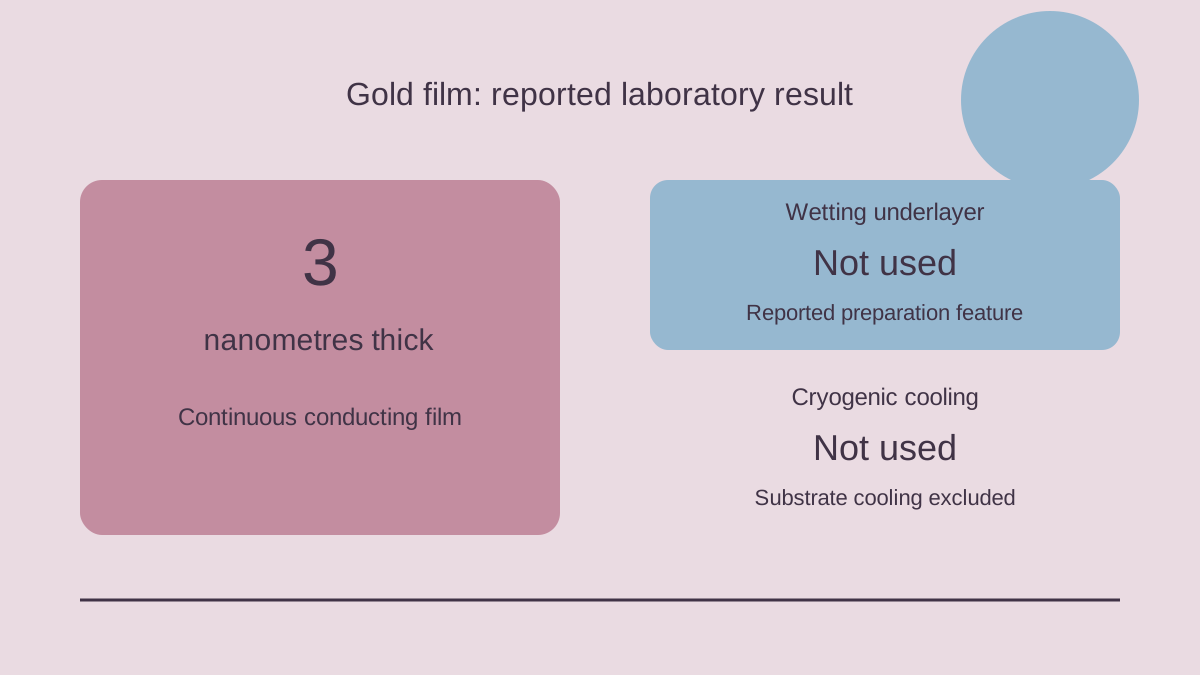
On November 10, 2025, Interfax reported that researchers in Novosibirsk, Russia, had produced a continuous conducting gold film three nanometres thick without a wetting underlayer or cryogenic substrate cooling. The report described a laser-deposition approach and potential transparent-electrode applications. It did not establish a commercial production line or customer-qualified device.
The business question is therefore how to turn a defined coating result into repeatable accepted output. The following framework proposes questions for that transition. It contains no measured factory performance, procurement forecast or claim that the reported film has passed the tests described below.
Start with the component that the buyer would receive
A coating supplier and a device developer should first agree what is being purchased. A research sample, a coated sheet and a completed patterned electrode are different deliverables. Their acceptance conditions need not be interchangeable. If the supplier quotes a coating service while the buyer budgets for a working component, apparently favourable prices may conceal an unfinished responsibility between them.
The intended deliverable should specify its usable dimensions and the stages already completed. It should also identify who provides the substrate and who bears the loss if that substrate cannot be used after coating. A low coating charge on a costly customer-owned substrate could become expensive when rejected pieces are included. Conversely, an expensive-looking completed part might include operations that a competing quote leaves to the buyer.
This definition would give the research team a useful development target. Instead of asking whether the film is generally suitable for electronics, a project could ask whether one particular part meets one agreed acceptance document. That narrower question would produce evidence that a customer could actually use, while leaving other proposed applications open for separate work.
Keep thickness, continuity and function in the same acceptance record
The reported thickness is a meaningful research headline, but a customer would need the result connected to the functional requirement of its component. An acceptance document should say which electrical and optical observations matter, where they are taken and how they are interpreted together. It should not treat the thinnest point as a substitute for evidence about the whole agreed usable area.
A prospective buyer might accept variation within specified bounds, or it might need every designated region to satisfy the same condition. These are different commercial promises. The supplier should establish which promise it can support before pricing the work. Without that choice, a statement that a sample is conducting could mean less to a device engineer than it appears to mean in a research announcement.
Measurement uncertainty also belongs in the record. When a result is close to a contractual limit, both parties need an agreed rule for deciding acceptance. Otherwise a repeat measurement could create a dispute even without any change in the material. Establishing that rule would protect the interpretation of the research rather than weaken it.
Distinguish a selected observation from an area specification
A selected observation and an area-wide requirement answer different questions. For production planning, the buyer should define the area that must perform and whether edges or other excluded regions may be removed. A supplier should then record the inspected area against that definition. This is a proposed qualification principle; it does not imply that the published study failed to inspect its samples.
Suppose a customer can trim an outer region before assembly. The resulting usable part could still be commercially satisfactory, but the trimmed material would not belong in the accepted-output denominator. If a different customer requires the complete coated surface, the same manufacturing run would need a different acceptance calculation. A single yield percentage without an area definition would hide that difference.
An inspection map could make the relationship visible. Its purpose would be to connect each accepted region to the evidence used to release it. The map need not be elaborate for its own sake. It should be detailed enough that an engineer can identify the surface represented by the measurements and the commercial team can price the output represented by the engineer's decision.
Choose inspection that supports the promised release
Inspection has a cost, but skipping an unresolved measurement does not remove the underlying uncertainty. A proposed production route should therefore consider inspection alongside deposition. The appropriate plan depends on the promised product, the consequences of a missed deviation and the evidence that a sampling rule actually represents the delivery.
If only some pieces are tested, the supplier should describe how those pieces are selected and what permits the remaining pieces to be released. If inspection changes or consumes a sample, the costing should account for that sample separately from saleable output. These decisions would prevent a development programme from reporting one volume as both inspected material and delivered product when the two are not equivalent.
Inspection time should also enter the delivery schedule. An operation that deposits a coating quickly could still produce accepted parts slowly if release decisions remain unresolved. The meaningful production rate is the rate at which qualified output becomes available to the buyer, rather than the rate at which an isolated machine completes its operation.
Test the interface with the customer's next operation
A coated sample may face further work before it becomes part of a device. The qualification programme should identify that next operation and decide what must remain true afterward. This could involve a customer's assembly or patterning step, but the relevant sequence should come from the actual proposed product rather than a generic list of electronics applications.
Responsibility should be divided at observable points. If the coating is accepted on receipt and rejected after further processing, the parties need a way to determine whether the incoming part, the subsequent operation or the chosen combination requires investigation. Automatically assigning every failure to the coating would be as unhelpful as assuming that an accepted incoming measurement guarantees all later outcomes.
A useful pilot would retain the connection between incoming records and later component results. That connection could identify which acceptance condition needs revision. It would also keep a positive demonstration from being applied to a different manufacturing sequence without an explicit check that the sequence remains comparable.
Give durability a defined task and an endpoint
Durability should be expressed through the use being proposed. A buyer considering a flexible component would need a defined mechanical duty; a different application might ask a different question. Calling a film flexible does not itself establish how a completed part will behave over a customer's required service. The research report should not be read as answering every such requirement.
The test would need an endpoint: what constitutes failure, what is measured during the trial and what conclusion follows from reaching the chosen duration or number of operations. A successful trial would support the conditions actually tested. It would not justify an unlimited lifetime or an unrelated duty that happened to share the word flexible.
Costing should distinguish this development qualification from routine delivery checks. The first establishes a basis for the product; the second verifies that subsequent deliveries still belong to it. Combining both into a single unexplained testing allowance would make it difficult to see whether a growing production volume improves unit cost or simply increases unfinished qualification work.
Compare complete process routes
The report's absence of a wetting underlayer and cryogenic substrate cooling creates a sensible comparison question. What would the complete proposed route require to deliver the same accepted part as an alternative? It does not, by itself, provide the answer. Removing two named features cannot establish total cost, energy consumption or production simplicity without accounting for everything that remains.
A comparison should include the agreed substrate, coating operation, inspection, handling, release and rejected output. It should also state which responsibilities are performed by the supplier and which move to the customer. If one route delivers a completed accepted electrode while another ends with a laboratory sample, their costs should not be placed side by side as equivalent products.
The baseline should remain visible as development proceeds. If a proposed route becomes more attractive because the product specification has changed, that may still be a useful outcome. It is simply a different conclusion from making the same product more cheaply. Keeping these explanations distinct would make a commercial decision more reliable.
Price accepted output rather than deposited output
Consider an entirely hypothetical accounting example using abstract units, not measurements from this research. A trial costs 120 cost units and produces 80 units of coated area. If 60 area units pass the agreed specification, the trial cost is two cost units per accepted area unit. Dividing by all 80 coated units instead would give 1.5, but that lower figure would not describe what the customer could buy.
If only 40 area units are accepted at the same total cost, the cost per accepted unit becomes three. No assumption about actual gold prices, equipment performance or physical dimensions is contained in this example. Its purpose is to show why acceptance belongs in the denominator before an apparent material-saving argument becomes a production-cost claim.
Recovered value from rejected output, if any, should enter separately and only when the proposed recovery route supports it. The same applies to inspection costs that vary with the run. A transparent calculation would let a buyer understand whether an improved price comes from greater acceptance, a different specification, changed operating costs or an accounting assumption that still needs confirmation.
Keep the material account separate from the product account
A thinner coating may invite discussion of material economy, but the commercial account should follow the entire proposed use of the input. A development project would need to record the material supplied to a run, the material represented in accepted output and the disposition of the remainder. Film thickness alone does not provide those quantities.
Any recovery proposal should identify ownership, timing and the costs required before recovered material can be used or sold. A theoretical recoverable amount is different from a credit actually available to finance the next run. Giving both the same accounting treatment could make a development plan look less demanding in cash than it would be in operation.
This material account would complement the area-based acceptance account rather than replace it. A process could use its input efficiently but make too few accepted parts for a buyer's schedule. Another could deliver enough parts while carrying an expensive loss elsewhere. The investment decision needs both views connected to the same defined product.
Calculate capacity at the release point
A capacity estimate should begin with the route from incoming substrate to accepted delivery. The schedule would include preparation, coating, inspection, any permitted rework and release. It should distinguish equipment occupancy from time waiting for an unresolved decision. These categories may have different remedies and should not disappear into one optimistic output forecast.
More equipment would help only if the relevant limiting step could use it. If inspection or qualification holds the output, adding deposition capacity would not automatically increase what a customer receives. A development team should identify that dependency before committing to an expansion framed entirely around coating speed.
The capacity claim should also name the product mix. A line that changes between different substrates or specifications might need a different schedule from one making a single agreed part. This is a planning question, not an assertion about the research apparatus. It would become relevant when a supplier offered delivery commitments across more than one application.
Use a pilot to answer a purchasing decision
A useful pilot has a decision attached to it. The customer and supplier should agree what evidence would justify a repeat order, what would require another trial and what would end the proposed application. Without this agreement, a pilot can accumulate interesting measurements while leaving the commercial question unchanged.
- Define the deliverable and its usable area.
- Agree functional limits and the measurement rule.
- Track accepted output through the customer's relevant next operation.
- Record total route cost and the treatment of rejected output.
- Set a release decision and the conditions for a repeat delivery.
Those steps would keep the pilot connected to procurement. They would also limit the interpretation of a positive result to the product tested. Qualification for one customer sequence could be valuable without becoming a claim that every display, sensor or other potential device application has been demonstrated.
Document changes before extending the claim
Once a part is accepted, the supplier should identify the configuration supported by that evidence. A change in substrate, usable area, inspection method or downstream sequence may require additional checks. The change should be described before the next delivery is advertised as equivalent. Otherwise the customer could unknowingly buy a product whose supporting evidence describes a different configuration.
Not every change demands a complete restart. The parties could agree which changes are administrative, which need a targeted comparison and which alter the application enough to require fresh qualification. The value of that framework is proportionality: it preserves meaningful evidence without turning every ordinary document revision into a new research programme.
Records should also preserve unsuccessful trials. A selected positive sample may justify further work, but a production plan needs the distribution of accepted and rejected outcomes under the agreed conditions. Keeping the complete record would make it possible to evaluate whether later improvements represent more consistent delivery or merely another successful selection.
Separate a technical advantage from a market forecast
A prospective electrode technology needs a buyer willing to test and purchase a specific product. Lists of possible device applications do not supply that commitment. A commercial plan should identify the evaluation owner, the time needed for a purchasing decision and the conditions of the first repeat order. These are proposed milestones, not customers reported by Interfax.
Price discussions should refer to the accepted deliverable and its responsibility boundary. A buyer may value a different combination of performance, handling and delivery than a research team initially expects. That feedback can usefully redirect development, provided it is recorded as a change in the commercial target rather than proof that the original target was already reached.
Contract certainty should be assessed separately from technical progress. A promising trial may justify continued development while leaving order volumes open. Building a large production commitment on an unconfirmed demand assumption would combine two different uncertainties. A staged plan could resolve the application first and then expand capacity against clearer delivery requirements.
The useful next milestone is repeatable accepted delivery
The reported film gives a reason to investigate a particular transparent-electrode route. Its commercial meaning will depend on the product chosen, the evidence that qualifies it and the cost of producing that product repeatedly. None of those conditions should be inferred merely from a very small thickness number.
The next persuasive milestone would connect a defined area specification, a recorded acceptance decision, performance through the relevant customer sequence and a complete cost account. If that connection can be reproduced on later deliveries, the research would have a stronger basis for a manufacturing proposal. Until then, the result remains a promising laboratory development with commercial questions that can be tested explicitly.
Sources: Интерфакс Россия.





Leave a comment