

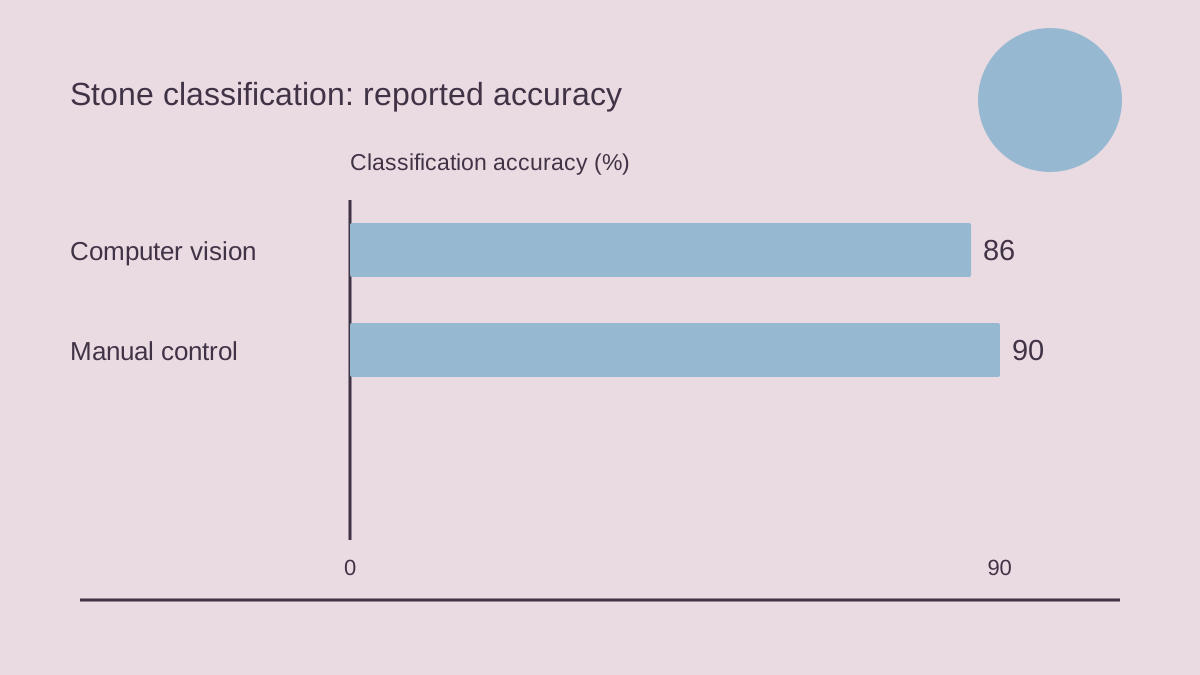
A June 17, 2026 Interfax report describes a stone-shape computer-vision project at Don State Technical University in Rostov-on-Don, Russia. The reported classification accuracy was 86%, compared with 90% for manual control, while analysis time was reported to fall by 20%. The practical question is how a receiving operation would use those classifications to make an accountable decision about a batch.
Start with the receiving decision
A classification result becomes useful for procurement when the receiving operation has a defined decision to make. That decision might concern accepting a batch, holding it for review or requesting another assessment. The image label is an input to that decision, rather than the decision itself. A proposed pilot could therefore begin by identifying who makes the receiving decision and which information that person needs before releasing the material to the next operation.
The decision record could distinguish an individual particle classification from a conclusion about the batch represented by the sample. If that connection remains undefined, a favourable classification statistic may have little practical meaning for receiving. The historical report does not supply a completed batch-acceptance programme or prove that rejected material has been eliminated from supply. Those outcomes would need evidence about the actual receiving process, not just about the image classifier.
Keep the accuracy comparison in its stated scope
The reported accuracy figures describe a classification comparison. They should not be silently relabelled as the proportion of compliant batches accepted, the proportion of defective batches prevented or the quality of finished concrete. Each of those would concern a different outcome and would require a defined observation programme. The reported figures can motivate a practical evaluation while leaving those wider questions unresolved.
A pilot record could identify the evaluation images, the reference labels and the procedure used to compare classifications. It could also state which conditions the comparison covers. If the receiving operation introduces other image conditions or another material population, the previous accuracy figure would not automatically answer the new question. A meaningful handover would preserve the original comparison and identify the evidence required for the proposed application.
Ask which errors matter to the operation
An overall accuracy figure can combine different kinds of disagreement. A receiving pilot could separate the errors relevant to each class and the decisions those errors might influence. A mistake that sends a batch to review may have a different operational consequence from a mistake that supports release without further checking. The programme could identify those consequences before deciding whether an overall percentage is an adequate basis for accepting the system's proposed role.
This is an original proposal for interpreting classification evidence, not a claim that a particular error pattern has been observed in the university project. The historical report does not provide the distribution of disagreements needed for such an account. A partner could ask for that distribution or collect it during a defined pilot. Until then, neither the overall percentage nor the shorter analysis time establishes how the receiving operation would manage its most consequential errors.
Use a hypothetical error-cost example
Consider a hypothetical evaluation containing 100 classified items. Suppose two proposed procedures each classify 90 items correctly, but their ten disagreements affect different decisions. In one procedure, all ten lead to an additional review; in the other, some lead to release when the reference would require a hold. These invented counts are not results from the Rostov-on-Don project. They illustrate why an identical accuracy percentage can accompany different operational questions.
The receiving team would need to decide which disagreements require a second assessment and how that assessment is recorded. The example does not establish a price for an error or show that one actual system is preferable. It makes the missing information explicit. A pilot could preserve the item-level disagreement and the resulting receiving action, allowing the team to examine whether the proposed classification process supports the decision it was introduced to assist.
Connect the sample to the batch
A batch decision would need to identify the sample from which the images were obtained and its relationship to the received material. The programme could record the sampling event, the batch identity and the images generated from it. This would not prove that a sample is representative under every condition. It would make the relationship visible so that a partner can assess the intended conclusion and the limitations of the sampling arrangement.
If material from different deliveries is mixed in an evaluation record, the relationship between the classifier output and the receiving decision could become unclear. A proposed pilot could keep deliveries separate and record any later combination. The purpose would be to preserve an interpretable path from material receipt to image assessment and batch action. A classifier that performs well on identified images would still need that path before its results could support a defined receiving workflow.
Preserve the image conditions
The evaluation record could identify the image-acquisition arrangement and any preparation performed before classification. If the arrangement changes, the new observations would retain that change rather than be treated as an unchanged repetition. This is a proposed documentation framework; it does not specify unreported equipment or claim that the historical project has established compatibility with every receiving environment.
A partner could use the record to ask whether the intended site resembles the conditions already evaluated. Where the conditions differ, the next pilot could investigate the difference. A change in image quality or acquisition procedure should not be hidden inside a general claim about artificial intelligence. Keeping the conditions visible would make it easier to distinguish a problem with the image input from a disagreement about the classification rule or its intended operational use.
Define the reference assessment
The manual-control comparison creates a question about how reference assessments would be recorded in a receiving pilot. A reference label should have an identified procedure and a record of disagreement where disagreement occurs. Calling an assessment manual does not, by itself, provide an explanation of how an uncertain case was resolved. A useful pilot could keep the human assessment and the machine output separately visible before recording the final receiving action.
If two assessors disagree, the pilot could retain both observations and identify the review used to resolve the case. A later change to the reference should remain traceable rather than silently alter the evaluation dataset. This would protect the interpretation of the comparison without claiming that the historical manual assessment was defective. The purpose is to give a partner enough information to understand what a reported disagreement means for the proposed receiving decision.
Measure the complete decision interval
The reported reduction in analysis time concerns the analysis comparison described in the source. A receiving operation would need a separate account of its complete decision interval. That interval could include sample preparation, image acquisition, classification, review and recording wherever those stages belong to the proposed workflow. A shorter classification operation would not automatically establish a shorter total interval if the surrounding stages changed or additional review was needed.
A pilot could record the time boundaries of each observation and distinguish routine cases from cases requiring review. This would let the team examine where time is spent without assigning an unreported plant-wide productivity gain to the project. The historical source also contains a separate statement about other artificial-intelligence systems; that statement should not be substituted for a measured outcome of the stone-shape classifier. The practical comparison would need its own receiving-workflow evidence.
Give disputed cases a defined route
A receiving pilot could state what happens when a machine output and the reference assessment disagree. The batch might remain in a defined review state while the relevant evidence is examined. The programme would need to identify who can resolve the dispute and which record accompanies that decision. This is a proposed arrangement, not a reported university policy or an established requirement for every stone supplier.
The disputed case could retain its sample identity, images, classifications and final action. Keeping these records together would make later analysis possible without reconstructing the event from memory. If the final action changes, the reason could remain visible. A system introduced to assist receiving would then be assessed through its contribution to an accountable decision, rather than through an assumption that a confident label necessarily warrants releasing the corresponding batch.
Set a pilot role before setting an approval claim
A proposed pilot could assign a limited role to the classifier before any wider acceptance decision. It might be used to support review, organise observations or provide a second assessment within a defined procedure. The pilot record would describe that role and identify which decisions remain with the receiving team. This would make the initial evaluation meaningful without claiming autonomous approval of every delivery.
- Identify the receiving decision and the person responsible for it.
- Preserve the connection between batch, sample, images and classifications.
- Separate class-level disagreements from the overall accuracy figure.
- Record the full decision interval, including disputed-case review.
- State the classifier's limited pilot role and the evidence needed before expanding it.
These checks are an original structure for discussing an industrial pilot. They are not reported project procedures or regulatory instructions. A supplier and a receiving operation could adapt them to the actual question. Their value would be to connect a promising classification result to a decision that has an identified owner and a traceable evidence record.
Keep training and evaluation records separate
A deployment enquiry could ask which images were used to develop the model and which were used to evaluate its proposed role. The two records would answer different questions. A favourable result on material already involved in development would not automatically establish a result on a separate receiving population. The historical report does not provide a complete dataset history, and this analysis does not invent one.
A proposed pilot could therefore retain evaluation identities and state any relationship to the development records. If the model is revised during the pilot, the revision would be attached to subsequent observations. Results from several revisions should not be silently combined into the performance of one unchanged system. A receiving team would then be able to see which version supported a particular action and whether the proposed expansion rests on evidence relevant to that version.
Plan changes after the pilot begins
An industrial trial can change its image arrangement, material population or classification procedure. Each change would create a question about the continued relevance of earlier observations. The programme could identify the change and preserve the previous configuration as a separate reference. If several changes occur together, the interpretation would need to acknowledge that their individual effects may not have been separated.
The receiving operation could also specify when a change requires another review of the pilot role. A revised model might warrant further evaluation before its output is used in the same way as the previous model. This is a proposed decision framework, not an assertion that a particular revision has been made in the project. It would help a partner keep operational use aligned with the evidence actually collected for the arrangement being used.
Do not substitute classification for finished-product evidence
The proposed receiving application concerns stone-shape classification. A claim about finished concrete or building performance would require evidence at the relevant product or structure level. A classifier result should not be treated as a complete account of those outcomes. The historical source includes expectations about practical benefits, but this analysis does not report those expectations as measured results or a demonstrated improvement in the life of a structure.
A procurement discussion could retain the narrower contribution: whether the proposed classifier helps an identified receiving operation assess its material under a defined procedure. That is a substantial practical question in its own right. Answering it would not eliminate the need for other information required by the intended use. Keeping the contribution specific would make the project easier to evaluate and would prevent one favourable metric from standing in for the whole chain of material and product acceptance.
Build the next decision around traceable evidence
The reported classification and time comparison creates a reason to investigate an industrial pilot. Its practical value would depend on how images, disagreements, review time and batch actions are connected. A receiving operation could use that connection to decide whether the classifier supports a defined task and whether its role should change. The decision would then rest on evidence about the intended workflow, rather than on the appeal of a single accuracy or time percentage.
The most useful next record would follow one batch from receipt through sampling, classification, disputed-case handling and final action. Repeating that record under identified conditions would support a clearer development decision. It would preserve the promise of the research result without assuming completed deployment, eliminated defective supply or improved building performance. The core question is whether a classification tool can contribute to a receiving decision whose basis remains visible and whose responsibility remains clear.
Sources: Интерфакс Россия.






Leave a comment