

Researchers in Novosibirsk, Russia, are developing copper-based composites containing graphite. Interfax reported on March 26, 2026, that sliding contacts and current-collector components were among the prospective applications. The report described material tests and early improved characteristics, rather than a demonstrated service life for installed transport components. Evaluating that prospect requires a combined operating envelope: conditions under which the relevant properties satisfy the same application's requirements.
A contact specification is more than one favourable property
A contact-material proposal should begin with the function of the proposed component. A favourable result for one property could be relevant without establishing suitability for that complete function. The assessment would need to define the properties that matter to the selected application and the conditions under which they must coexist. This is a proposed evaluation framework, not a statement that the reported specimens already meet a transport operator's specification. Without the application boundary, the word improved would leave a decision-maker uncertain about what the improvement would allow the component to do.
A useful specification would also distinguish required performance from desirable performance. Exceeding a desirable target would not compensate automatically for failing a necessary condition. The acceptance decision should state which conditions are compulsory, which observations are informative, and which trade-offs require a separate decision. That structure would make the combined question explicit. Instead of asking whether a material has an attractive property somewhere in the test record, an evaluator could ask whether the same identified candidate satisfies the necessary conditions for one documented task.
The same candidate should connect the measurements
Different tests can produce an impressive collection of results while leaving their relationship unclear. A qualification record would need to identify which specimen or batch supports each observation. If a conductivity result belongs to one candidate and a wear result to another, combining them into a single product claim would require evidence that the relevant properties coexist. A shared material name would not establish that connection on its own. The record should retain distinctions among candidates rather than assemble an idealised product from the strongest separate observations.
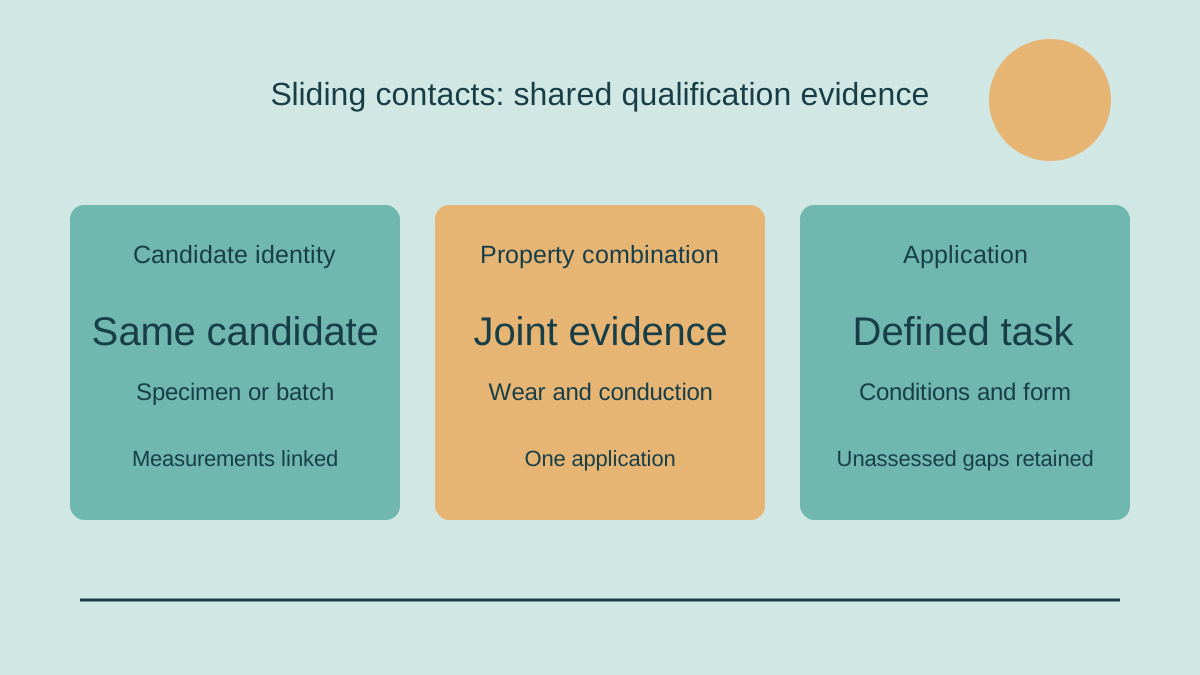
Some measurements might reasonably require different specimens from the same batch. In that case, the relationship should be documented, and the resulting inference should remain within what the batch evidence supports. A future report could distinguish direct observations on one specimen from observations associated through a recorded production history. The distinction would help a reader understand how much of the combined envelope is measured and how much depends on the relationship between specimens. Missing connections should remain visible instead of disappearing beneath a collective description of the material.
Test conditions define the reach of a result
A measurement gains practical meaning through the conditions attached to it. An evaluator would need to know the assessed configuration and the requirement against which its result is being considered. This article does not prescribe loads, electrical settings or an operating procedure. Its point is that the conditions supporting an observation should travel with that observation. Without them, a later application could inherit a claim while losing the boundary that made the original comparison meaningful. A qualification record would preserve that boundary before discussing a broader use.
The proposed use might fall partly inside and partly outside the recorded conditions. Those portions should be distinguished. Evidence within the assessed area could justify one conclusion, while an unassessed area would remain a question for further work. It would be misleading to extend the same confidence uniformly across both areas. A clear record could therefore show a supported region, an unresolved region and any excluded region. These labels would describe the state of evidence rather than assert that the material necessarily succeeds or fails beyond the assessed conditions.
The opposing surface belongs to the comparison
A sliding contact would operate in relation to another surface. A proposed qualification should consequently identify that relationship rather than assess the candidate as though it were an isolated object. The appropriate question would concern the selected pair in its documented configuration. A result associated with one opposing surface would not automatically cover a different one. Maintaining that distinction would help a purchasing team determine whether a supplier's evidence addresses the intended component arrangement or only a separate laboratory comparison that has not yet been connected to it.
The reference material would need the same clarity. If candidate and reference were assessed against different opposing surfaces, the difference should be recorded rather than attributed entirely to their material identities. Such a comparison might still be informative, but its scope would be different from a comparison holding that relationship constant. A future assessment could separate those questions. That would avoid forcing every observation into one ranking and would make it easier to identify whether another test is needed before selecting a contact pair for a particular application.
Wear evidence should retain its observation period
A wear observation should carry the interval over which it was obtained and the criterion used to interpret it. A measured change during that interval would not, by itself, establish the lifetime of an installed component. A longer service-life claim would require a justified connection between the observation and the claimed service boundary. The report offers no demonstrated field lifetime for the proposed transport parts. A qualification plan should preserve that absence rather than replace it with an assumed extension from an early material result.
It would also matter whether the observation describes the candidate alone or the assessed pair. A decision about replacement could depend on the condition of the complete arrangement, so the report should name what was examined. If a future test stops before an acceptance limit is reached, its duration should not be silently turned into a measured lifetime. The record could instead state that the candidate remained within the specified criterion during the assessed interval. This narrower conclusion would be useful precisely because it identifies both the supported finding and the unmeasured continuation.
Electrical evidence should meet the application question
A material-level electrical observation and an installed-contact observation need not answer the same acceptance question. A qualification framework should identify the question behind each measurement. A result could support the description of a material while leaving the proposed assembled configuration unassessed. The decision-maker should be able to find that distinction without reconstructing it from separate documents. No specific electrical performance threshold is proposed here. The threshold would belong to the intended application, and the evidence would need to show how the assessed candidate relates to it.
A combined record would also retain the point at which the electrical observation was made relative to other assessments. If observations concern different states of the candidate, they should not be described as simultaneous acceptance without support. A programme could be designed to investigate that relationship, but a programme's intention would remain different from its completed result. Showing the order and identity of the observations would help distinguish a candidate that has separate promising measurements from one that has demonstrated the required combination over a documented assessment period.
The component form creates another evidence boundary
A specimen establishes evidence for its assessed form. A proposed component could differ in dimensions, attachment or manufacturing route. The qualification question would then concern the transfer from one form to another. A claim that a route can be scaled would not alone demonstrate that the larger or differently shaped component has the same accepted properties. The assessment should identify which form was measured and which remains proposed. This would allow scale-up to be discussed as a defined development task rather than as an already completed qualification.
Different product forms should have separate records even when they share a composition label. A bulk part and a coating could have different acceptance questions arising from their intended configuration. Their evidence should not be pooled merely to enlarge the apparent result set. A future comparison could explain what is common between them and what requires independent assessment. This would give each route a fair opportunity to demonstrate suitability while preventing the strength of one route's evidence from being transferred without explanation to another proposed product.
Manufacturing repeatability concerns the delivered population
A single successful specimen could justify further investigation. Purchasing repeated components would require evidence about the population expected to be delivered. A future qualification should therefore retain batch identifiers, the relevant observations and any rejected or unresolved candidates. Reporting only the most favourable specimen would answer a narrower question than production acceptance. The latter asks whether the supply supporting the intended application can satisfy the agreed requirements consistently enough for that commitment. This article reports no established production acceptance rate or commercially demonstrated repeatability for the proposed contact material.
A change in a manufacturing route should also be treated as a change requiring an identified evidence decision. Some earlier observations might remain relevant, while others might need to be repeated or extended. The record should explain that decision rather than assume either complete continuity or complete invalidation. This approach would help maintain a traceable qualification history as the candidate develops. It would also prevent a final delivered component from carrying a collection of favourable results obtained on earlier forms whose relationship to the current form has not been established.
Reference materials need comparable questions
Improvement against a reference is meaningful when the reader can identify the reference and the assessed question. A candidate could lead on one measure and remain unresolved on another. A qualification report should retain that pattern instead of forcing it into a universal better-or-worse label. The report's general statement about early characteristics does not provide the complete application-specific comparison needed for a procurement decision. A later assessment would need to show which measured differences matter to the selected component and which necessary conditions remain unsupported.
The comparison should also distinguish a laboratory reference from the component an operator currently uses. Those might be related, but the relationship would need to be stated. A supplier could reasonably investigate both comparisons, each with its own scope. Keeping their names and results separate would help readers assess research progress alongside practical adoption. It would prevent a favourable comparison against one specimen from being presented as evidence against every existing installed alternative, including alternatives that were never part of the documented assessment.
A combined envelope should show gaps
An operating envelope would be more useful if it showed unassessed combinations alongside assessed ones. Otherwise, a reader might interpret the outer bounds of separate measurements as proof that every combination within those bounds has been accepted. That inference would require support. A proposed evidence map should make clear which combinations have direct observations and which are only candidates for further assessment. It could then guide additional work towards an actual application gap rather than simply add more measurements around already familiar conditions.
The map should not confuse an unassessed combination with a failed combination. These categories call for different decisions. A failure would need its own record and interpretation; an unassessed combination would need an evidence request. An unresolved observation could occupy a third category until its explanation is established. Preserving these distinctions would help a team avoid both premature rejection and premature acceptance. The result would be a clearer picture of where the material has demonstrated a relevant property combination and where the proposed use still outruns its documented evidence.
A qualification dossier can link the necessary evidence
A concise dossier could assemble the information needed to evaluate the proposed component without suggesting that qualification is already complete. Its entries should connect the application requirement to the candidate identity and the supporting observation. The following structure is a proposed analytical aid, not a description of records already maintained by the researchers or a claim that a transport operator has accepted the material:
- The intended component, its function and the necessary acceptance conditions.
- Candidate and reference identities, including the relationship among assessed specimens.
- The opposing surface and configuration covered by each comparison.
- Observed property combinations, their assessment periods and their evidence limits.
- The component form and manufacturing history to which each result applies.
- Failed, unresolved and unassessed combinations, with a stated next evidence decision.
A complete set of headings would not establish a complete evidence base. Each entry could explicitly identify an outstanding question. That would make the dossier useful for deciding the next assessment as well as for reviewing the observations already available.
A replacement decision needs a separate service account
A prospective longer-lasting contact could invite an economic argument, but that argument would need demonstrated service evidence and a clear cost boundary. Material price alone would not establish the total consequence of replacement. A proposed assessment could include acquisition, qualification and the work associated with the selected service arrangement. It should show which commitments are measured and which remain assumptions. This article provides no calculated saving, replacement interval or forecast of transport maintenance expenditure. Those conclusions would require evidence beyond the reported early material characteristics.
Any calculation based on a future service life should retain that life as an explicit assumption until it is supported. A conditional comparison could help identify which observation would most affect the purchasing decision. It would not turn the assumed interval into a tested result. The distinction would give an operator a clearer reason to request field evidence, rather than rely on an attractive calculation whose largest input is still unknown. It would also connect the next qualification step with the actual decision the commercial proposal asks the operator to make.
Application families should remain separate
A material programme can explore more than one potential application. That breadth would not make every application share the same qualification result. Each proposed component should retain its function, configuration and acceptance boundary. Evidence developed for one task could suggest a useful question for another without establishing the answer. Treating the applications separately would allow the research programme to expand while preserving the strength and limits of each finding. A general material description would then serve as an organising label rather than as a universal certificate of suitability.
This separation would also help interpret variants within the programme. A candidate developed for one property combination should not borrow another variant's strongest result without evidence that the relevant combination survives in the selected candidate. The record could explain the relationship among variants while keeping their measured observations distinct. That would make development choices easier to review and would avoid an imaginary composite product assembled from several different promising materials. The practical question would remain specific: what has the proposed candidate demonstrated for this proposed task?
The next step should close a defined application gap
The early research provides a basis for further assessment, with the next step determined by the intended use and the existing evidence. If the combined properties of one candidate remain unclear, that would define one gap. If the material observations are documented but the proposed component form is unassessed, the transfer question would define another. A focused next commitment would identify the question it aims to answer and the acceptance decision that answer would inform. This would connect research progress to component selection without assuming that selection has already been justified.
The strongest future case would link a traceable candidate with comparable references, a documented opposing surface, relevant property combinations and repeated evidence for the intended component form. Service observations could then support claims about installed use within their actual boundary. Until those connections exist, early improved characteristics should remain early improved characteristics. A combined operating envelope would give them a precise role in the qualification process: evidence for identified conditions, an account of unresolved conditions, and a basis for choosing the next assessment needed before a larger operational commitment.
Sources: Интерфакс Россия.



Leave a comment