
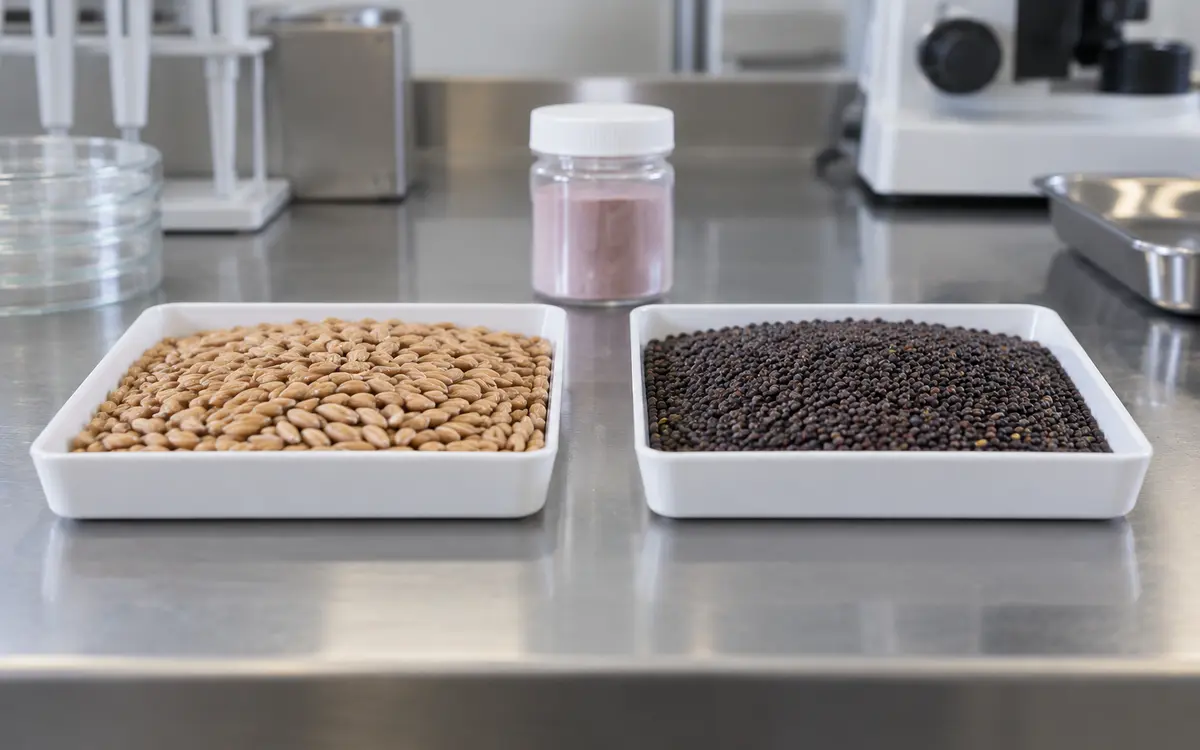
A two-component seed coating developed in Novosibirsk, Russia, has produced encouraging trial observations. Interfax reported on April 13, 2026, that field work on wheat and rapeseed recorded earlier emergence and improved growth indicators. Expanded field trials and work towards scaling the treatment remained planned. Those observations invite a field-to-field question: what evidence would establish where the coating's benefits persist, and what a grower could reasonably expect?
The decision should name its harvest question
A promising early observation can justify further assessment without answering the grower's final purchasing question. The intended outcome should therefore be named before a trial is interpreted. If the decision concerns accepted harvest output, an earlier growth observation should remain an earlier growth observation until its connection to that output is measured. This article does not claim a demonstrated harvest increase from the reported work. It examines how a future comparison could preserve the distinction between a developmental observation and the agricultural outcome a purchasing proposal asks a grower to value.
The distinction does not make an early observation irrelevant. It gives that observation a precise role in the evidence chain. A trial could retain emergence, later development and accepted harvest as separate outcomes, with the relationship among them investigated rather than presumed. If the chain remains incomplete, the report should identify the missing part. That would allow readers to recognise progress while understanding what further evidence is needed before attaching a harvest expectation to a seed-coating decision for a particular crop and location.
A crop result should retain its crop identity
Evidence obtained for one crop should not silently become evidence for every crop named in a development programme. A future assessment would need to attach each observation to the crop and seed population actually assessed. The intended purchasing decision could then be matched to the relevant record. Where the proposed crop is absent from that record, its performance would remain unassessed. Sharing a product label would not supply the missing comparison. The programme could be broad while each completed finding remains specific to its documented subject.
Within a crop, a trial would also need enough seed identity information to make its reference meaningful. If coated and reference groups differ in their starting material, the record should show the difference rather than attribute every later observation to the coating. A comparison with a shared starting population would ask a different question from one using different supplied populations. Both might produce observations worth reporting, but their interpretations should remain separate. Preserving that distinction would help a reader determine which question the trial can actually answer.
A field should be an identified observation setting
A field result becomes more useful when the assessment records the setting in which it occurred. A site name alone would not necessarily describe the conditions relevant to transfer. The record would need to identify the conditions chosen for observation and distinguish them from conditions not assessed. This is an evidence requirement, not a prescription for field management. Its purpose is to let a prospective user compare the proposed use with the assessed setting instead of relying on an unexplained claim that the product worked in a field.
The same principle would apply when a programme moves to another location. A later trial should show what remains comparable and what has changed. A difference in result would then be an observation to examine in relation to the recorded settings, rather than immediate proof of either universal reliability or universal failure. Without those records, a collection of locations could look like a transfer study while offering little information about transfer. The value lies in the documented relationship between settings, not simply in the number of place names listed.
A fair reference should be chosen before the result
The reference should represent the question the evaluator intends to answer. A comparison against uncoated seed would address one question; a comparison against another defined treatment would address another. Neither should quietly replace the other after the results are available. The report should state which comparison supports each conclusion and what was held common. A product described as better should have an identifiable reference behind that description. Without it, the reader cannot tell whether the claimed improvement is relevant to the alternative actually available for the intended purchasing decision.
The comparison would also need to consider how groups are assigned and observed. A future trial could use a documented allocation intended to reduce selection effects, with a clear record of deviations. This is a proposed analytical condition rather than a claim about the design of the reported trials. The source does not provide the complete design information needed here. If that information remains unavailable, an evaluator should retain the resulting uncertainty instead of reconstructing a favourable trial design from the reported headline observations.
Observations should keep their time basis
Earlier emergence and a larger value at one observation point are not interchangeable findings. A future report should identify what was measured and when. Comparing groups on a common date could answer a different question from comparing them at a common developmental stage. The distinction matters for interpretation even without assuming that one method is always preferable. The selected time basis should match the intended question, and the report should preserve it. Otherwise, observations made on different bases could be combined into a general growth claim whose meaning remains unclear.
A sequence of observations could help connect an early difference with a later outcome. It should retain each observation rather than select only the point showing the largest contrast. An early lead could remain an important finding while its later relationship remains unknown. The record could describe that uncertainty directly. A purchasing assessment would then see the evidence as a sequence with defined gaps, rather than as a single favourable picture assumed to represent the whole growing period or the final accepted harvest.
Harvest acceptance should be explicit
If a trial is intended to support a harvest decision, it should define the harvest outcome relevant to that decision. Total collected output and output accepted under a specified requirement would be different quantities. A future assessment should identify the requirement and apply it consistently to coated and reference groups. This article provides no crop-specific acceptance threshold. Such a threshold would belong to the intended use, and the trial would need to report the evidence against it rather than presume that any larger observed plant measure implies a larger accepted harvest.
Rejected or unresolved output should remain visible alongside accepted output. If part of a record cannot be evaluated, its absence should not be converted into assumed success. Equally, an unresolved observation should not automatically count as a confirmed adverse result. These categories should have distinct meanings. Keeping them separate would make the eventual harvest account more informative and would allow a grower to understand whether an apparent advantage depends on excluding observations whose explanation or acceptance status has not yet been established.
Storage claims need the assessed conditions
A claim about holding treated seed should travel with the conditions under which it was assessed. A future purchasing record would need to identify the seed batch, its treatment history, the holding period and the relevant recorded conditions. The source's general mention of storage conditions does not establish every possible storage arrangement. This article offers no temperature or humidity instructions. Its question is whether a proposed delivery and holding arrangement falls inside the evidence supplied for the treated material, or whether that arrangement requires a separate assessment.
A field trial should also connect the stored material with the material eventually planted. Without that connection, storage evidence and field evidence might concern different populations. A supplier could investigate the relationship through identified batches and comparable records, but the intention to do so would not establish the result. A clear evidence chain would show where continuity is documented and where it is assumed. That would make a storage proposition useful for planning without turning a limited observation into a universal promise of unchanged quality.
The complete treatment route belongs in the comparison
A comparison of treated and reference seed should show the scope of the route being evaluated. Material acquisition, treatment, holding and preparation for planting could create different commitments for the alternatives. A resource account should identify which commitments it includes. Moving an activity to a supplier would not automatically remove that activity from a whole-route comparison. A separate grower expenditure account could still be useful, provided it is named accurately. This article describes an assessment boundary and does not provide a recipe or an application protocol.
The route should also retain material not reaching the field. If a future process produces accepted treated seed and material requiring further review, the comparison should not show only the accepted portion while ignoring the associated commitments. No such rejection rate is reported here. The point is to define a record that could capture it if observed. A claim of process advantage should rest on a reconciled account rather than on a selected output quantity disconnected from the resources committed to produce and deliver it.
Other inputs should not disappear from the explanation
A field comparison might include differences in inputs or management beyond the coating itself. Those differences should be recorded. An observed outcome would then describe the assessed package, with the contribution of the coating left distinct from any wider inference about that package. It would be misleading to attribute every difference to one product simply because the product is the focus of the trial. Where the intended question concerns the coating alone, the comparison should explain how the design supports that narrower interpretation.
A proposed combination with another input would require its own evidence decision. Findings for separate inputs would not automatically establish the result of their combined use. A future programme could examine that interaction, but planned work should remain planned work in the report. The distinction would allow researchers to discuss additional possibilities without presenting them as completed agricultural recommendations. A prospective user could then identify which arrangement has observations and which arrangement remains a development question awaiting a properly documented comparison.
Adverse and missing observations should be retained
A credible field record would retain observations that do not fit the expected direction. Their presence would not necessarily establish that the coating caused them, but their absence from the report would weaken the assessment. The evaluator should distinguish a confirmed adverse relationship, an unresolved observation and a missing observation. Each category would support a different next step. A statement that an adverse event was not observed in one assessed group should remain limited to that group and observation period, rather than become a guarantee for every future crop or setting.
The same discipline would apply to plants or plots removed from an assessment. A future report should describe exclusions and explain their effect on the comparison. Deleting an excluded record without explanation could make an apparent benefit depend on a selection the reader cannot evaluate. Retaining the record would allow a transparent interpretation. Where an explanation remains incomplete, the result could show how conclusions change under different justified treatments of that uncertainty, instead of quietly choosing the treatment most favourable to the product.
Repeated sites should show differences as well as averages
A field-to-field programme should retain the result at each assessed setting. An average could summarise observations while hiding an important difference in their direction or size. For a grower considering one setting, that difference might matter more than the aggregate. The future report should therefore connect each result with its site, crop and time basis before discussing the overall pattern. The source's planned expanded field work does not establish that pattern already. It identifies a development step whose eventual observations would need their own assessment.
Repeated observations at comparable settings would ask about repeatability, while observations at changed settings would ask about transfer. A programme could investigate both, provided it names them separately. An additional site would not necessarily be a repetition of the first, and another season would not automatically reproduce the same conditions. Showing those distinctions would make a larger evidence base more useful. The reader could identify which conclusion rests on repeated comparable observations and which rests on an initial observation in a newly introduced setting.
A transfer record can organise the evidence
A compact transfer record could connect a product proposition with the fields for which it has support. Its purpose would be to keep evidence boundaries visible, not to suggest that an early research programme has already completed qualification for every user. The following entries describe a proposed evaluation structure and are not records of completed trials:
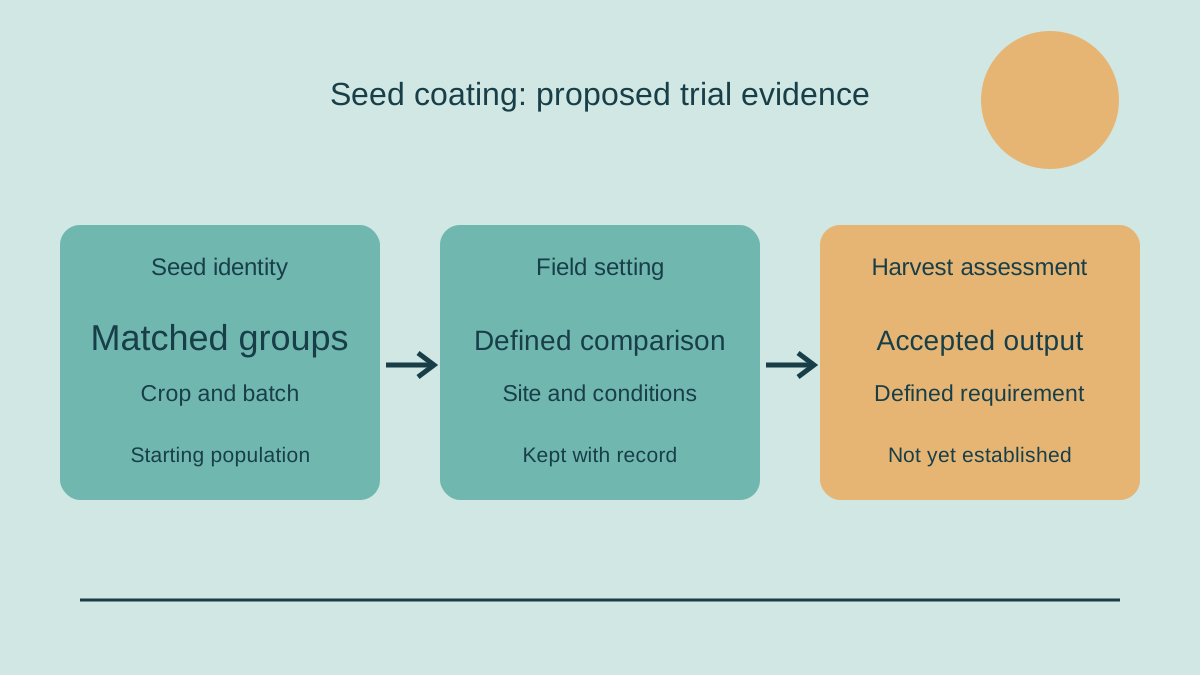
- Crop and seed-population identities for coated and reference groups.
- Field setting, comparison design and the question assigned to each observation.
- Time basis for emergence, development and harvest measurements.
- Accepted, rejected, missing and unresolved outcomes, with explanations.
- Batch continuity through treatment, holding and planting.
- Conditions supported by repeated evidence and proposed conditions still unassessed.
A record containing these headings could still be incomplete. It should say where information is absent rather than treat a completed form as a completed proof. That would give the next trial a defined evidence task and help a grower match the proposal to the intended use.
An economic comparison should keep its assumptions visible
The commercial question would concern expenditure and accepted agricultural output over a named boundary. Price per treated seed quantity would not alone answer it. A future calculation could include the commitments made to obtain, handle and use the treated material, alongside measured output accepted for the intended purpose. It should distinguish incurred expenditure from prospective estimates. This article offers no forecast of profit or demonstrated saving. The required account remains a question for evidence rather than an implied consequence of an encouraging developmental observation.
If a calculation assumes a harvest improvement that has not been measured, that assumption should remain explicit. A conditional comparison could help identify how strongly the purchasing case depends on it. Such a calculation would guide an evidence request; it would not establish the assumed improvement. The distinction would allow a prospective user to see which missing observation matters most to the proposed commitment. It would also prevent an early growth result from becoming a financial promise through an unexplained change of endpoint.
The next commitment should match the next unanswered question
The reported work provides a reason to examine the coating further. A next commitment could focus on the gap most relevant to the intended crop and setting. If the question concerns harvest, the assessment should connect the developmental observations with that endpoint. If it concerns transfer, the programme should compare documented settings rather than simply add an undifferentiated trial. If it concerns delivery, identified batch continuity could become the priority. Naming the question would make further work useful for a decision instead of merely extending a promising description.
The strongest eventual case would connect identified seed, a fair reference, documented field conditions, a coherent observation sequence and accepted harvest output. Repeated and transferred observations would show how far that case extends, while a complete treatment account would support the purchasing comparison. Until those connections are established, encouraging growth observations should remain evidence for their actual scope. A field-to-field framework would preserve their value while showing the work still needed before a grower could attach a broader performance expectation to the coating.
Sources: Интерфакс Россия.


Leave a comment